Kick Chain
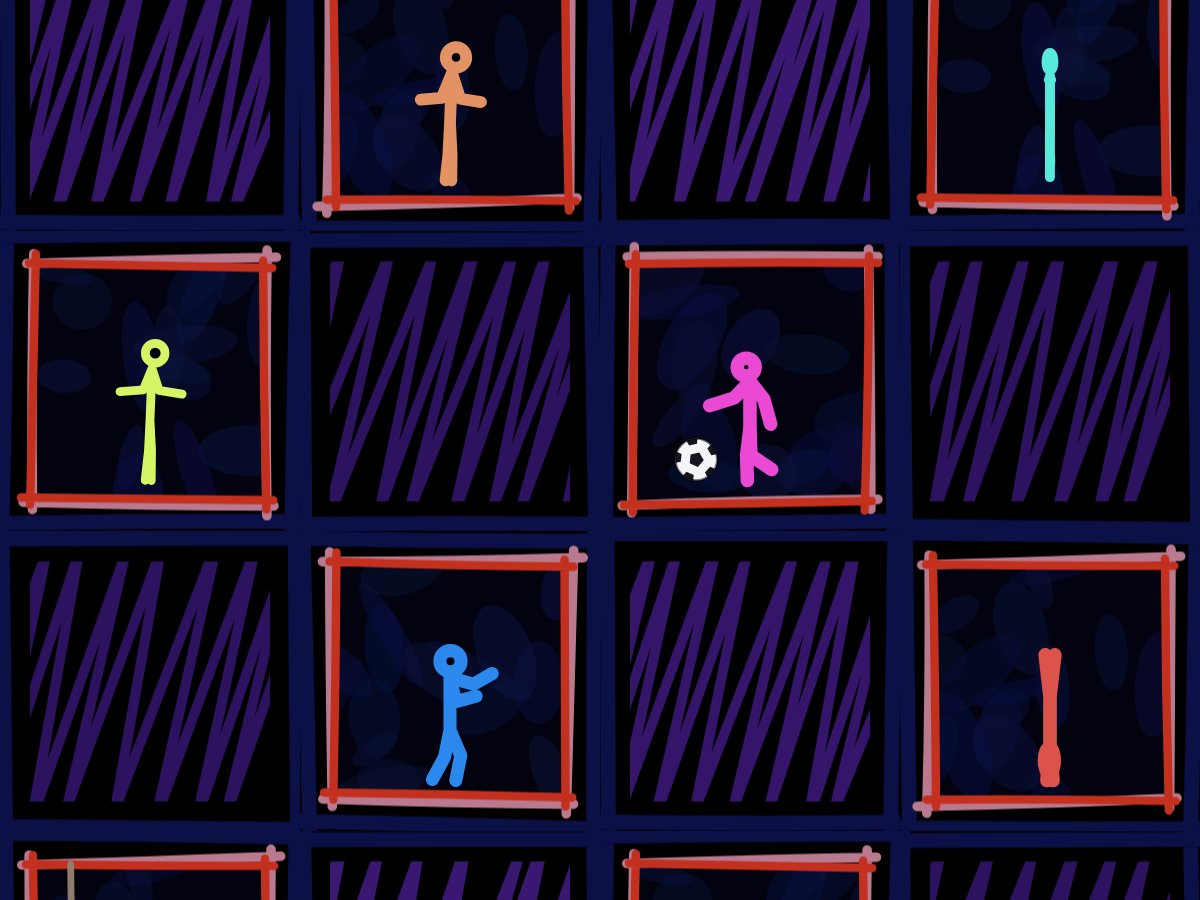
Two hundred stick figures in two hundred cells, each attempting a different move with a different degree of success. One ball is passed down the page from cell to cell, and the last figure kicks it all the way back to the top.
 Open the piece
I.The vision
I want to make a stick man animation of 200 different stick people attempting 200 different motions with varying levels of success and completion in 200 different cells. I want it to loop. I want a soccer ball to start at the top in the highest cell and then I want that cell's stick person to kick the ball to the next highest cell until it gets to the bottom and kicks it back to the top again. Zero text on the page.The brief, as I wrote it
II.Input
III.Thinking frames
Two hundred, honestly
What counts as a different motion?
Forty base moves, from cartwheels and backflips to juggling, the moonwalk and a rope climb. Each is attempted at five levels of success: nailed it, almost, gave up halfway, stumbled and sat down, wiped out. Every one of the two hundred cells is a unique pairing, with its own colour, proportions, tempo and facing.
A ball that interrupts
How does a figure mid-backflip take a pass?
Each figure breaks off its attempt as the ball approaches, turns to face its next target, winds up and strikes, then eases back into what it was doing. The ball lands where the foot will meet it.
The long kick
How does the loop close?
The last figure sends the ball the full height of the page. The view rides with it, the ball swelling as it climbs, and the first figure collects it to start again.
IV.Decision ledger
CBH my call C proposed by my AI collaborator (Claude, Anthropic) and accepted
| Decision | By |
|---|---|
| The concept, the counts, the loop and the ball's route | CBH |
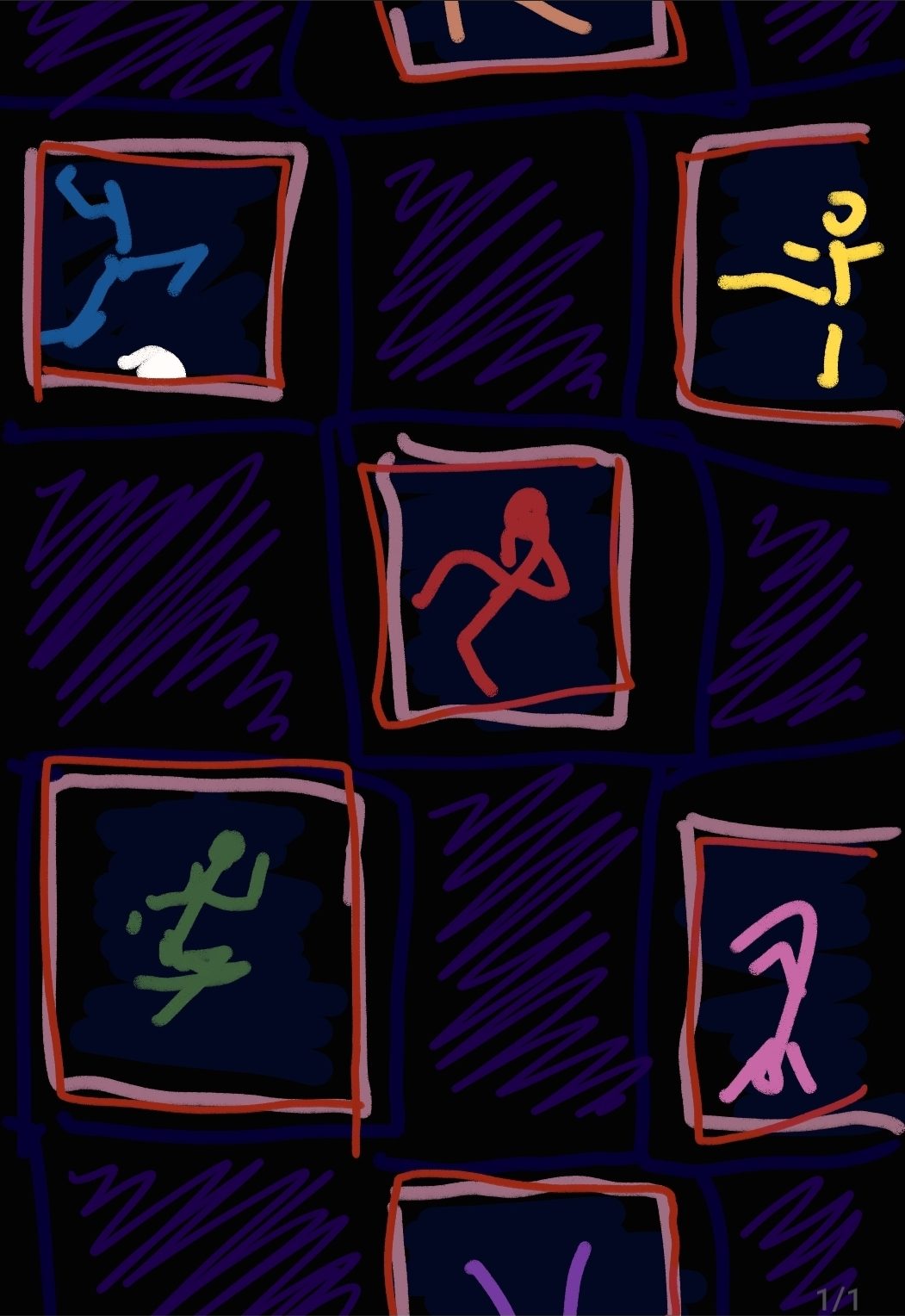
| The visual language, from the sketch | CBH |
| Zero text on the page | CBH |
| Forty moves times five outcomes, as the meaning of "two hundred different motions" | C |
| The ball snakes across each row on its way down | C |
| A view that follows the ball, lets you wander, and returns | C |
V.Studio review
Reviewed for art direction and engineering by a separate AI reviewer working only from the code. It confirmed the two hundred unique move and outcome pairings, the snaking route, the long kick back to the top, and the return to the ball after a drag. Findings, most severe first:
No reduced-motion handling; on a phone the long kick swept the view seventeen thousand pixels in four seconds.
Fixed. With reduced motion the view cuts from bottom to top instead.
After a tab switch the ball teleported, because the clock was wall time.
Fixed. The clock now advances only while the page is visible.
Resizing rebuilt every tile on each event and could jump the ball mid-pass.
Fixed. Resizing is debounced.
The canvas had no accessible description.
Fixed. Labelled as an image with a description.
About forty per cent of each figure's cycle is spent in near-rest poses, so a single still can look static; the ball stops dead on arrival.
Accepted for now. Logged for the next pass.
VI.Credits
Concept, sketch and direction: Christopher Blake Head. Built in collaboration with Claude (Anthropic).