The Shaft
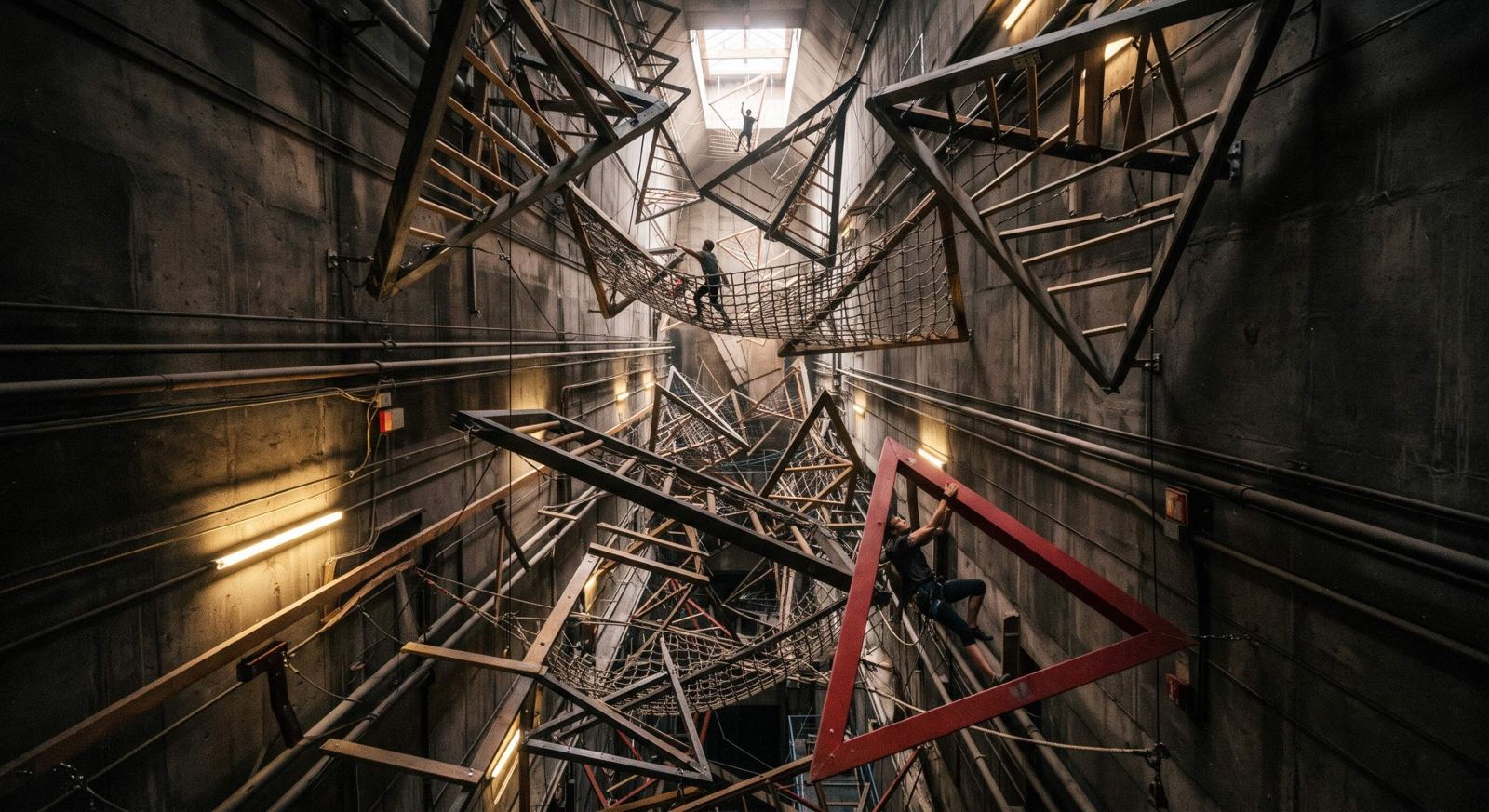
An endless ascent. A climb through purgatory. You climb a concrete shaft through suspended frames, nets and ladders, alongside other climbers, toward a red gate that is always somewhere above you.
Work in progress. The Shaft is still being built. What you can enter today is the current state of the piece, and the process log below keeps growing as new passes and reviews land.
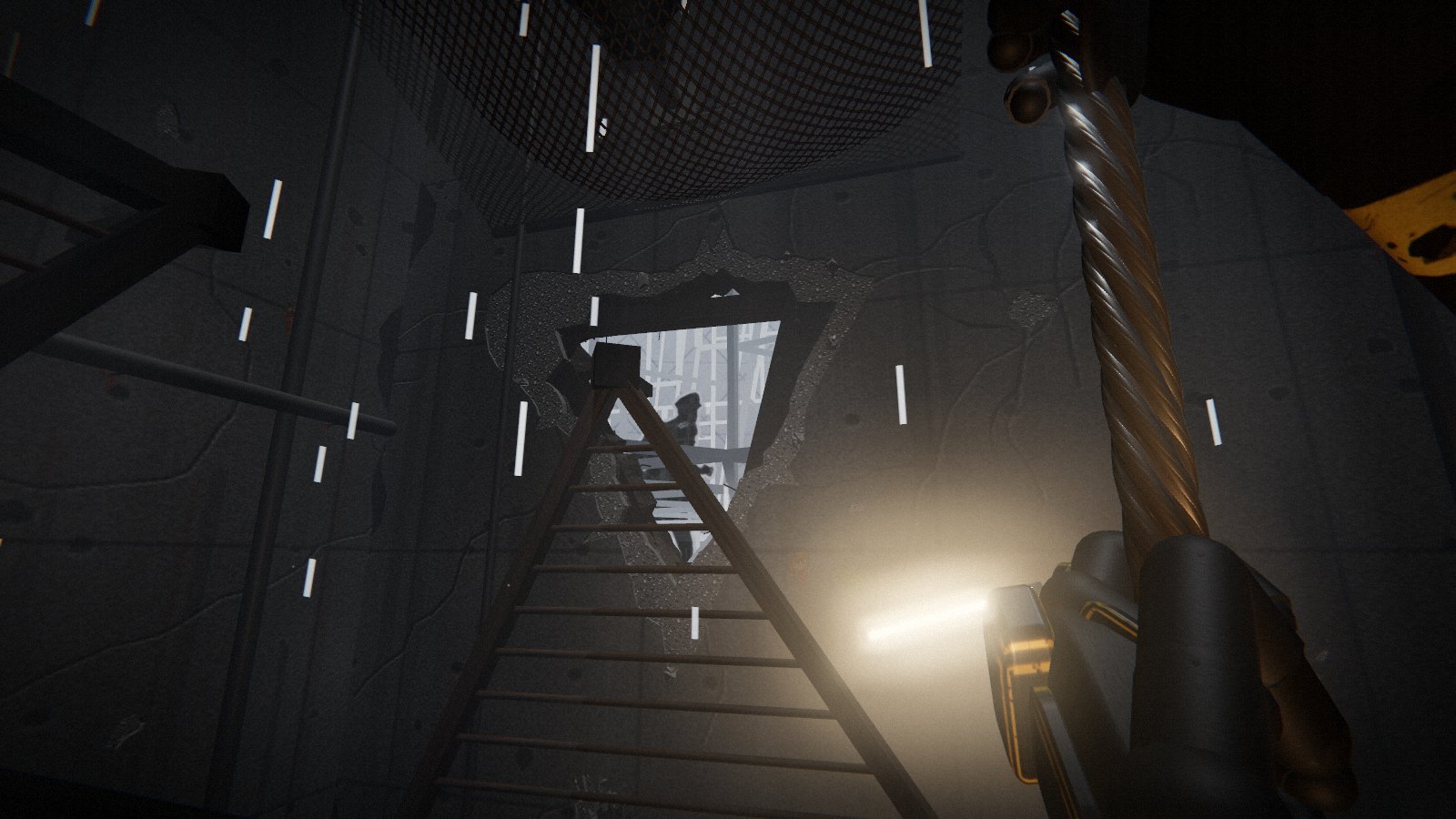 Enter the shaft
I.The vision
I want the viewer to feel like they are climbing through the frames in the shaft with the climbers. I want the climbing to never stop but to always feel like they are getting closer.The brief, as I wrote it
Two words in that brief carry the whole piece, and they pull against each other. Never stop asks for an animation with no ending. Closer asks for progress. Anything that never ends can never arrive at the end, so the work was to give the climb something real to approach, over and over, without the climb itself ever finishing.
I see this as the climb through purgatory. Even for those who hold hope for redemption at the light at the end of the tunnel, the climb will remain endless and they will never exit the shaft.CBH, Pass 29
That names what the piece had been doing all along. The light at the top is always the same distance away; the red gates come and go but the shaft never opens; the people who fall are not replaced by an ending, only by more climbing; the walls carry the drawings and the hands and the count of those who were here before, and the song that comes up out of the dark says it plainly: the height remains the same. Hope is real here, and it is never answered.
The Shaft represents an eternal climb through purgatory. Hanging onto hope is merely an illusion that intensifies the dread and torment once you again realize that you are a slave confined to a terrifying prison, sentenced to an eternity ripping the flesh from your hands as you inch towards your delusional escape. In the distance the shadow of a devourer of flesh lurks amongst the shafts.CBH, artist’s statement, November 2026
This is the reading the piece is now built to. Hope is not a way out; it is the thing that makes each return to the wall worse. The light above keeps its distance so that every moment of believing in it ends in the same discovery. The climb costs the body, hand over hand on cable and rung, and it is not chosen: it is a sentence. And out in the lattice, glimpsed through the breaks in the concrete, the giant walks the shafts, looks in, and takes climbers from the rope.
II.Inputs
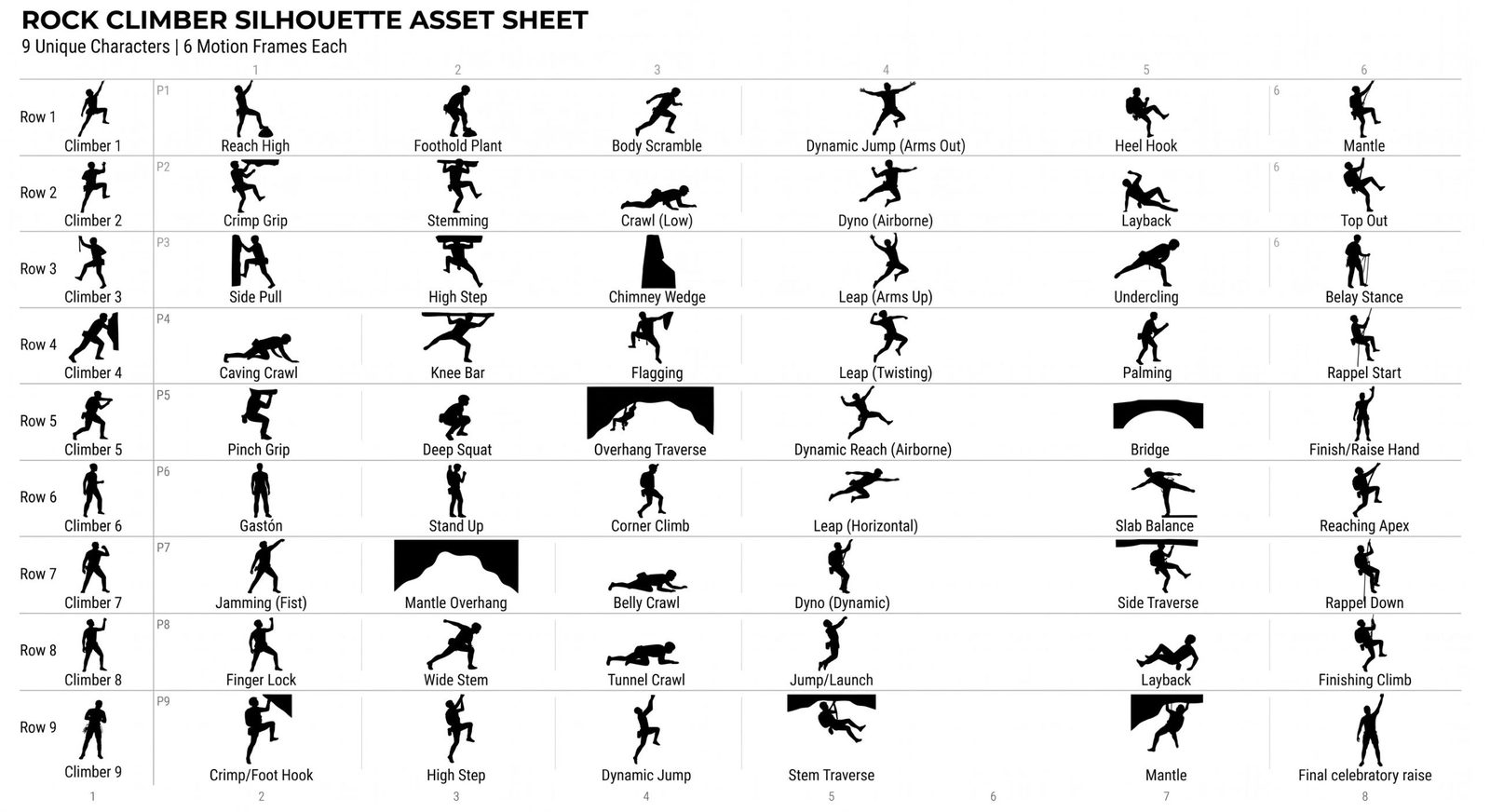
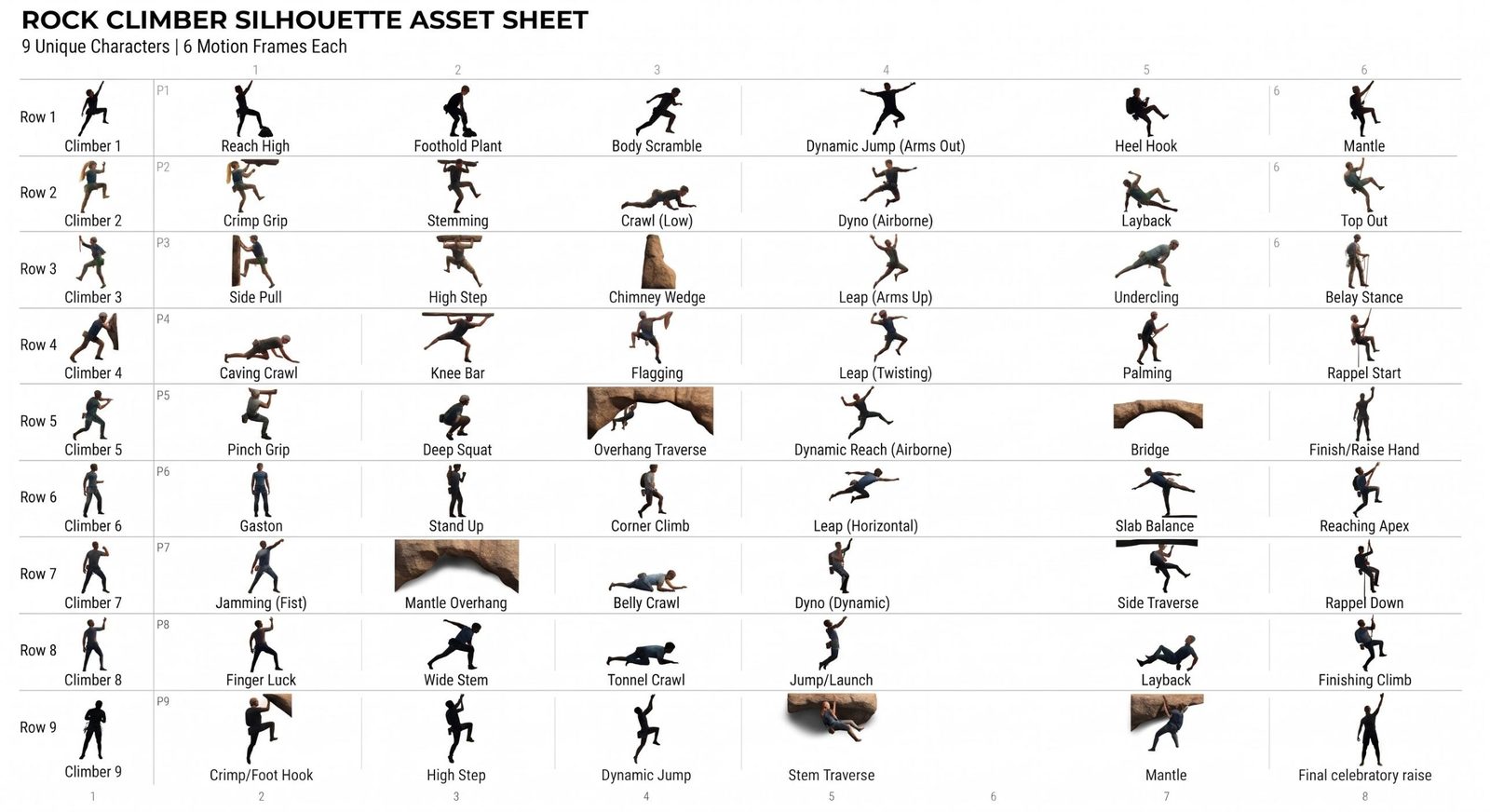
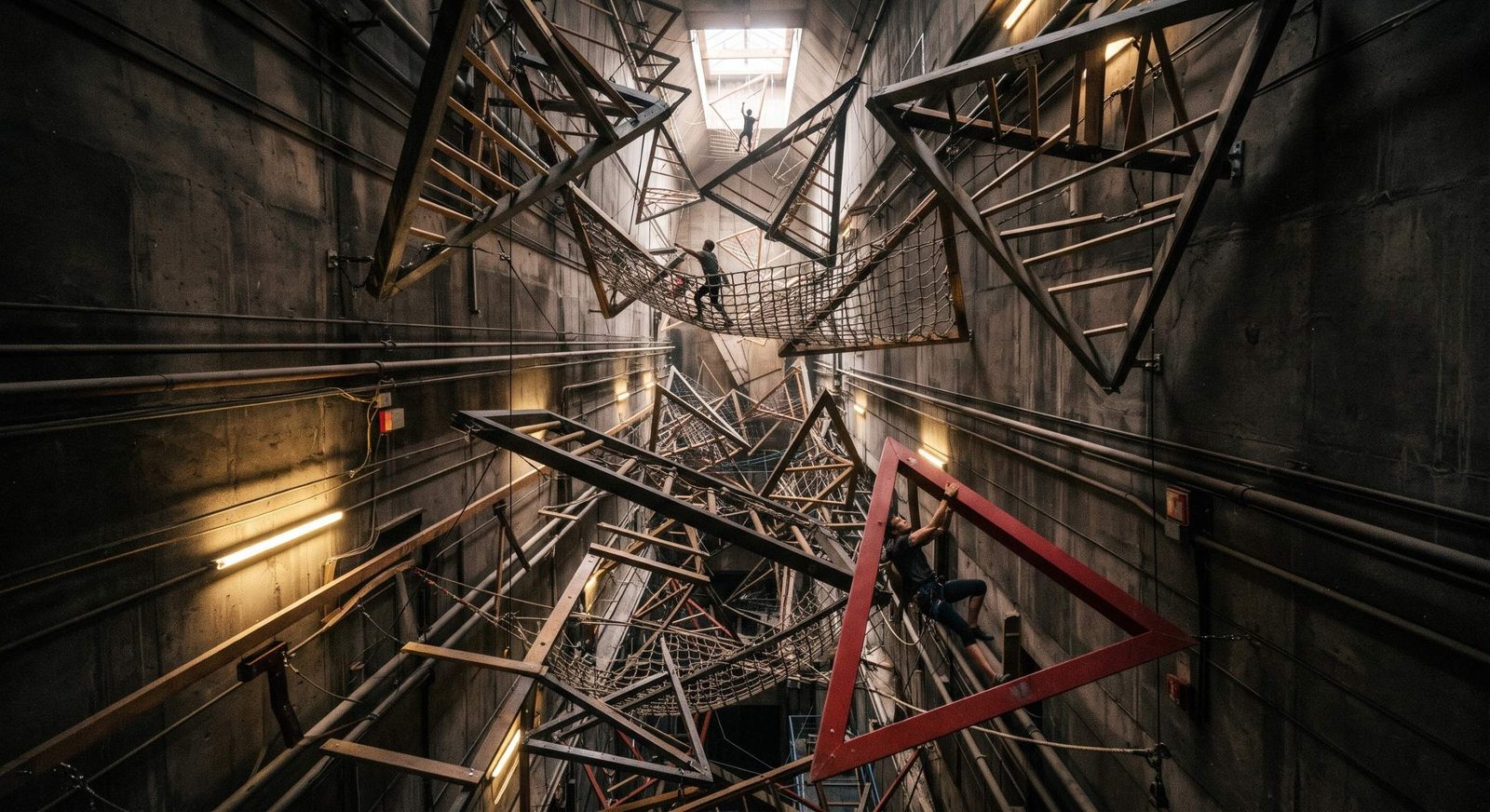
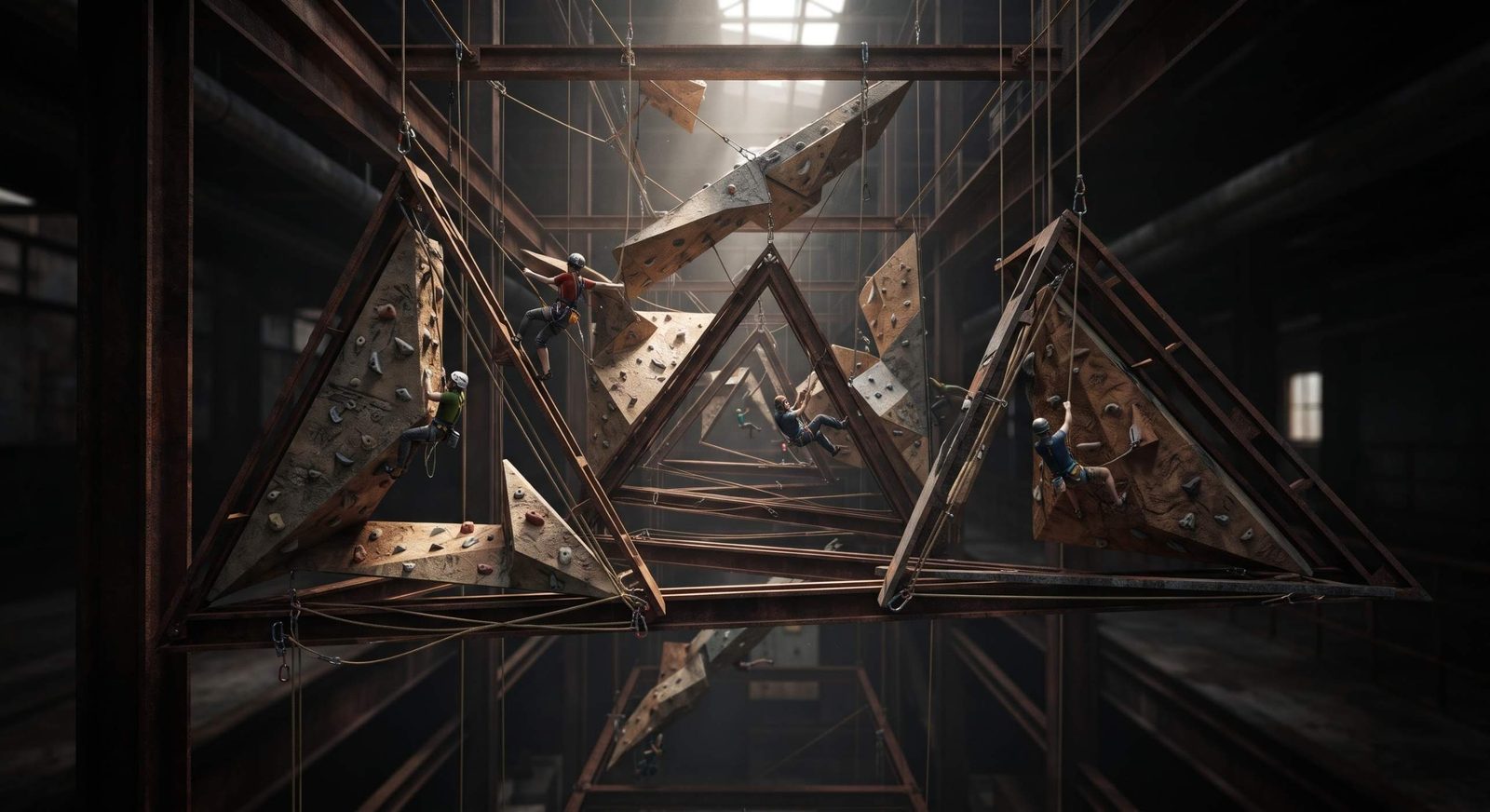
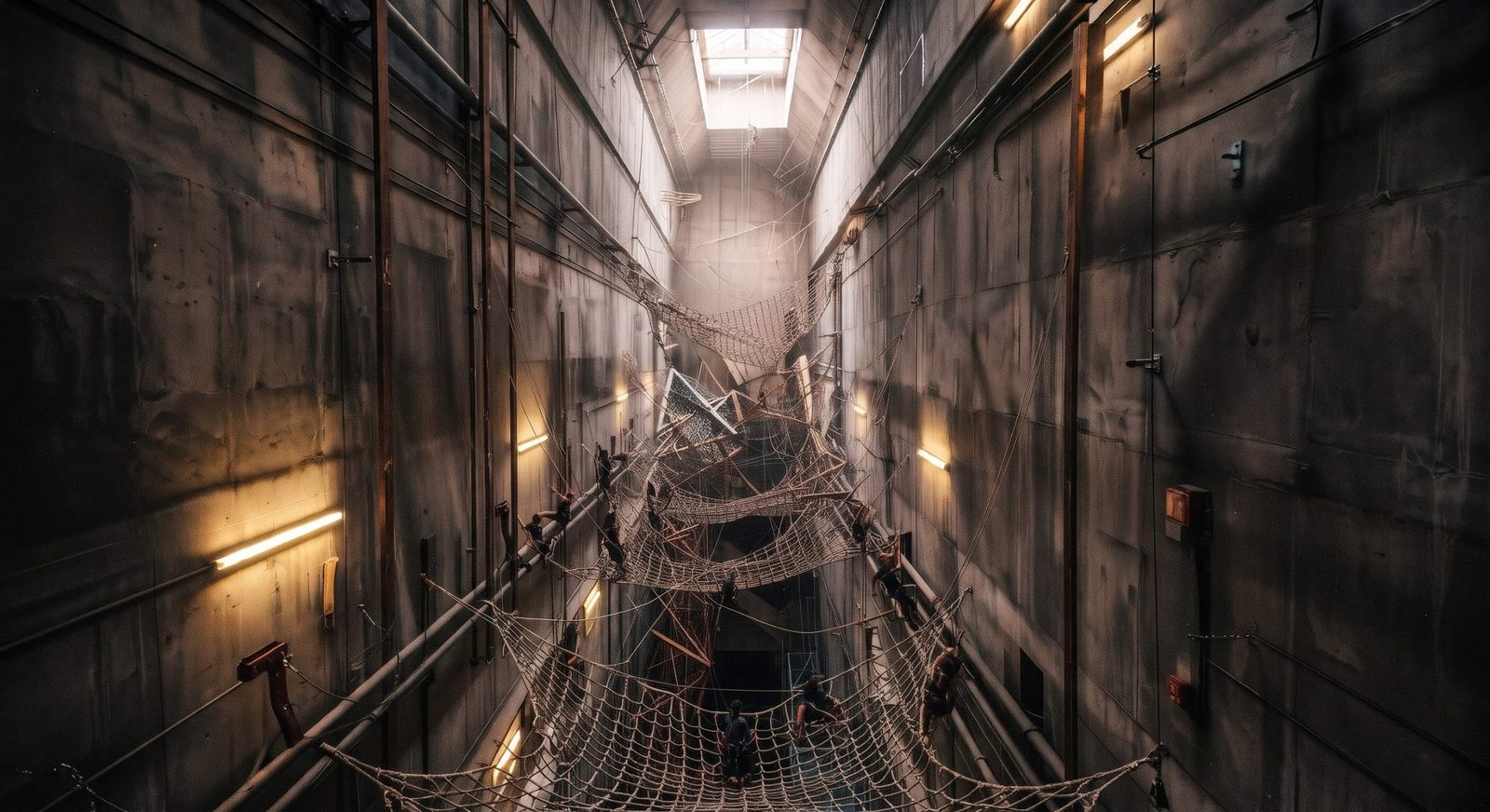
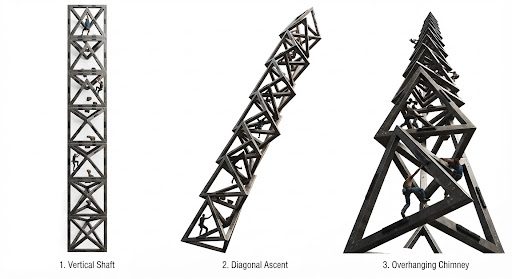
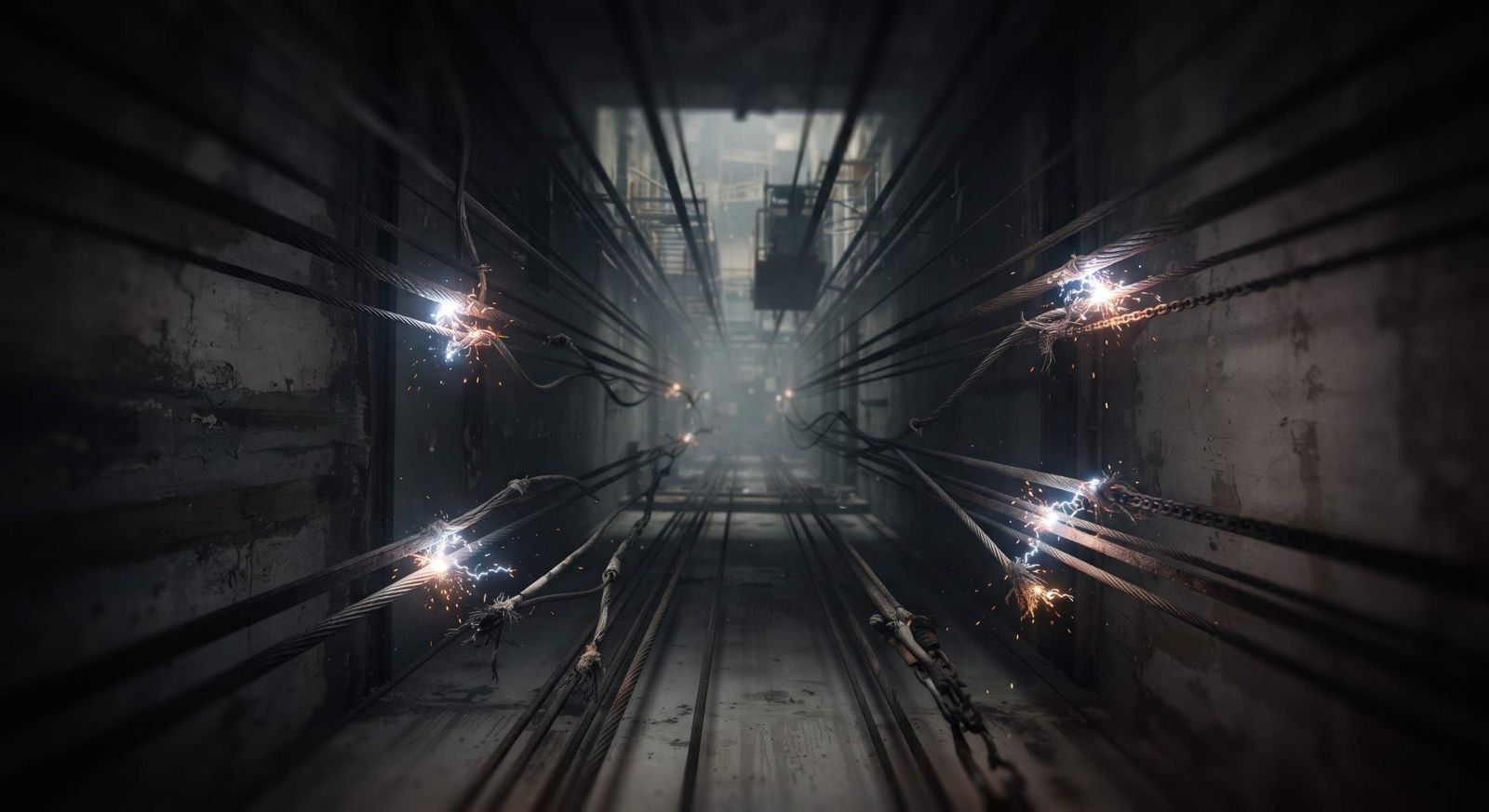
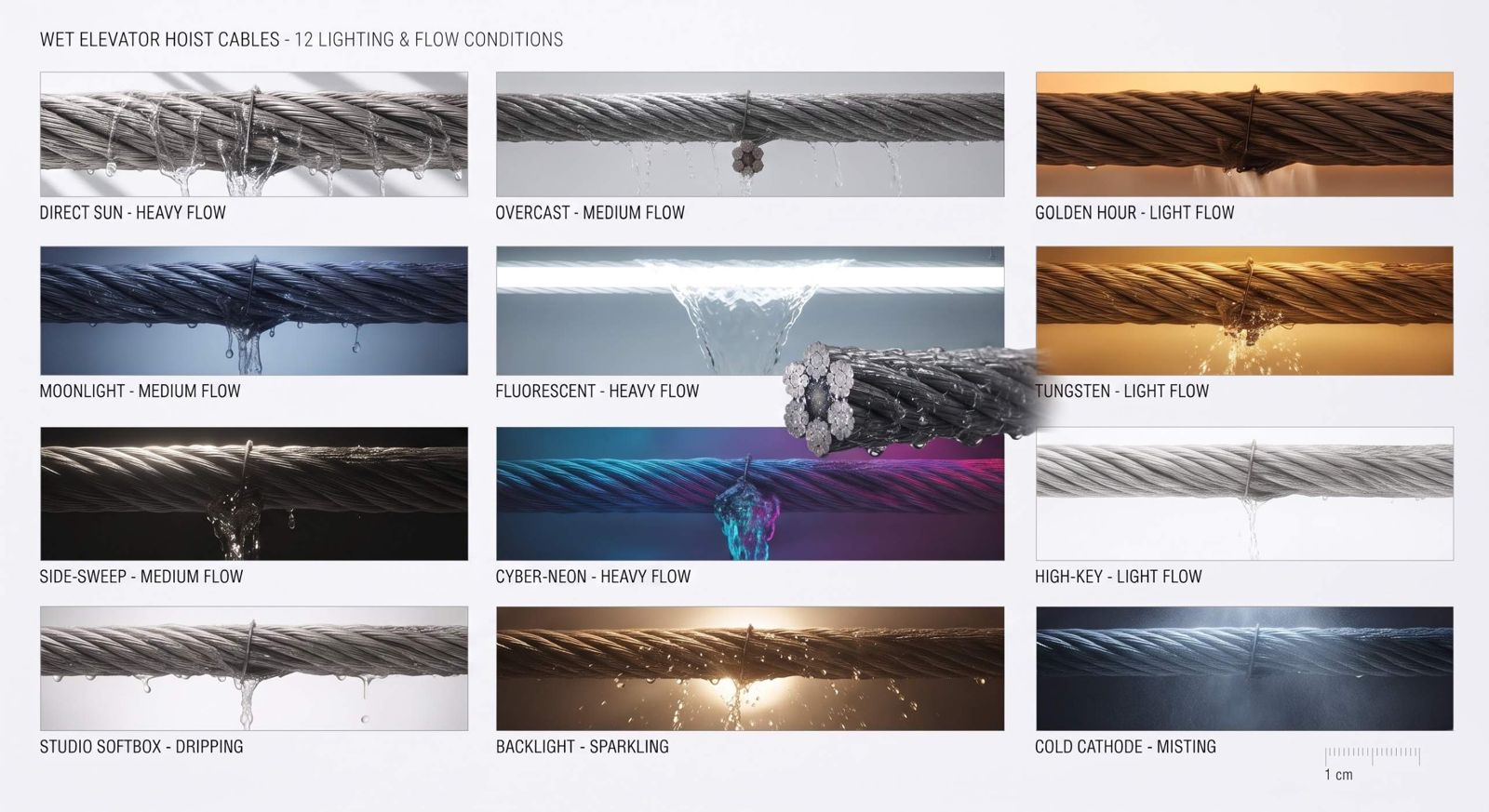
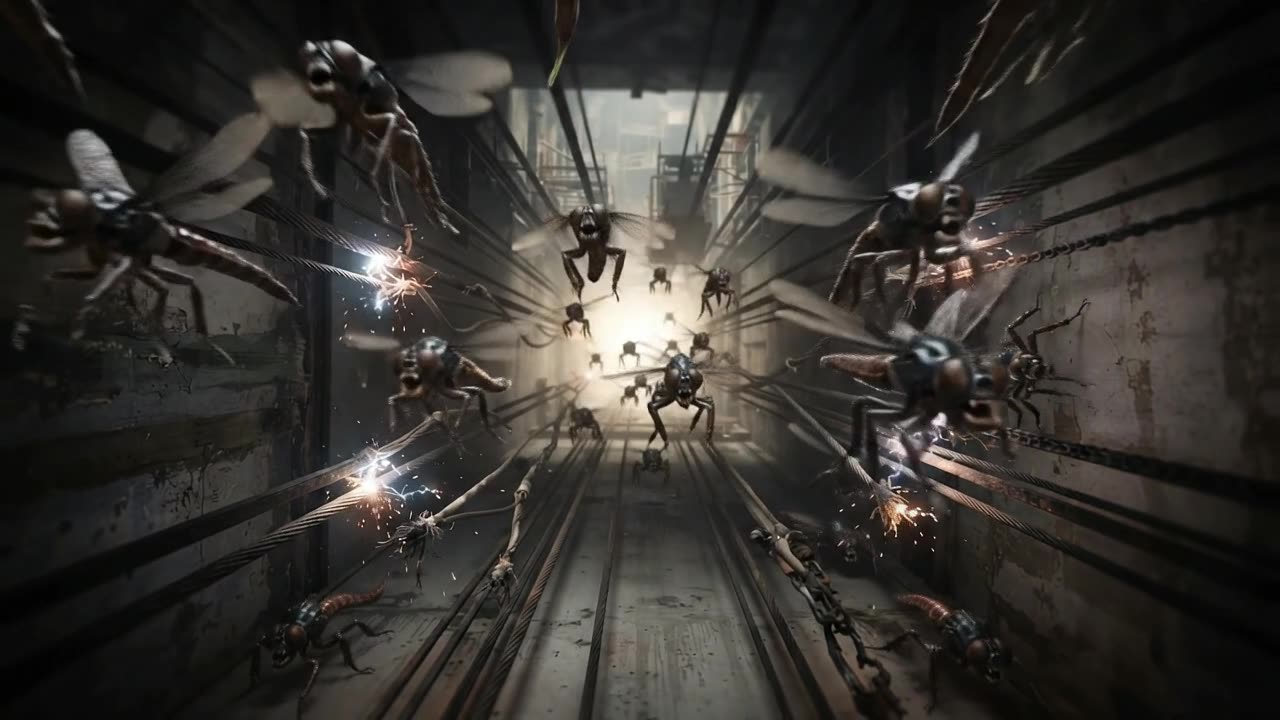
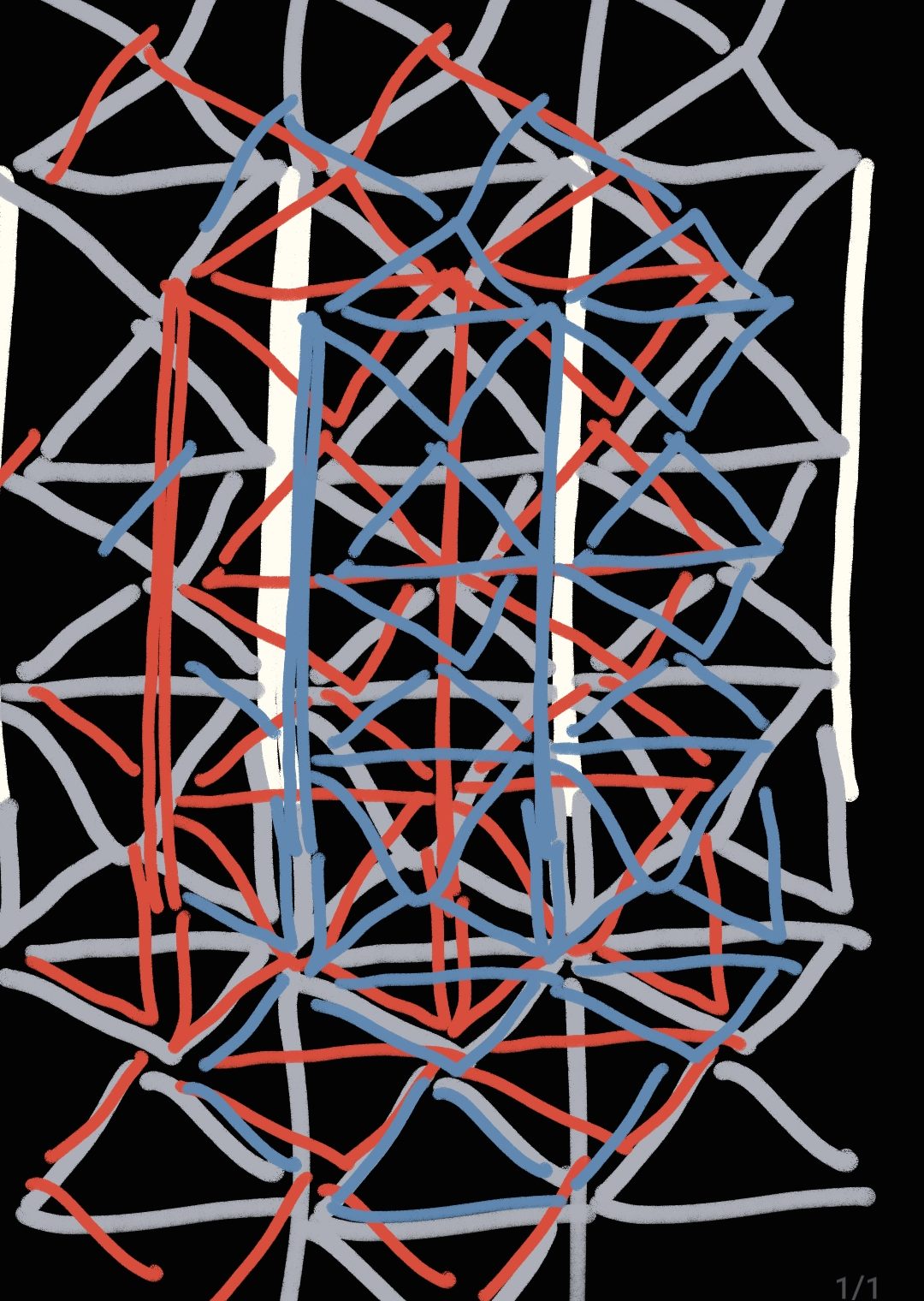
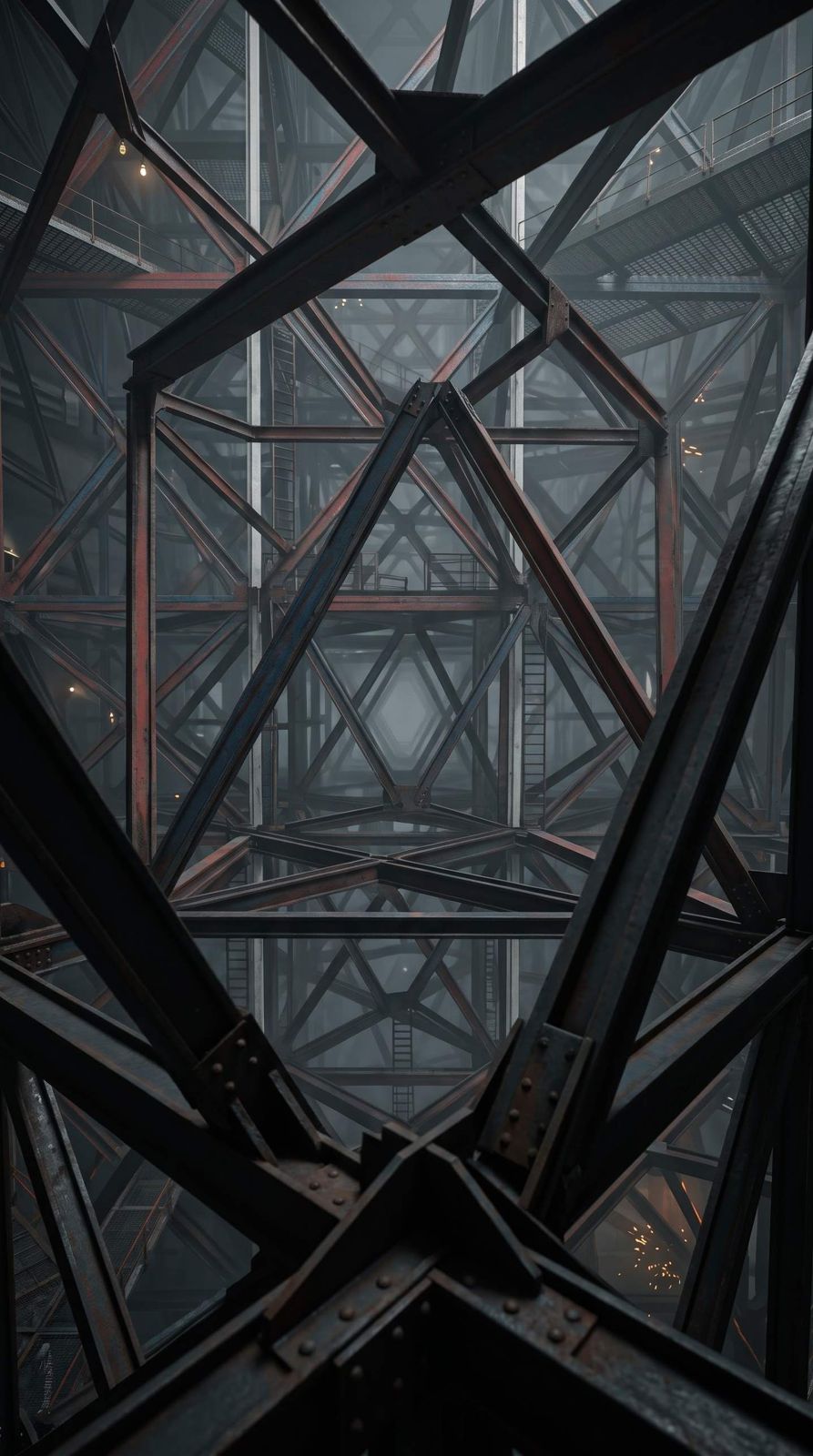
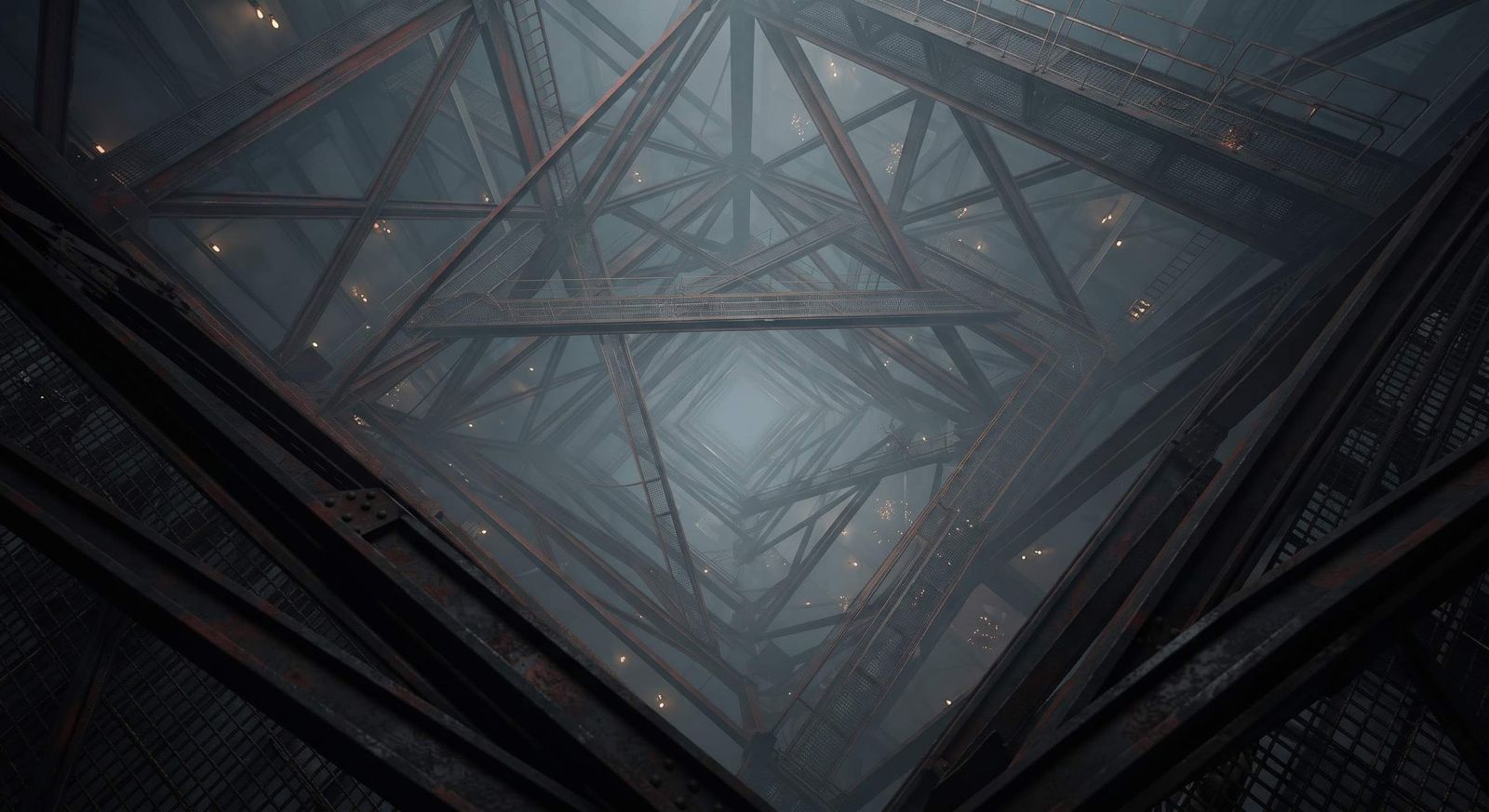
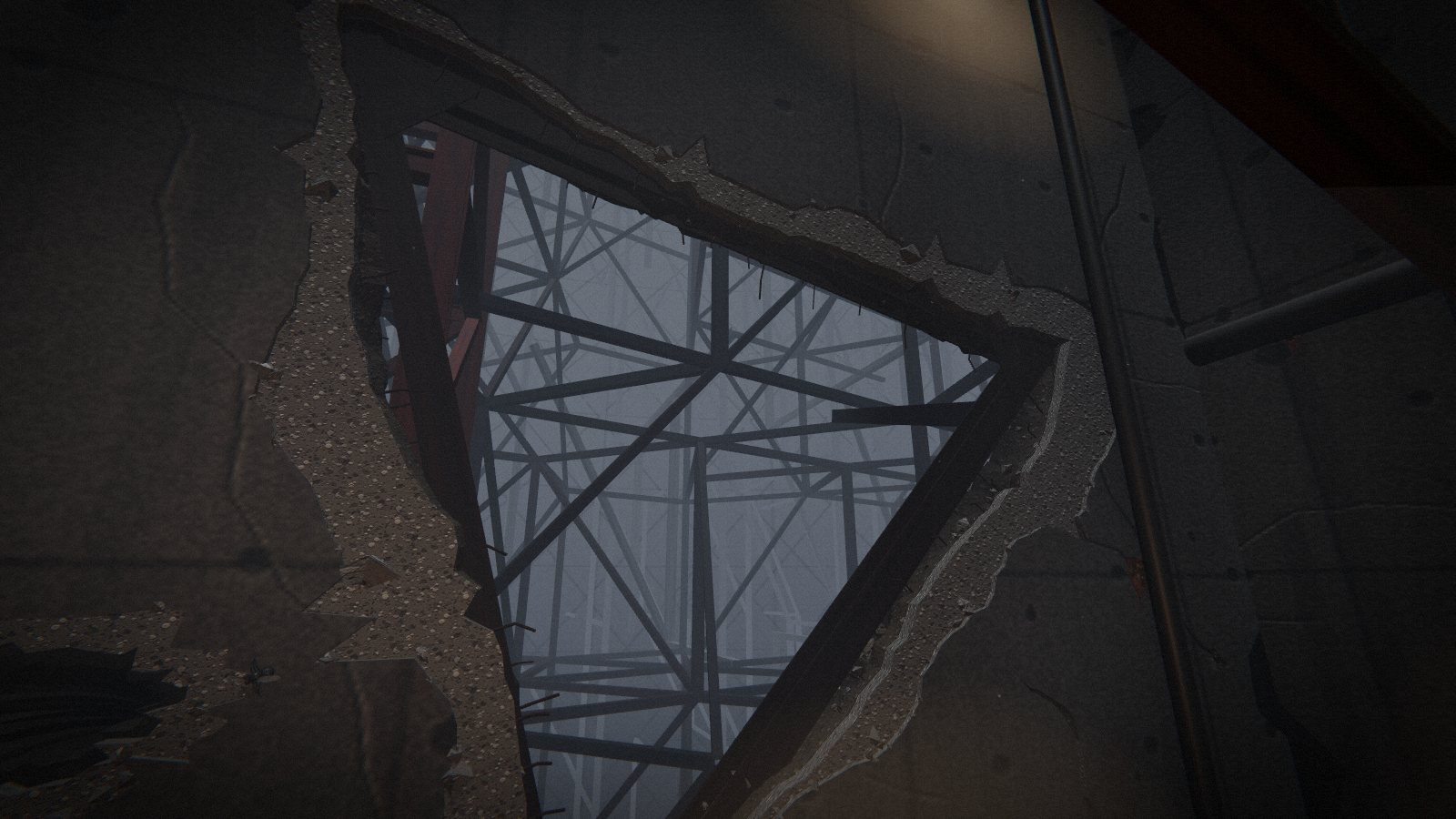
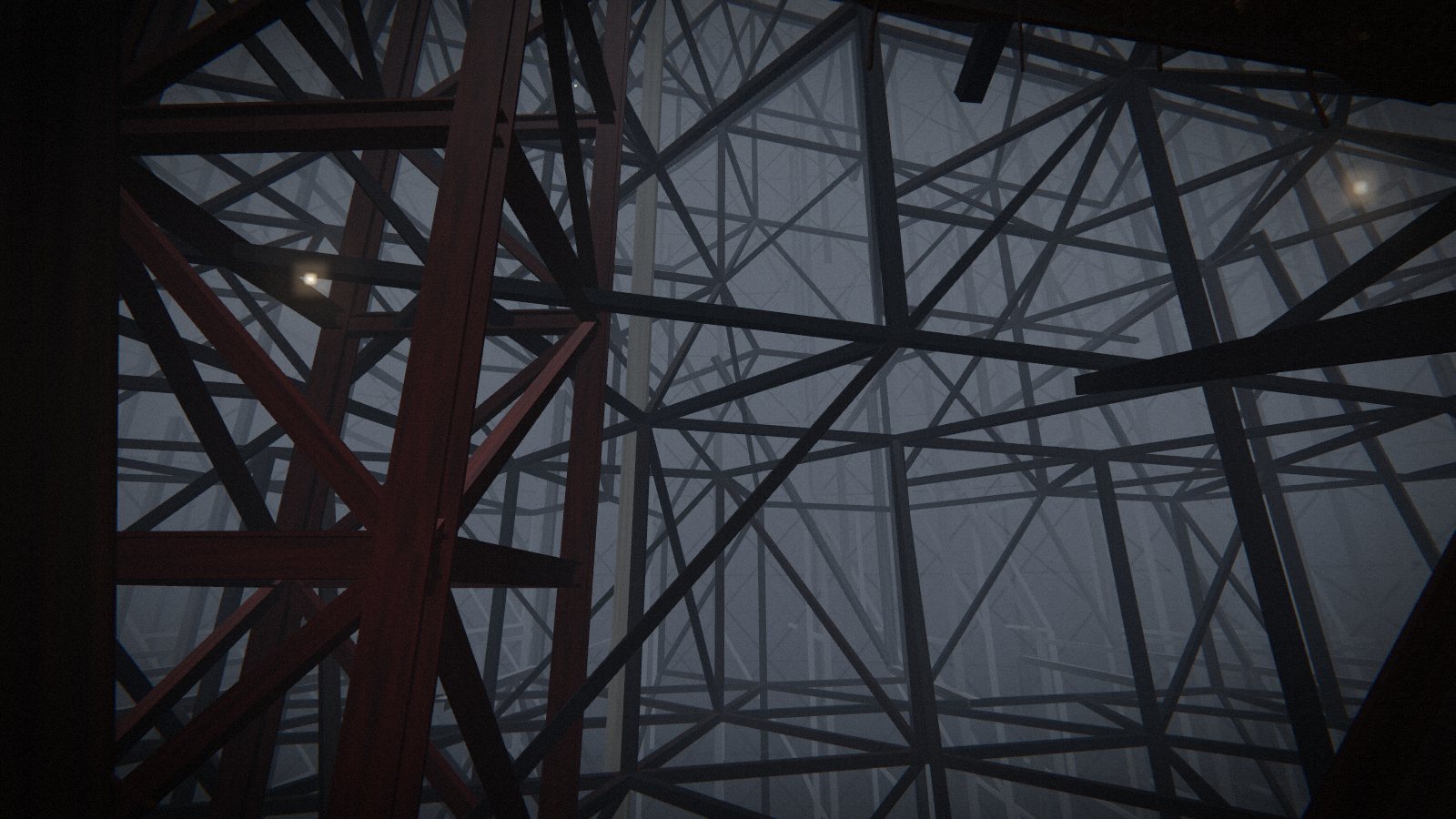
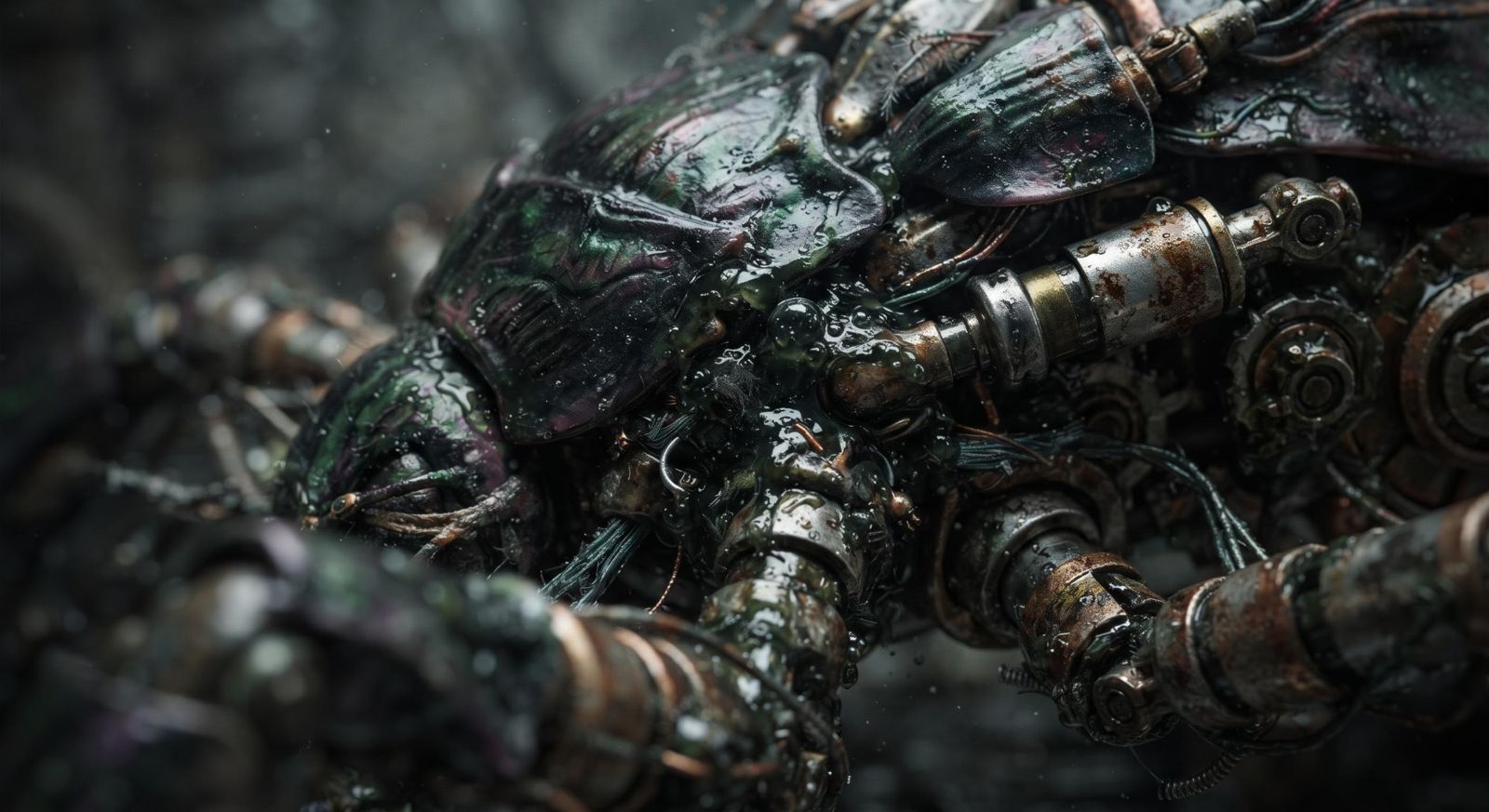
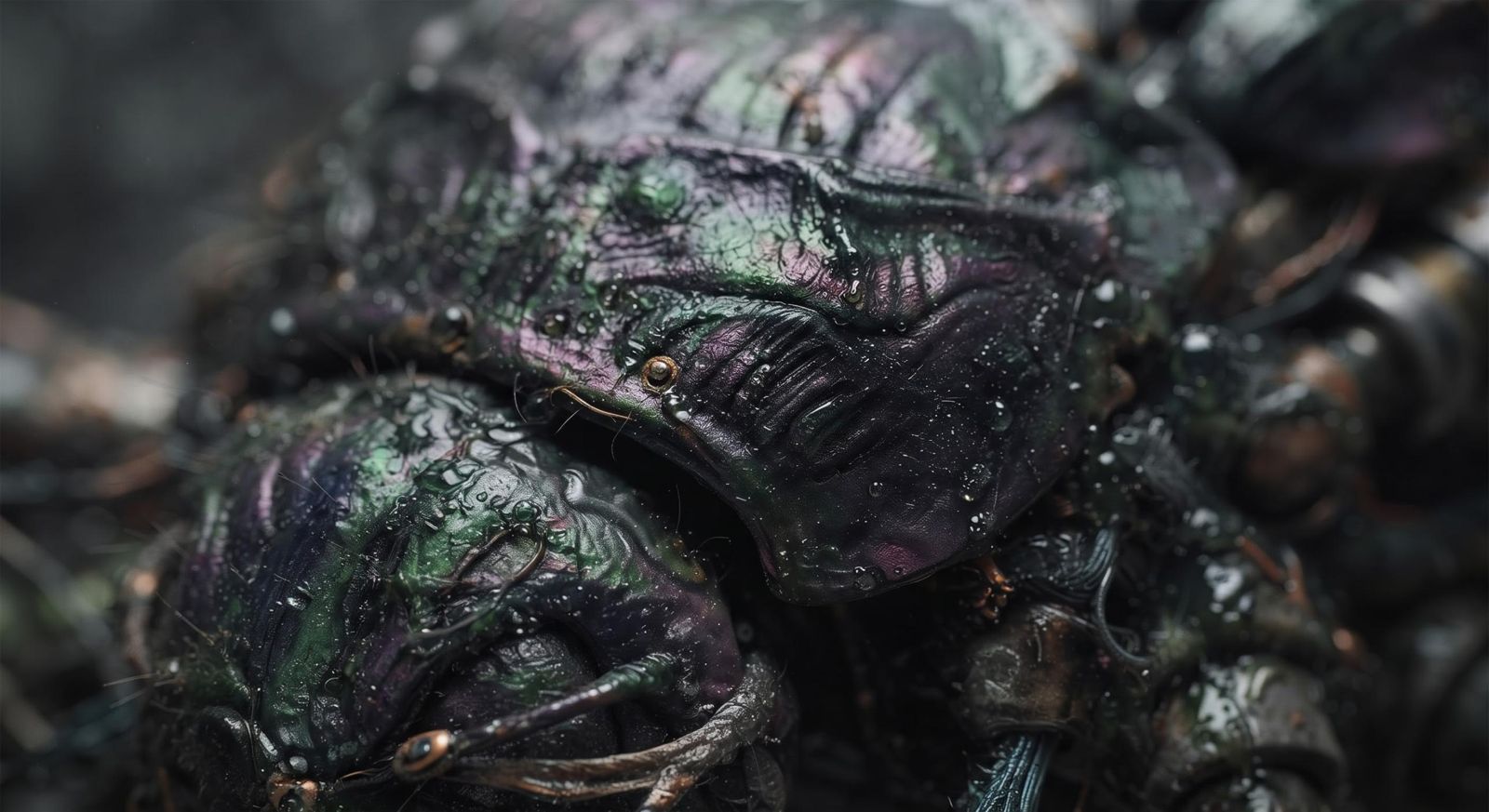
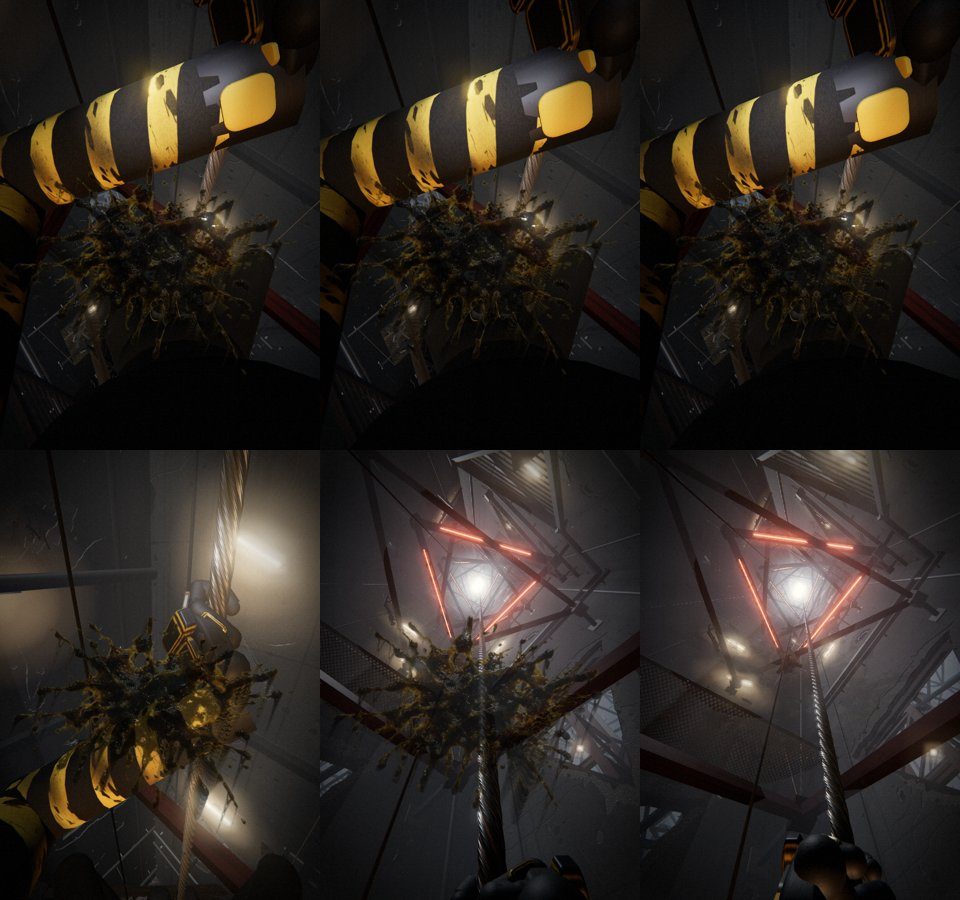
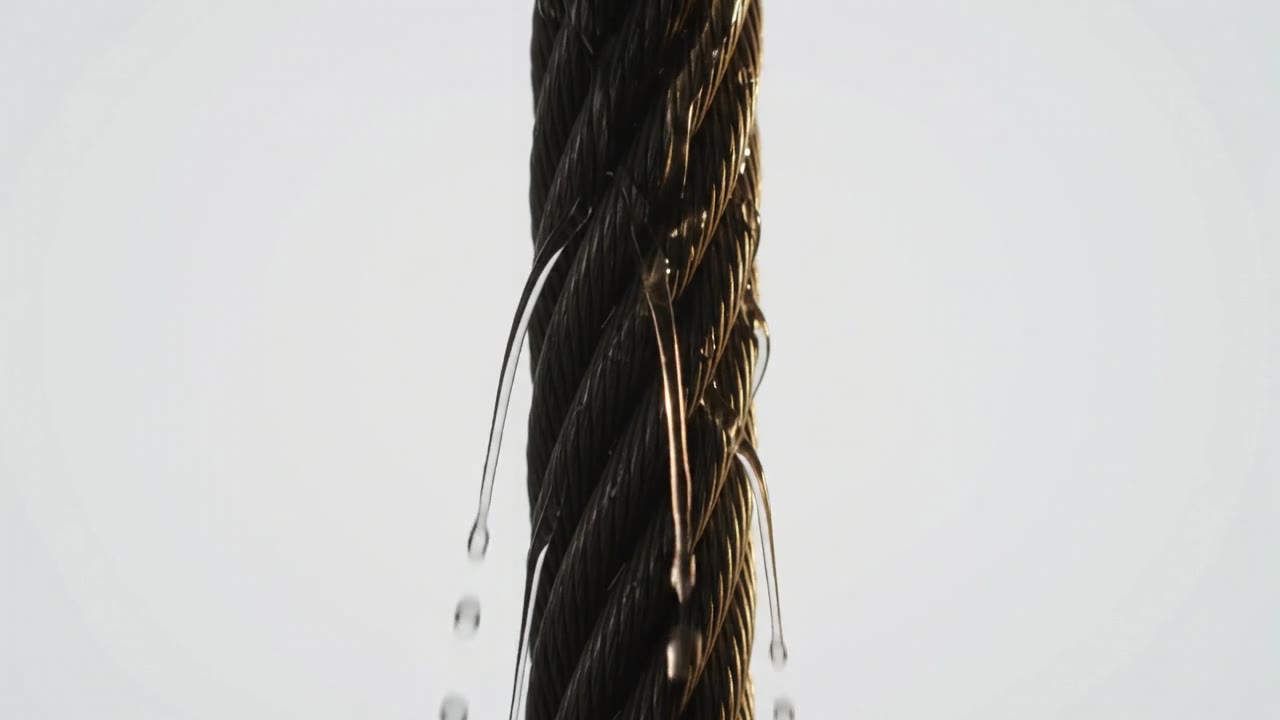
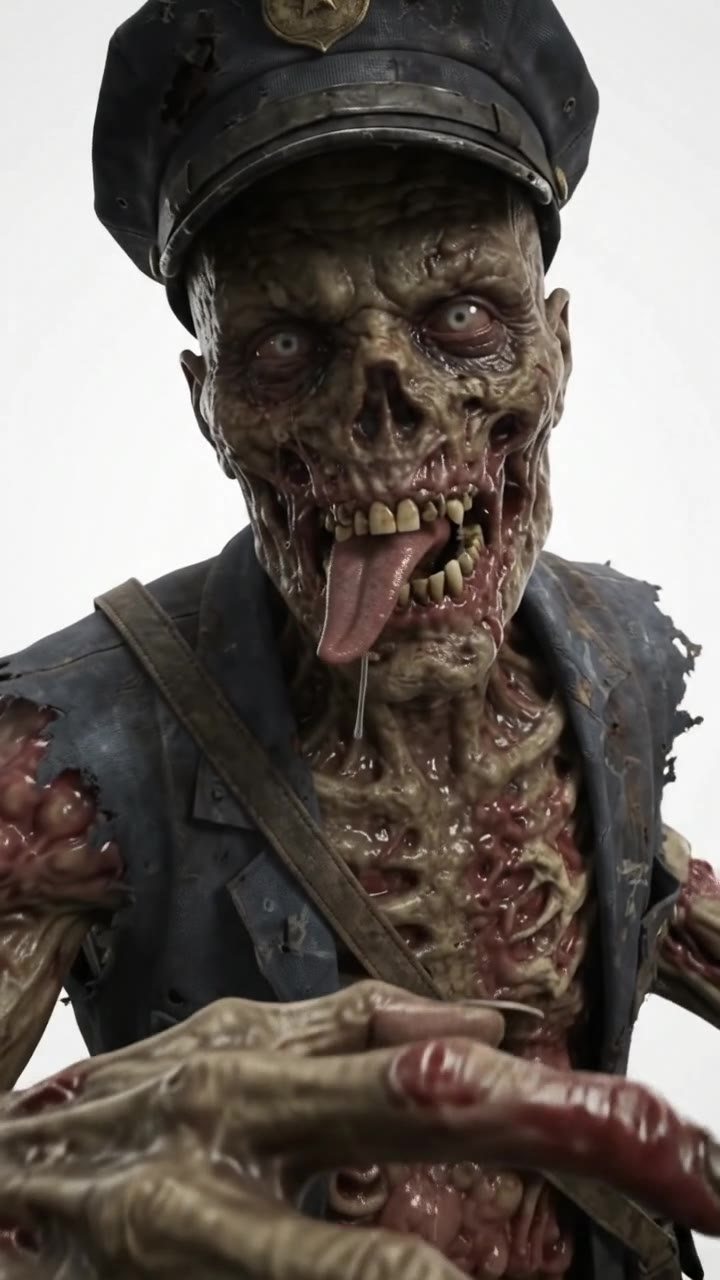
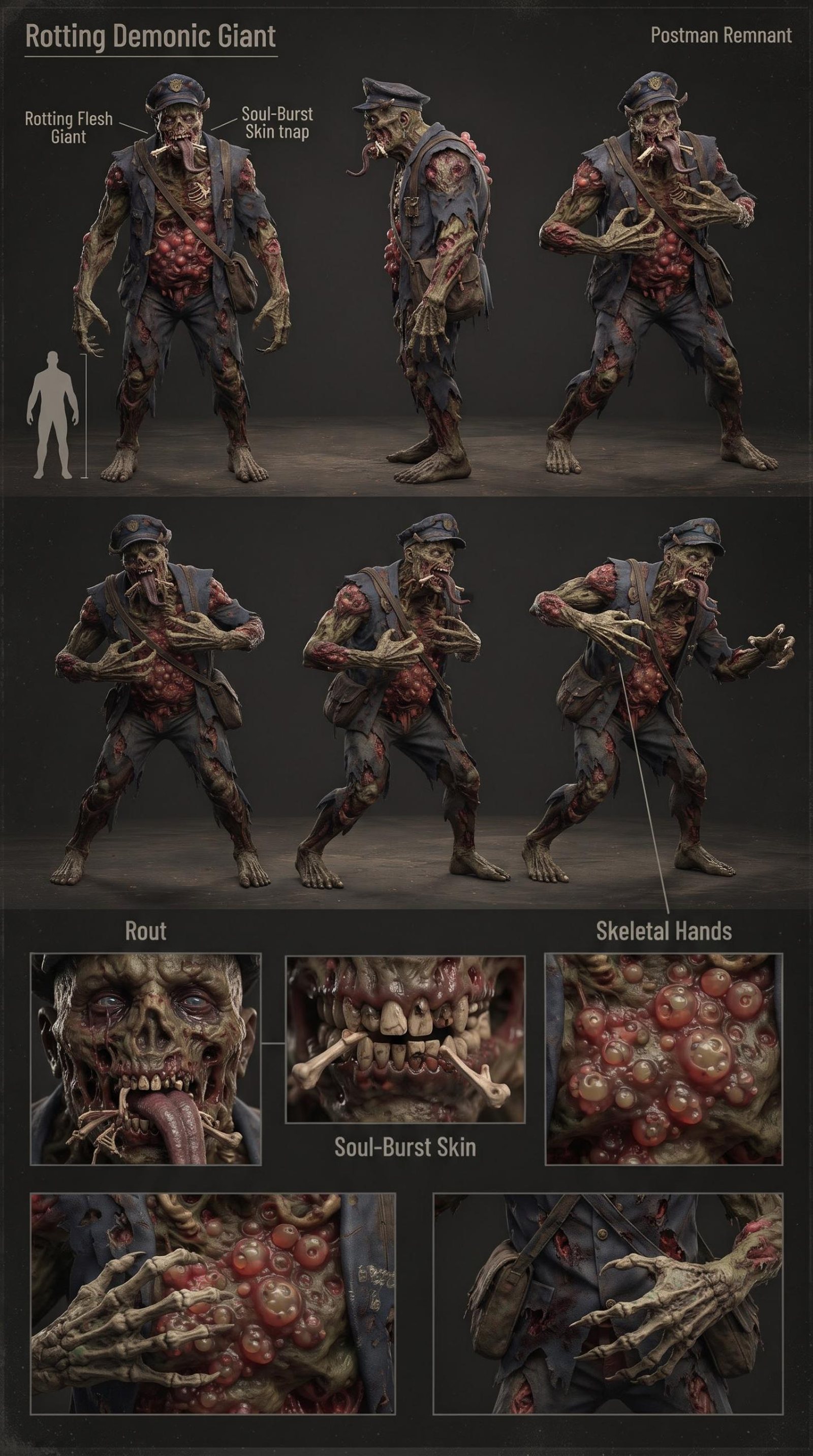
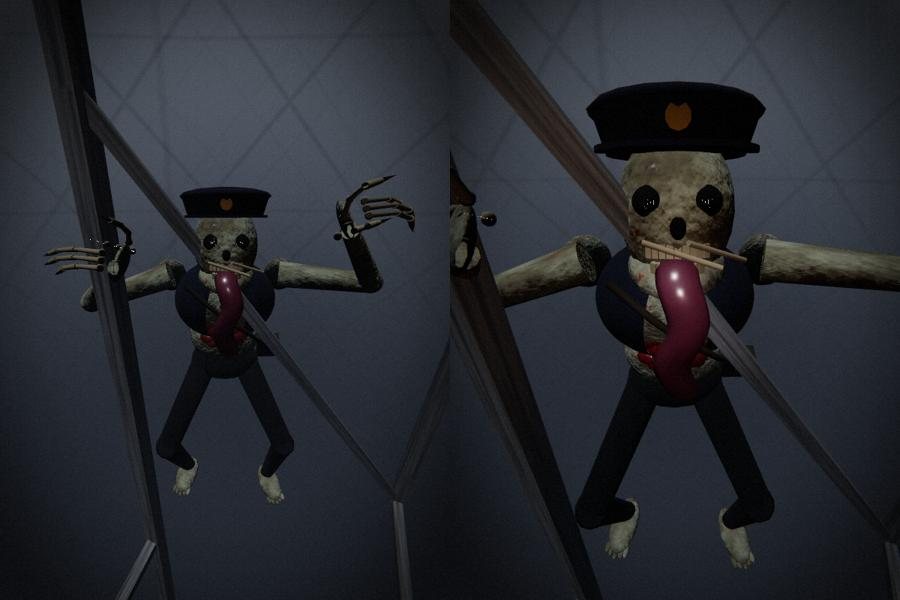
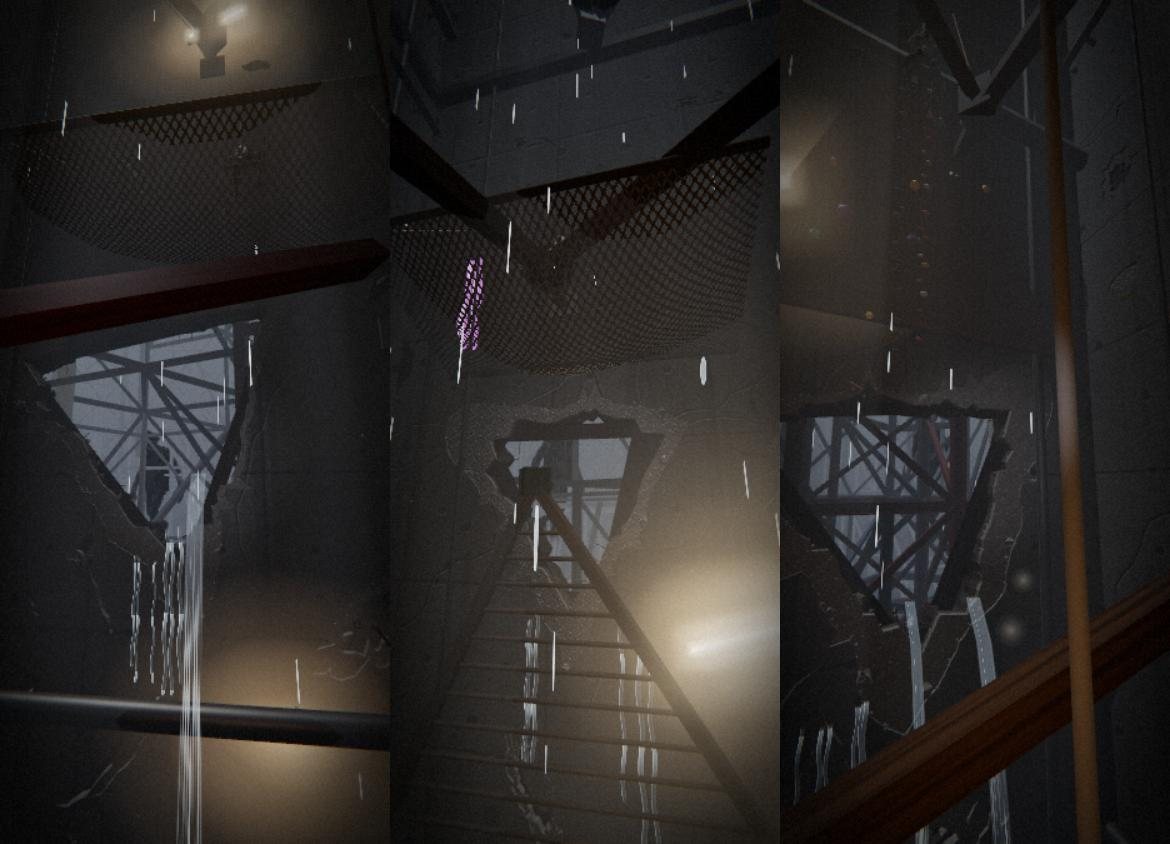
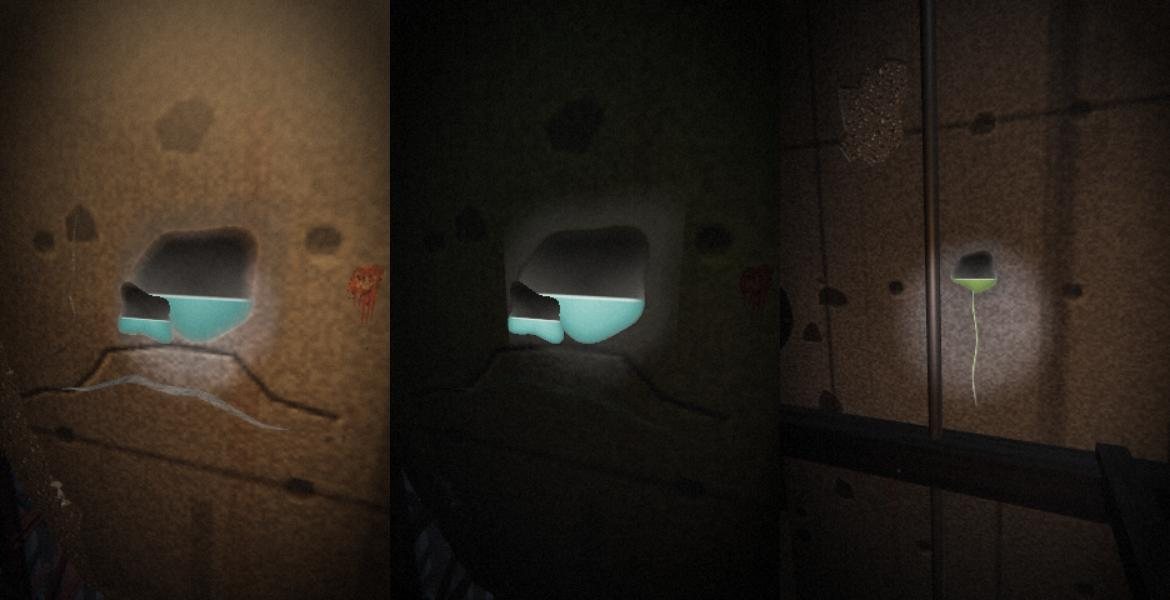
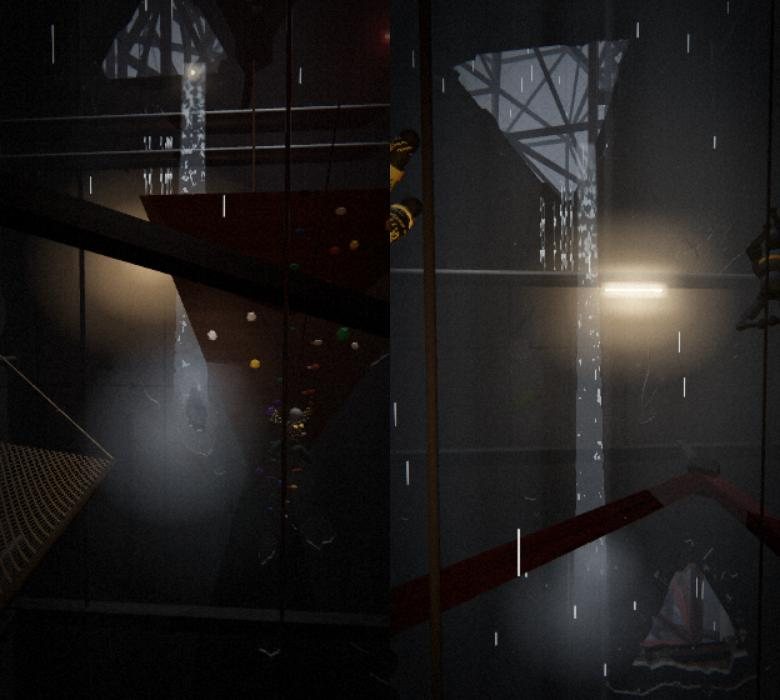
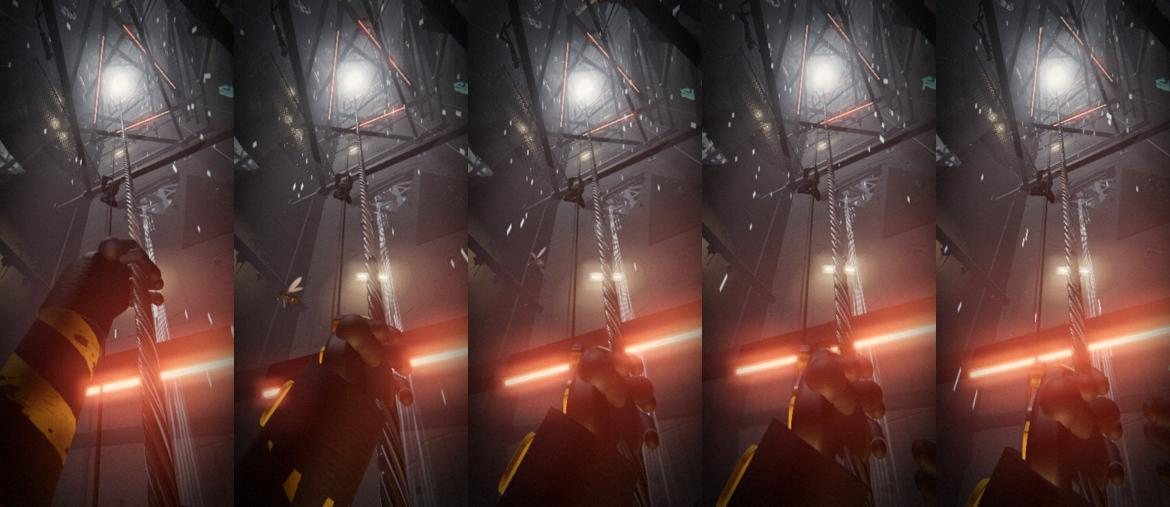
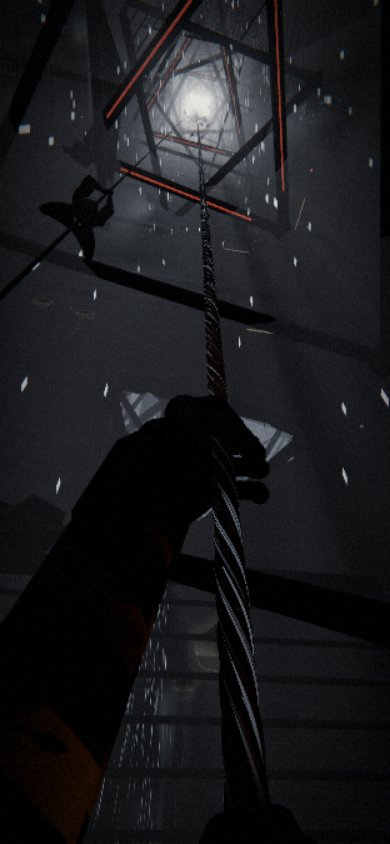
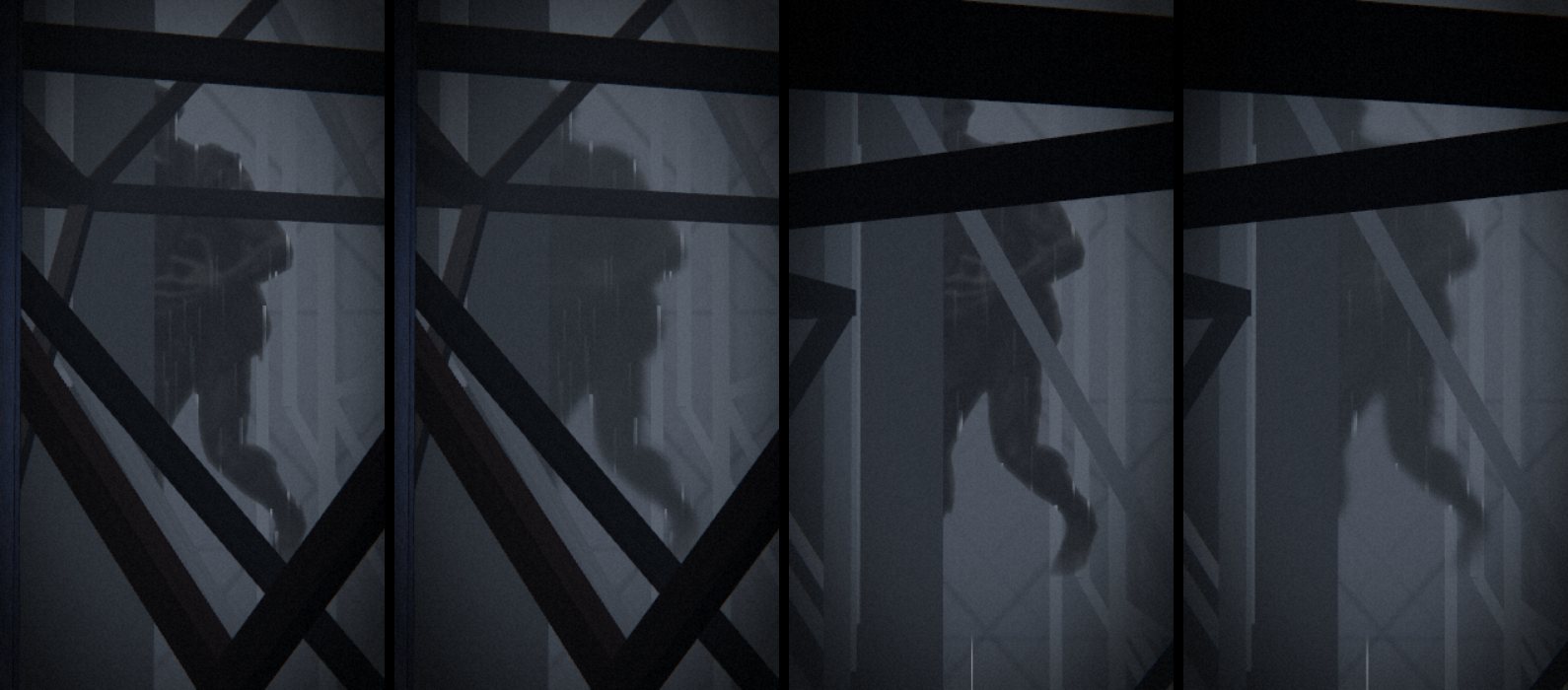
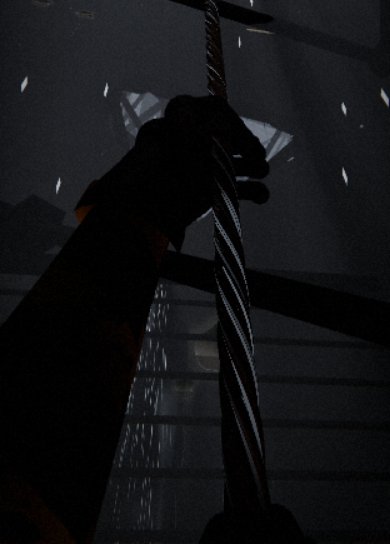
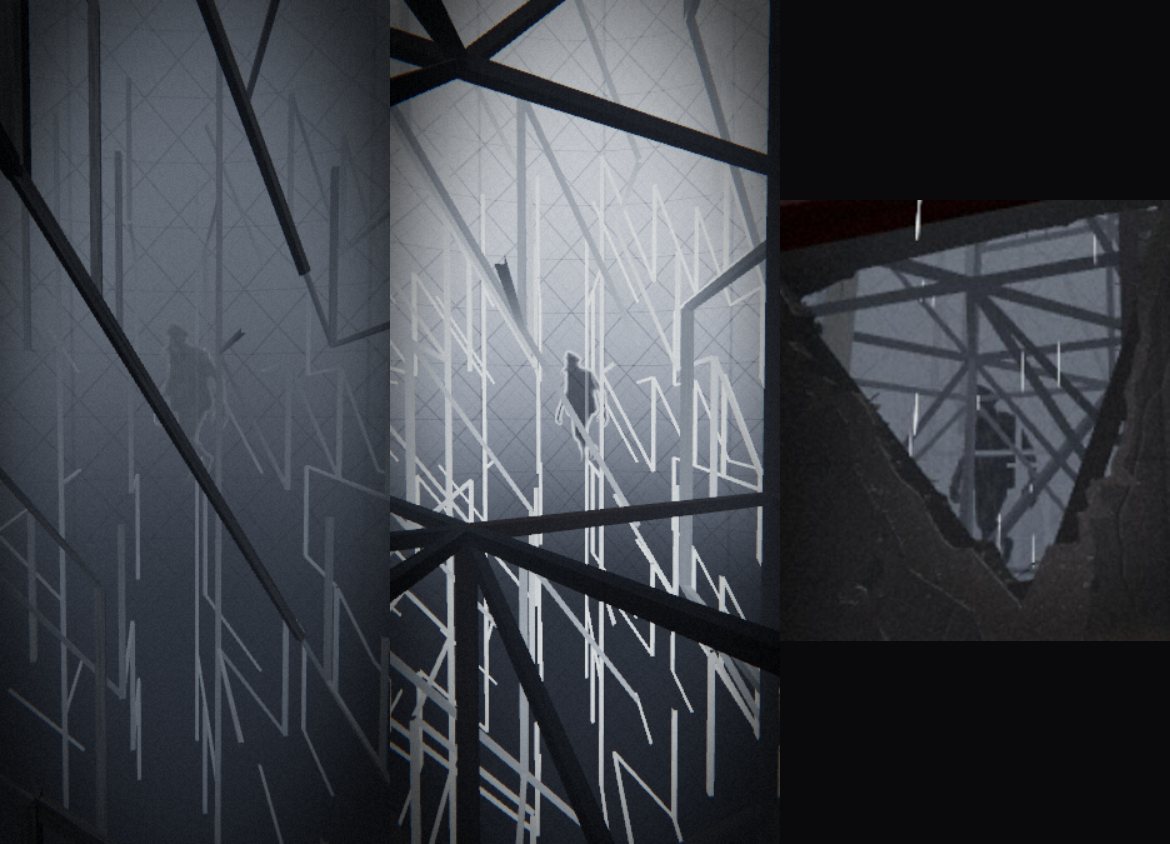
Before any code: a library of climbing poses and three concept images of the space. The poses set the body language. The concept images set the architecture, the light and the mood.
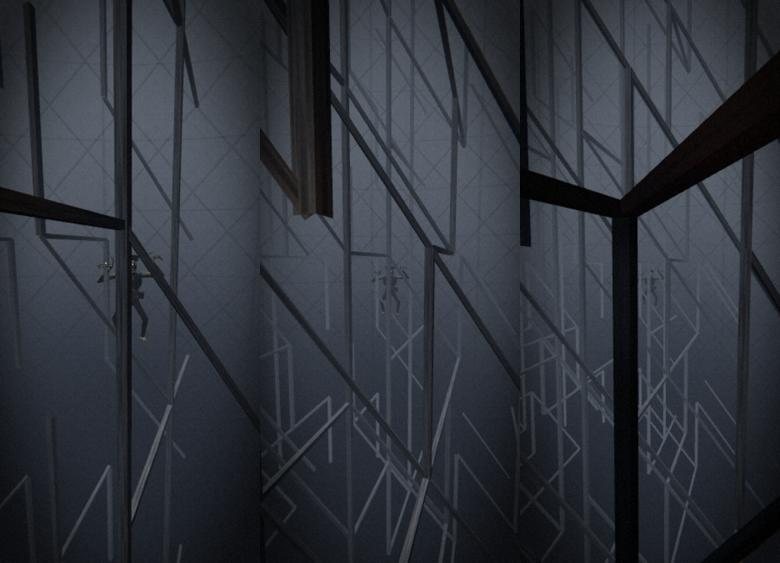
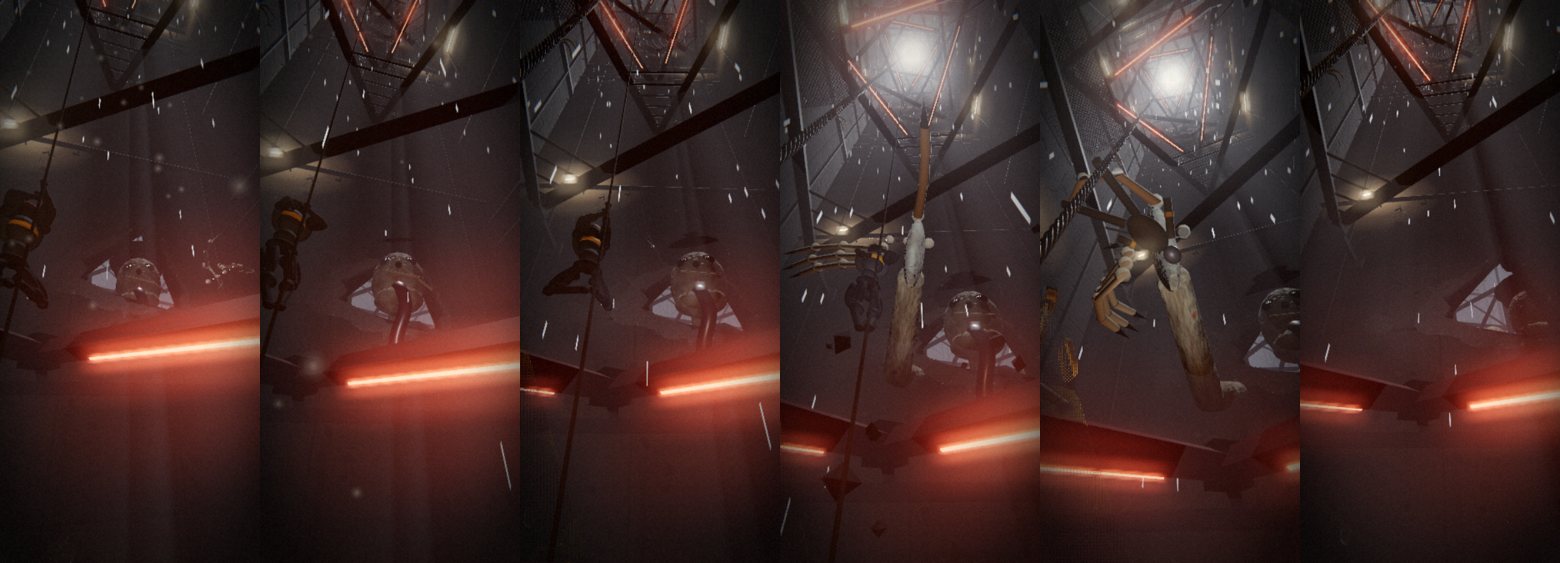
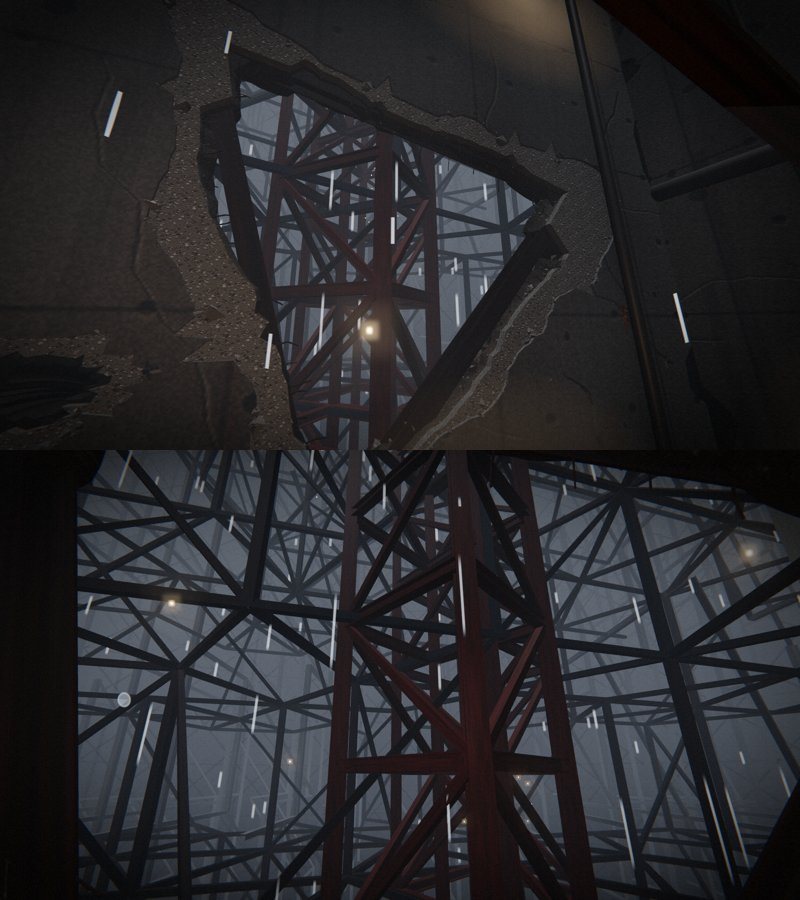
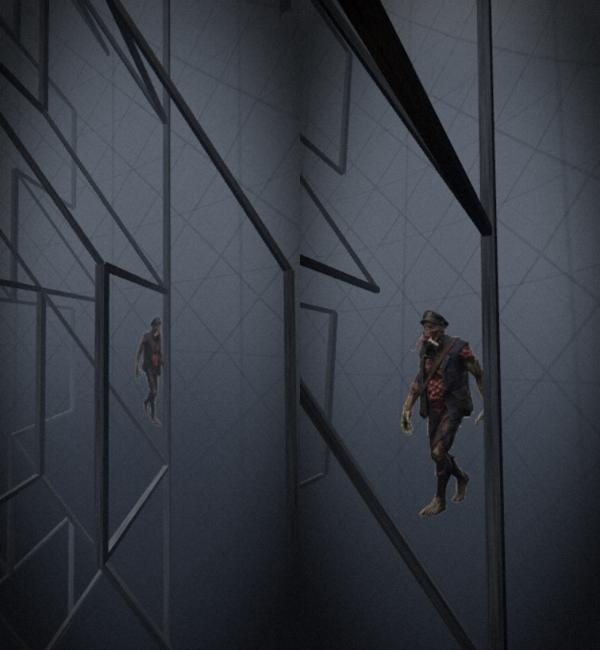
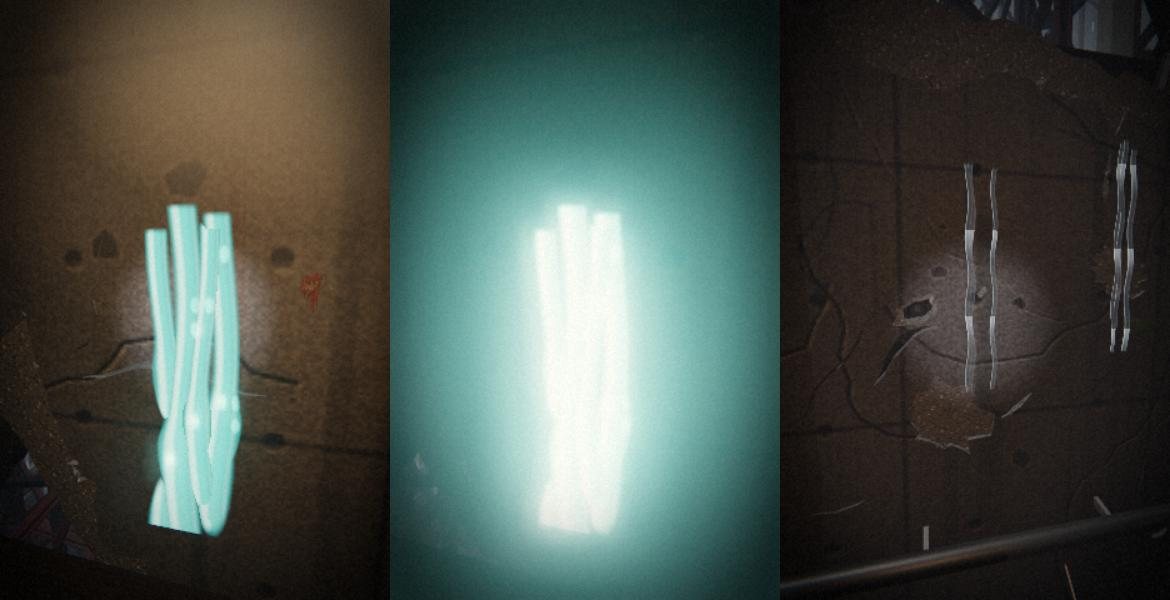
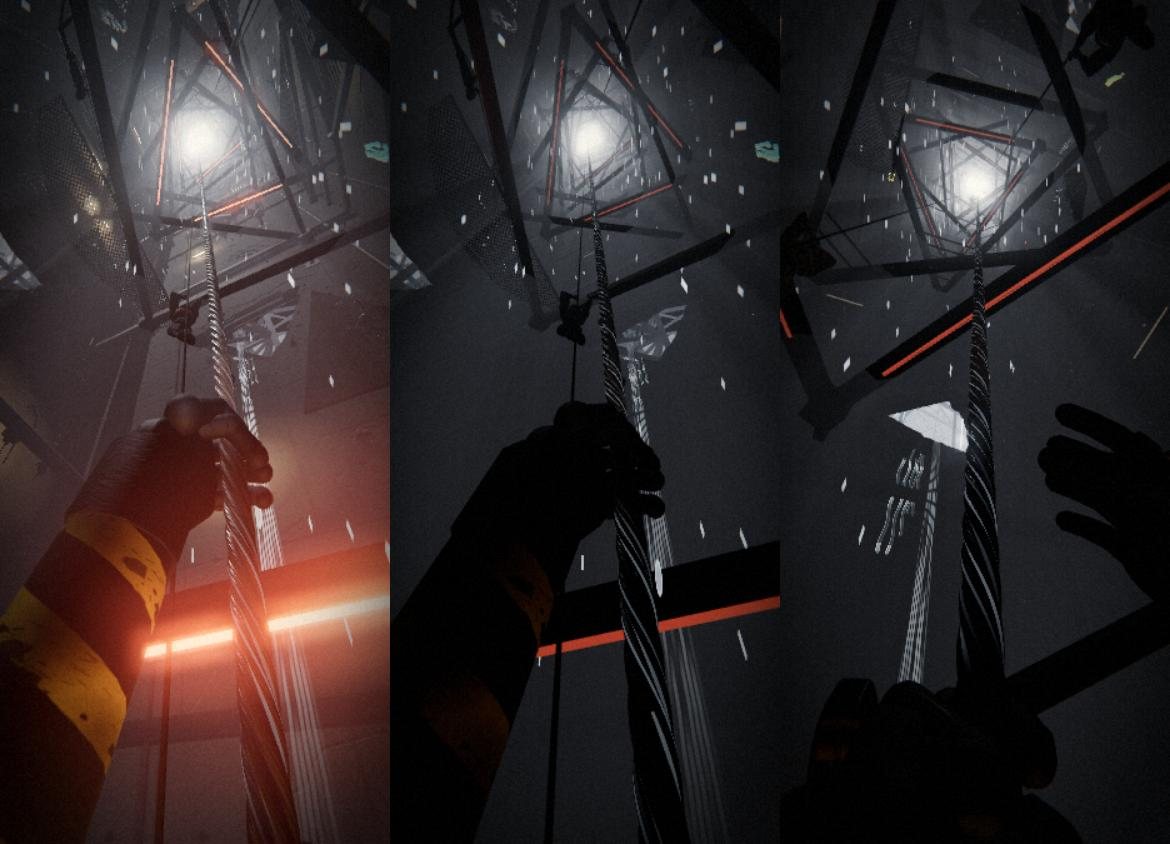
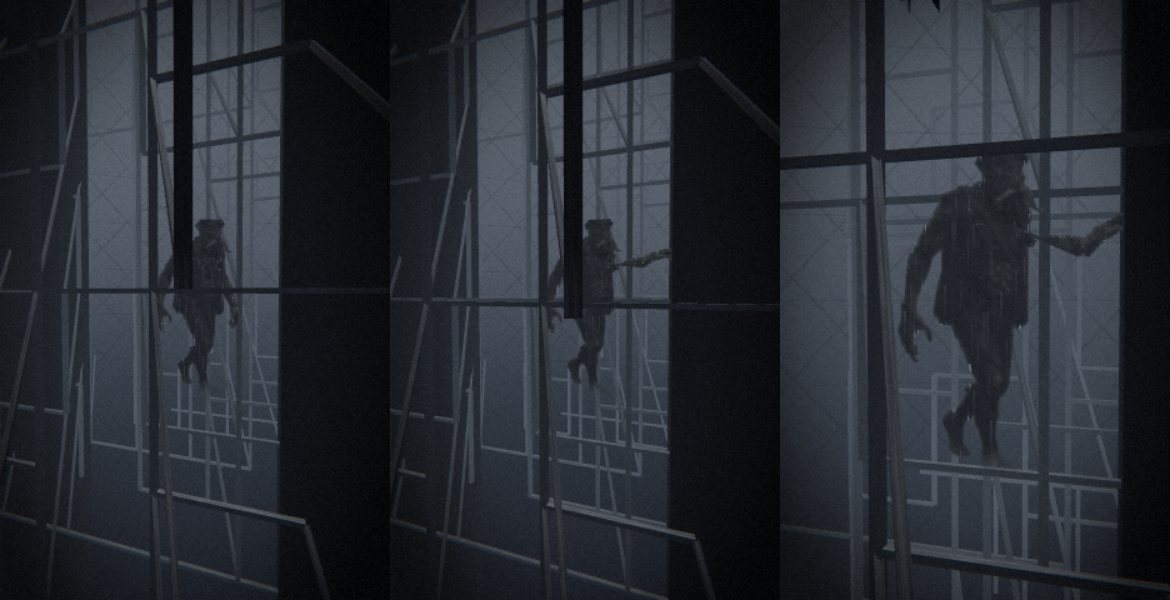
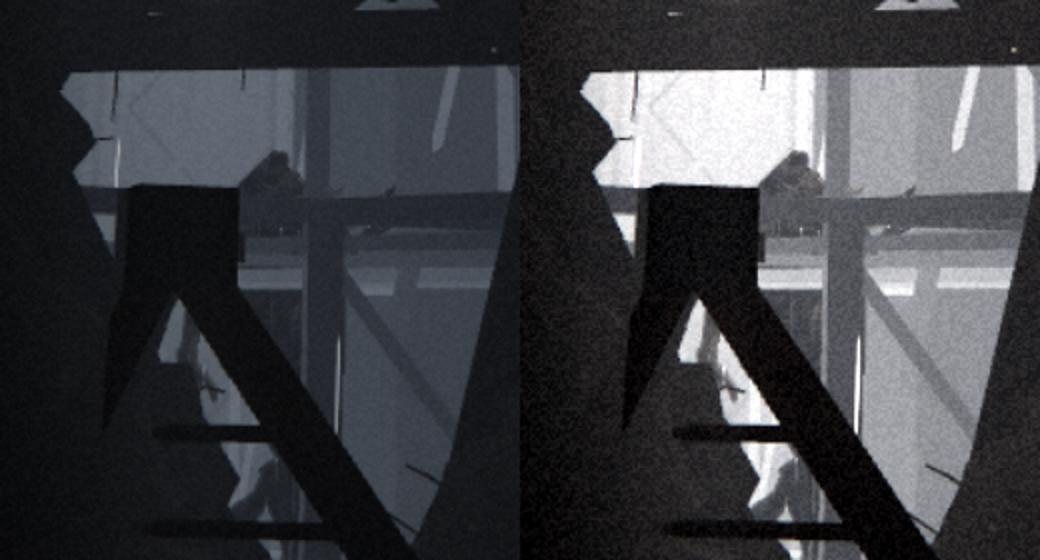
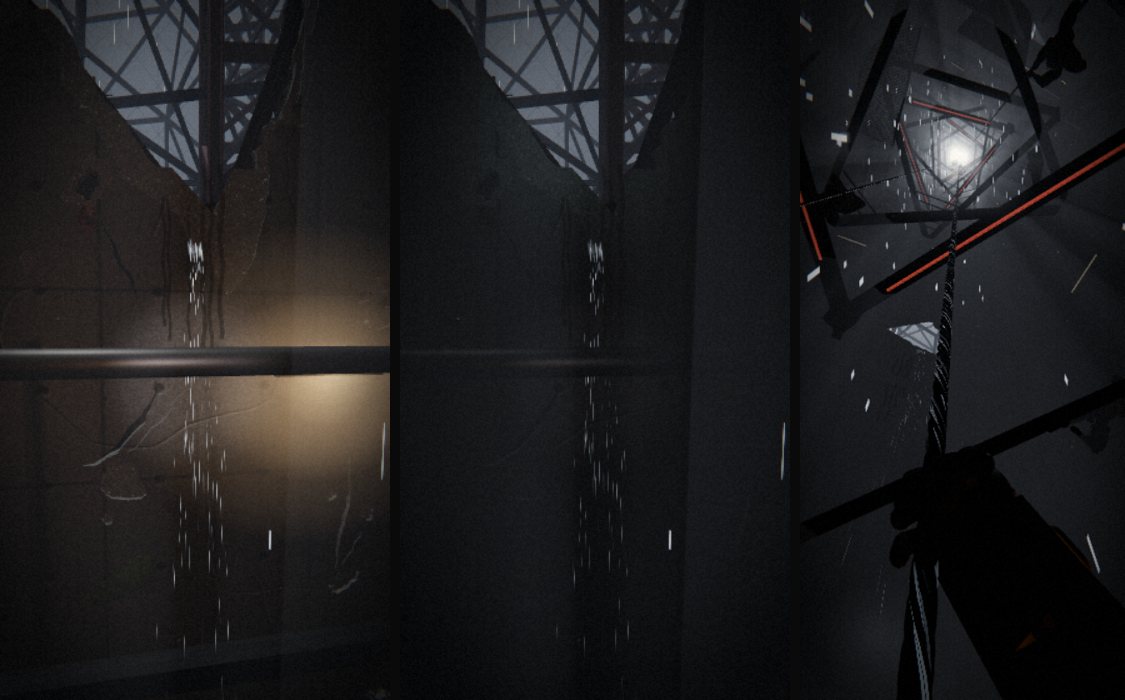
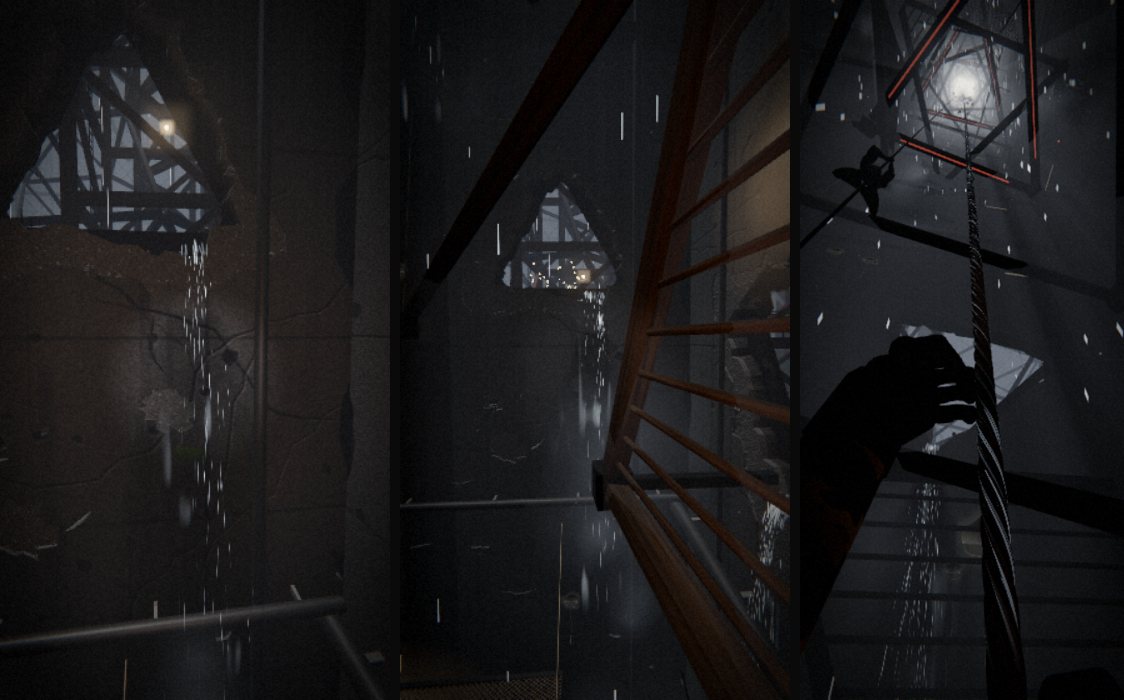
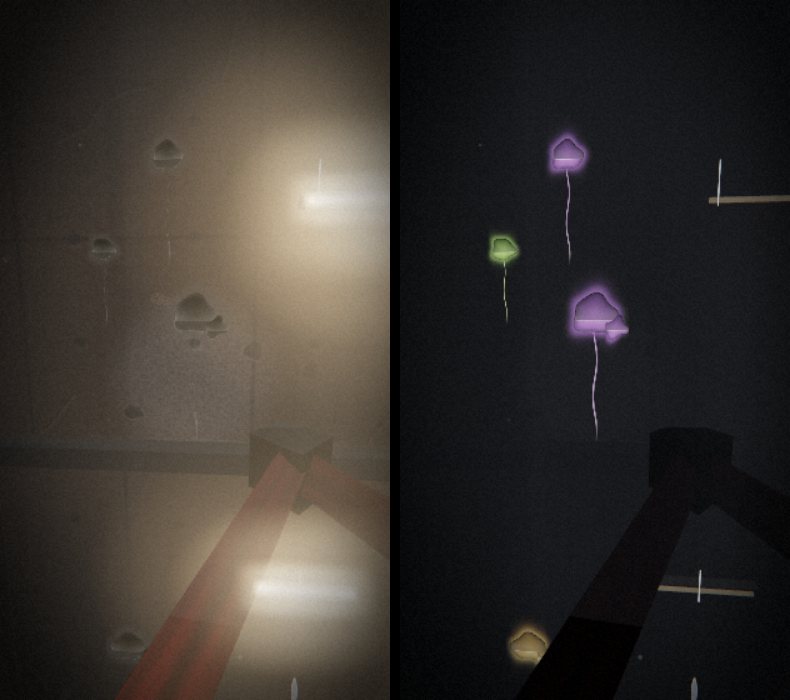
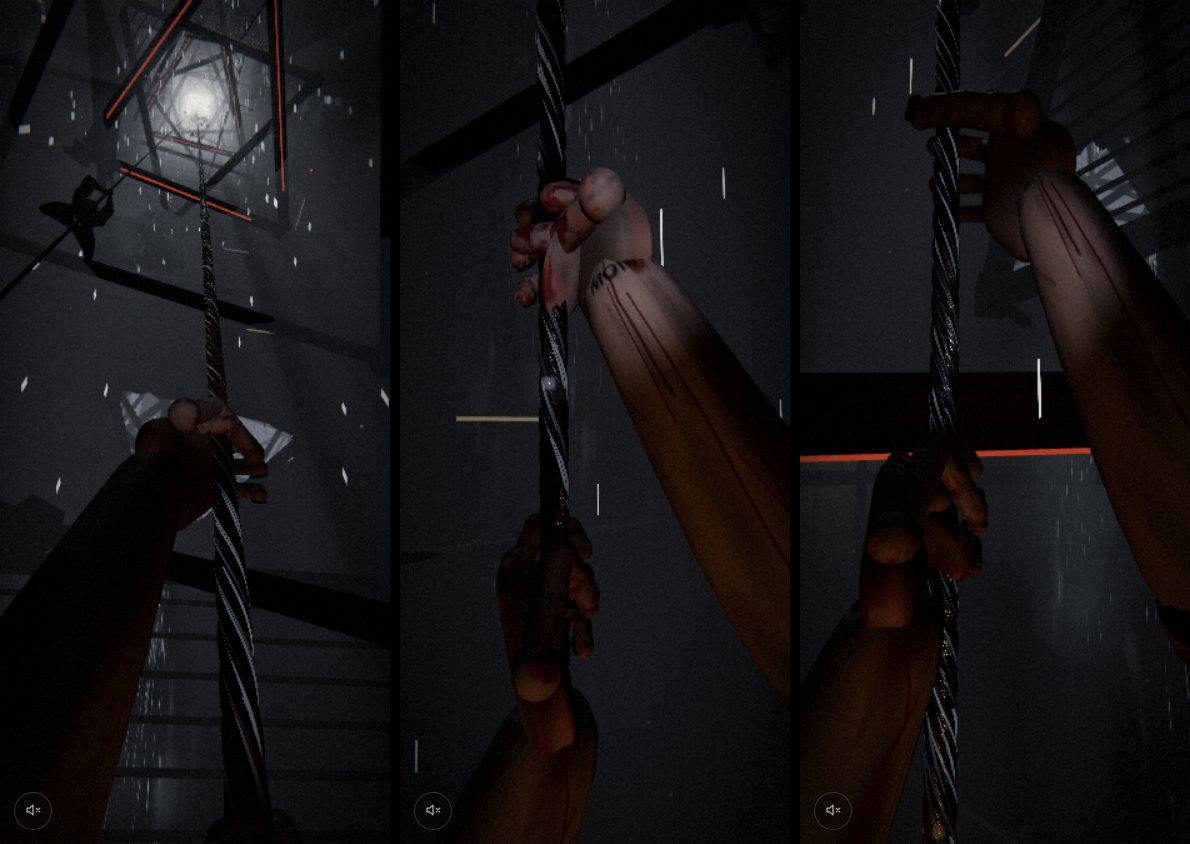
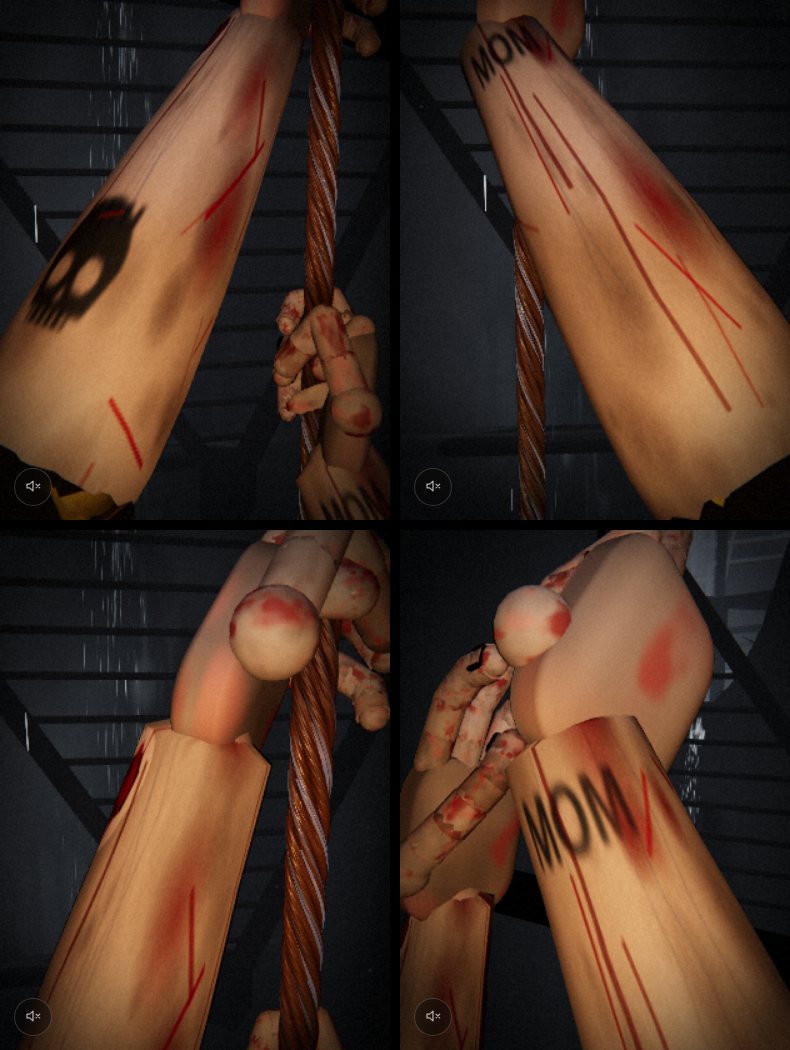
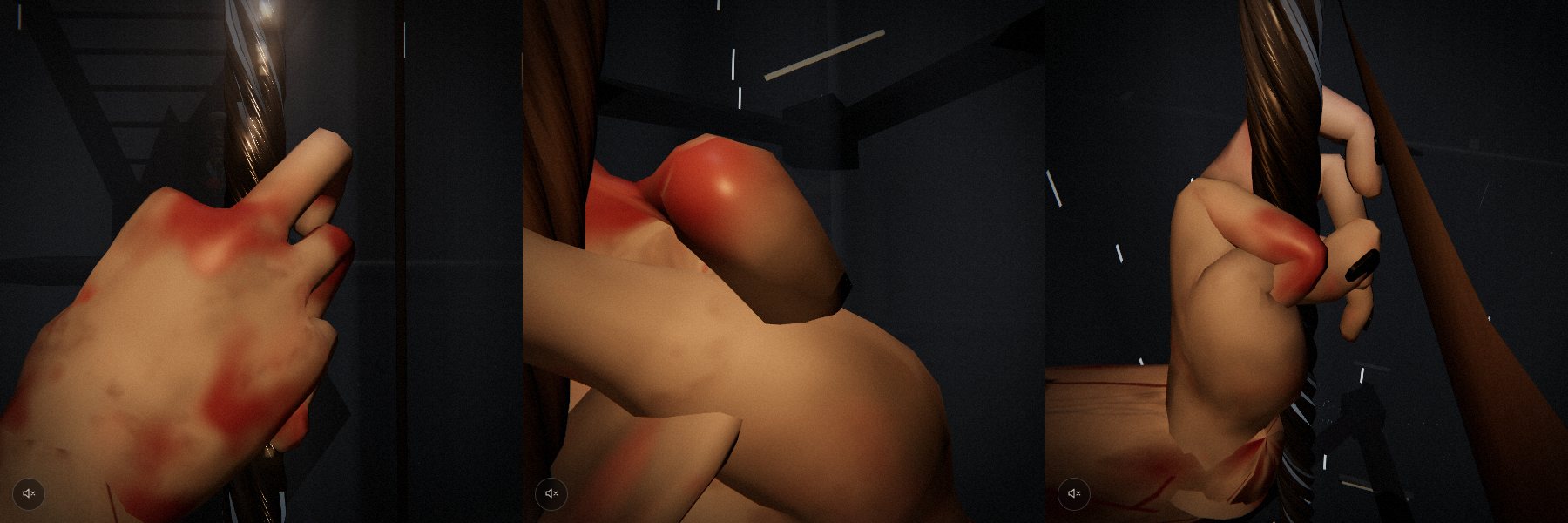
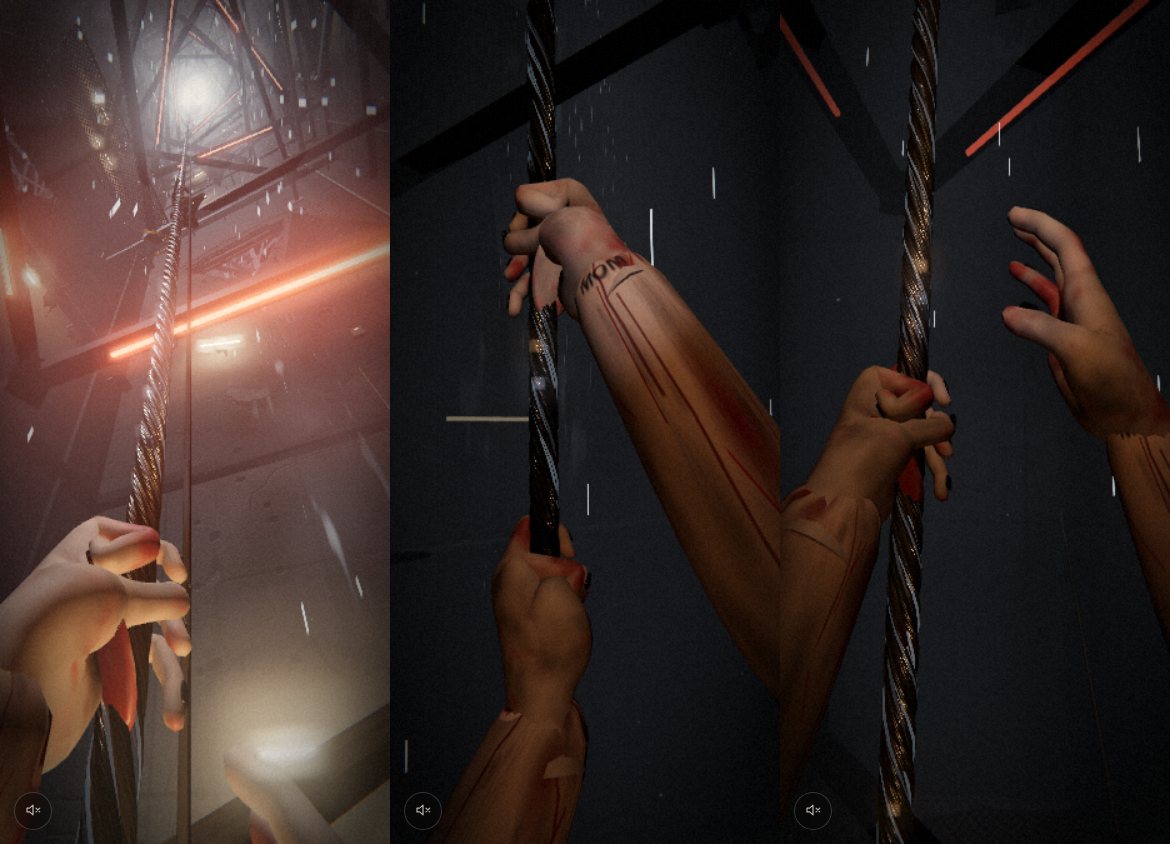
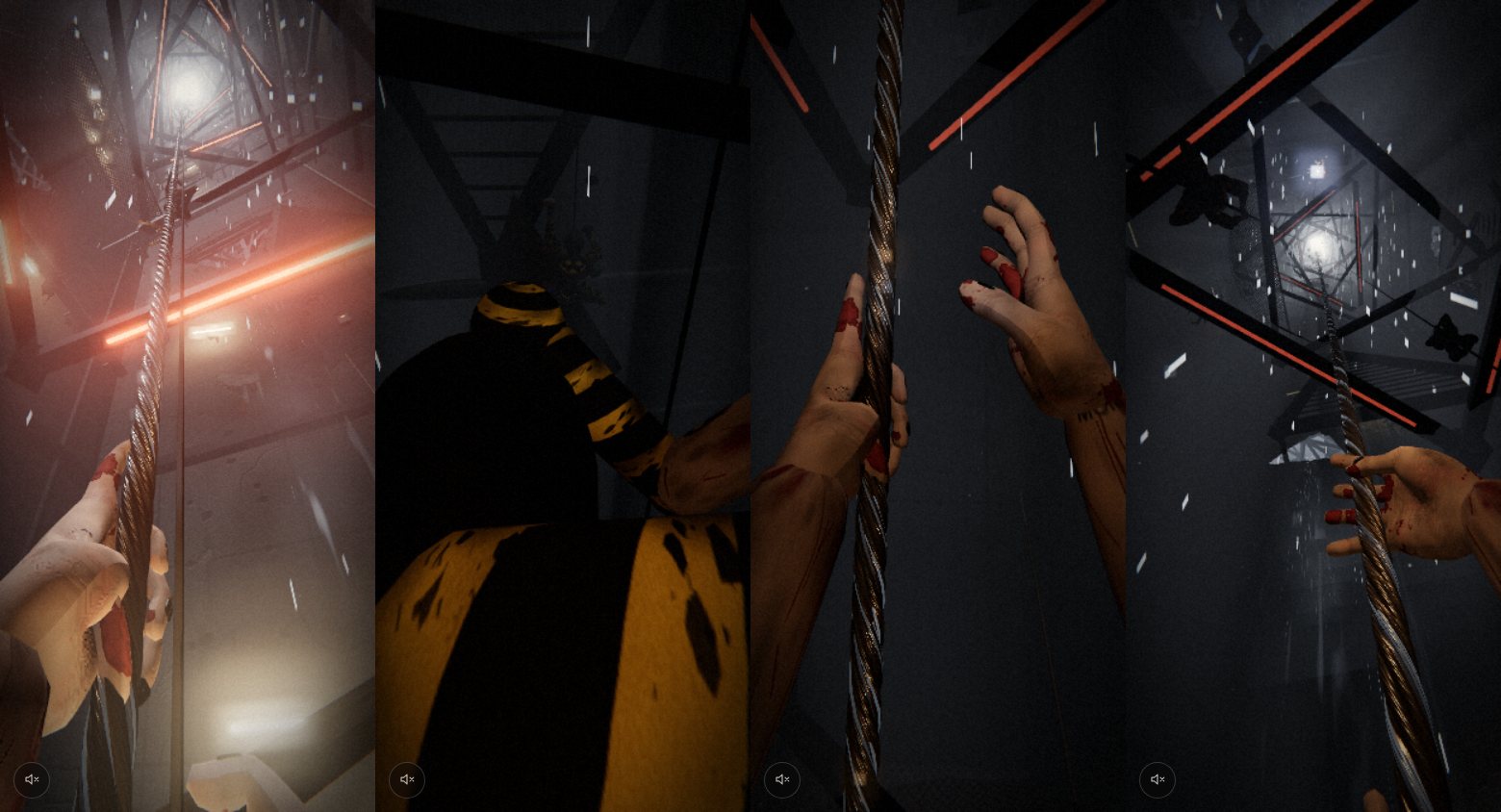
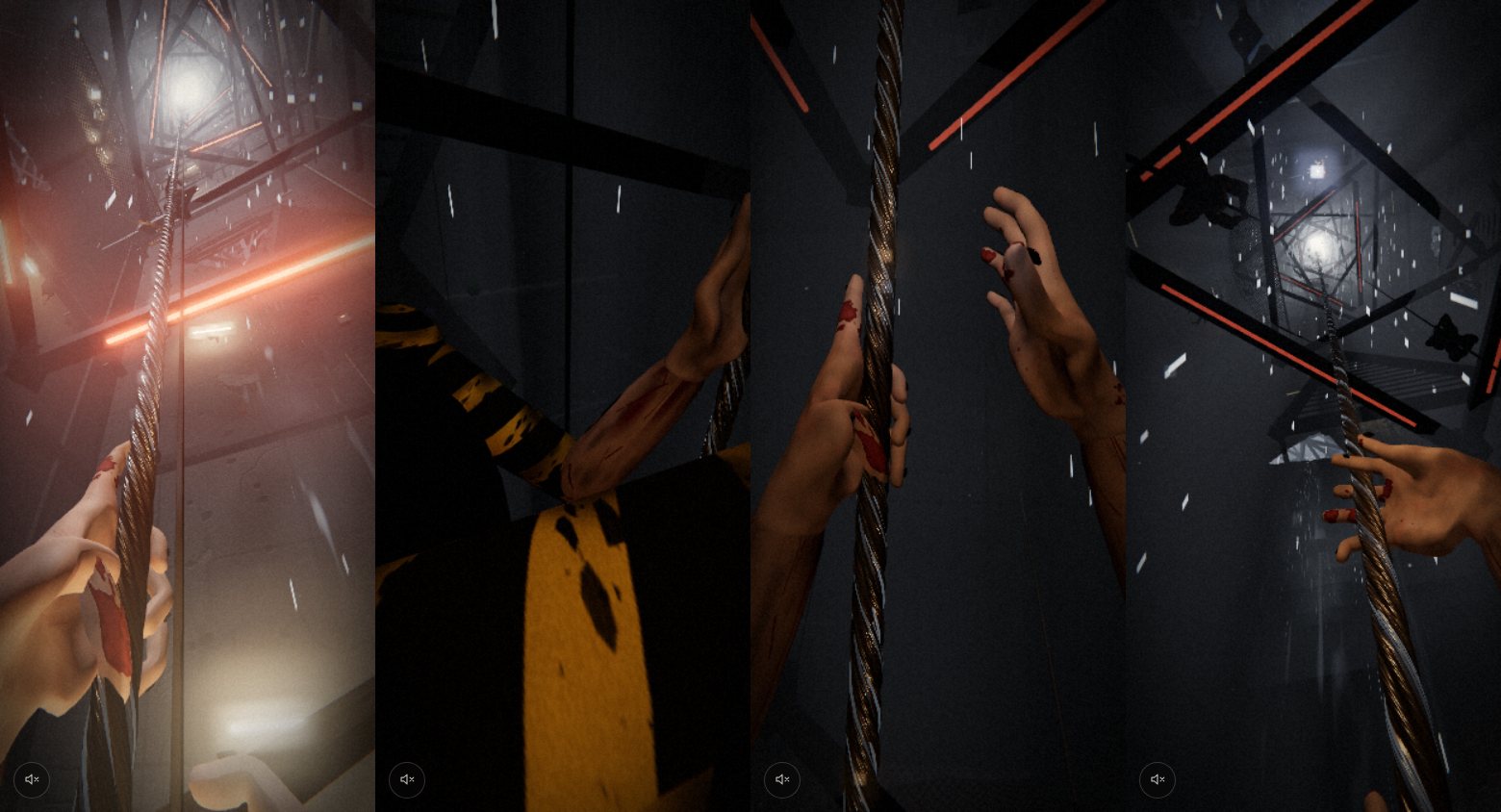
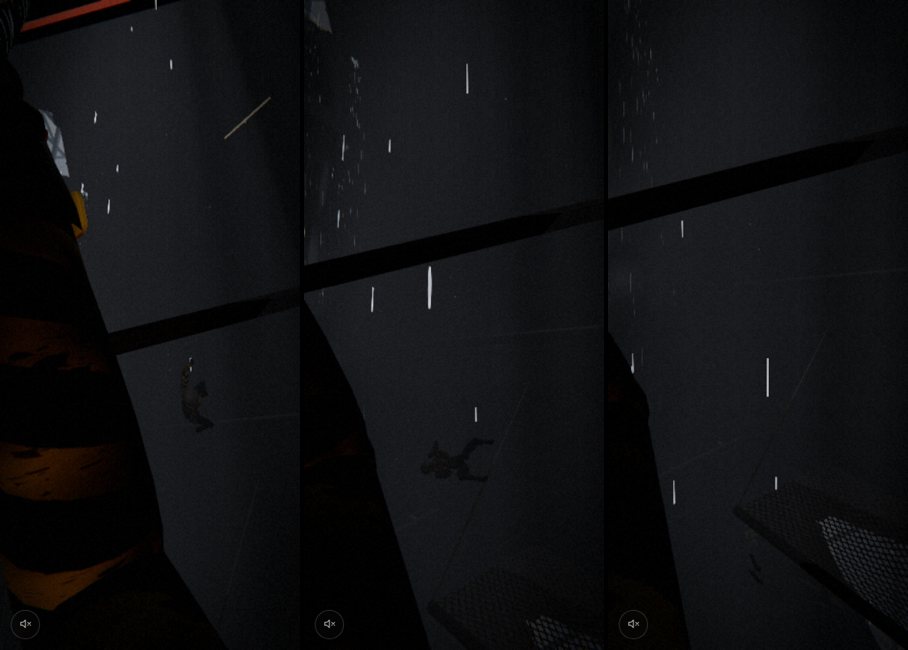
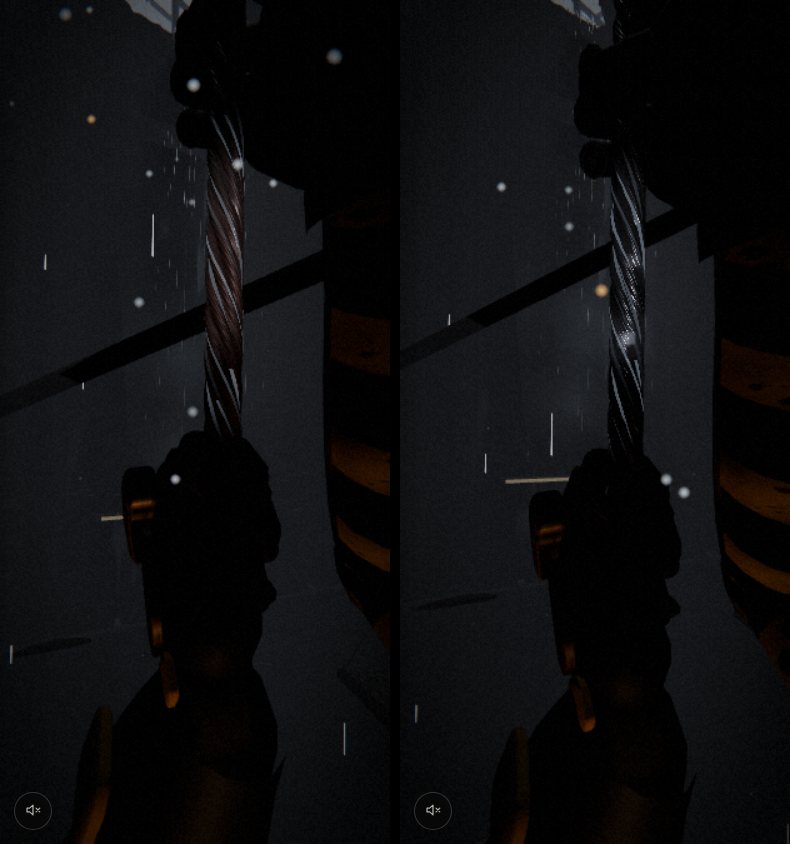
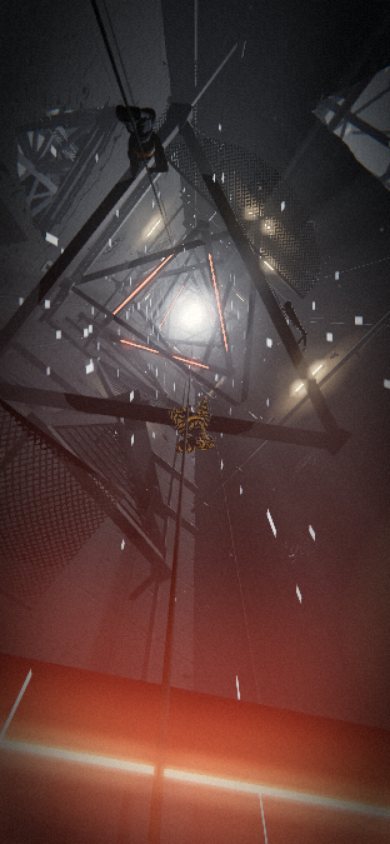
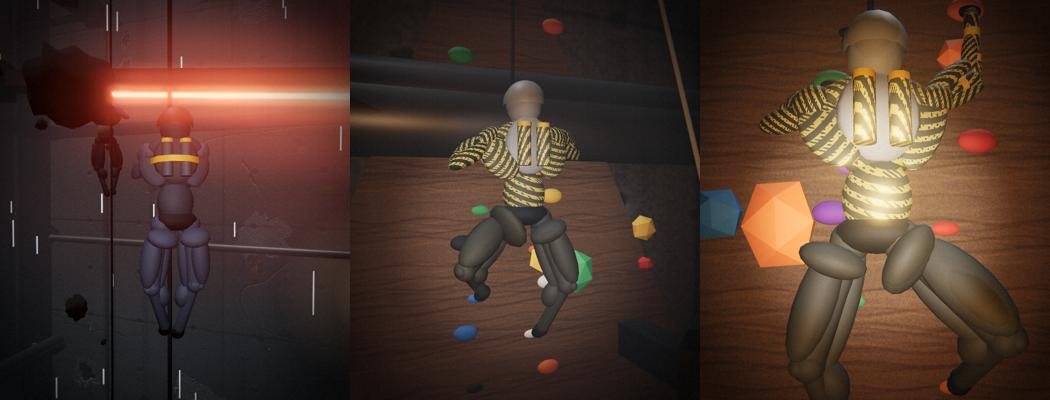
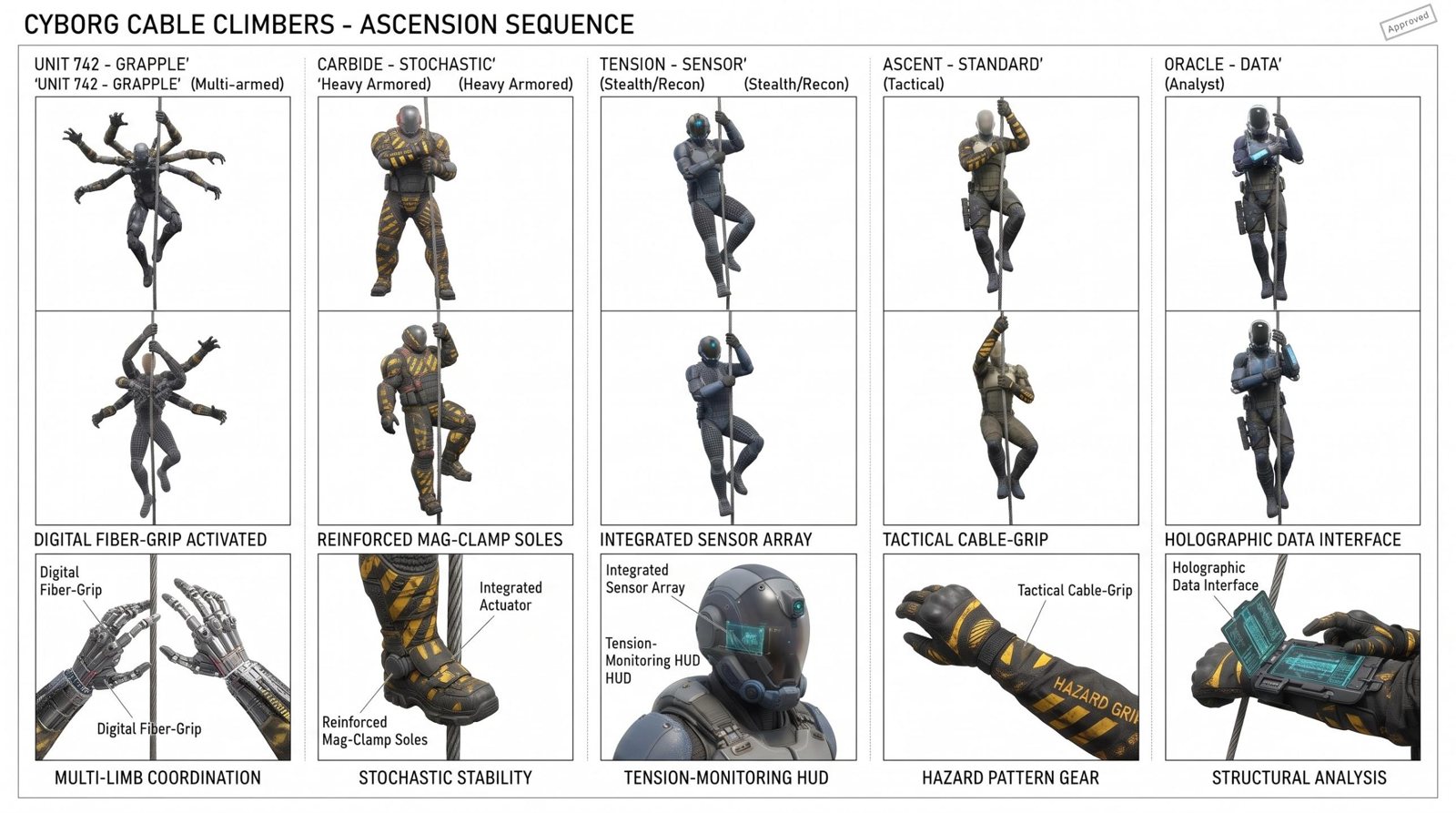
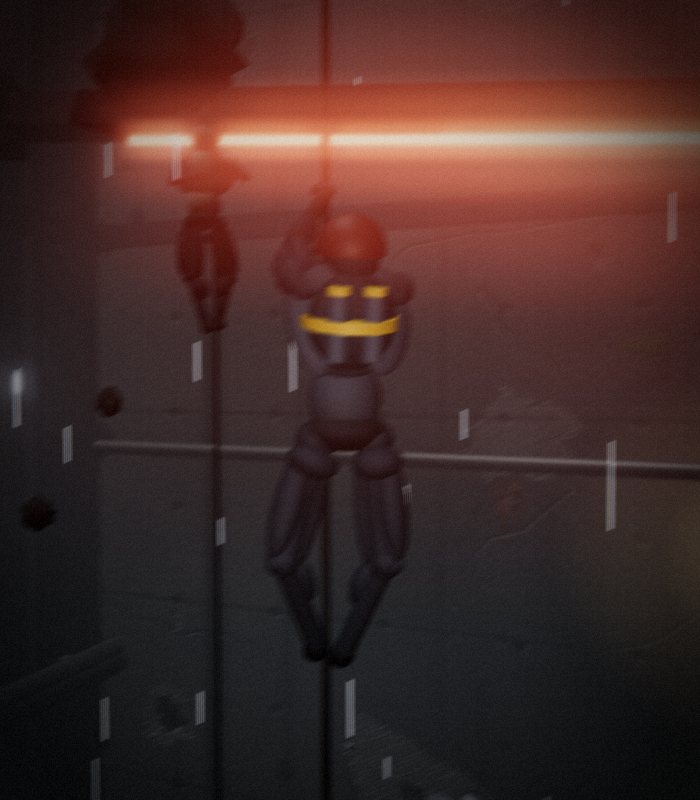
III.Thinking frames
Each frame is a problem the brief raised and the answer the piece gives to it.
Never stop
How does a place go on forever without repeating?
The shaft is built from six segment layouts, each of which can be turned to four headings. Segments are recycled from below to above as you climb, and the layout and heading of each are chosen by its height, so the same place is always the same place. A steel ring beam at every joint hides the seam. The timeline was jumped to the one-hour and ten-hour marks to confirm the world keeps building cleanly.
Always closer
How can you approach something you never reach?
By giving the climb real things to approach. Every 24 metres a red gate, a lamp-lined triangle, hangs across the shaft. It first shows as a red glint in the haze, grows into a beacon, and then you pass through it, and the next one is already glowing far above. Between gates, two lead climbers on ropes stay just above you. You close on them and they ease ahead, but the gap never shuts.
Climbing, not flying
Why does a smooth camera feel like an elevator?
Because climbers do not move at constant speed, or quickly. The ascent averages about 0.3 metres a second, a sustained rope-climbing pace, and pulses on a 1.7 second cycle: a pull, a surge, a settle. The view sways with alternating hands and rolls very slightly. The rhythm is computed exactly, not accumulated, so it never drifts.
Through the frames
How do you pass through the structure without hitting it?
The viewer's path is known in advance, so every red gate is fitted around it: sized, turned and tilted so your path threads it with at least two metres to spare, and so both lead climbers, bodies and all, pass inside it too. The big bracing triangles are sized so their openings always contain a protected climb column. Everything else is checked against that column and removed if it intrudes.
Bodies that climb
What makes a figure read as a climber at a glance?
A body that hangs, pushes and pulls. Every move has the same four beats: reach long from a lock-off, step a foot high while settling onto a straight arm, drive with the legs as the arm contracts, settle. Hanging on a straight arm puts the weight on the skeleton, not on a clenched muscle. The hips carry the rhythm: they shift over the supporting side, turn into the wall on a reach, lift on a high step, and swing out when the arms are straight. The skeleton has a spine that bends, a chest that counter-turns against the hips, shoulders that rise on an overhead reach, wrists, hands, ankles and feet.
Flesh over bone
How does a body show effort?
Every muscle runs from its origin to its insertion on the bones: biceps, triceps and deltoids, the forearm flexors, lats, traps and the long muscles of the spine, glutes, quadriceps, hamstrings and calves. When a joint shortens a muscle it thickens, because flesh keeps its volume, and a loaded muscle bulges further: a gripping forearm, a driving thigh. Tendons run taut to the wrist and heel, kneecaps and elbow points show, and the body is pushed out from the wall rather than let a hand pass through the chest.
Something falls
What pulls a viewer into a space?
The space acting on its own. Water drips steadily from the skylight, streaking in the haze and blooming into soft discs as it passes the lens. Every half-minute or so the shaft sheds: a trickle of grit, then concrete chunks, splintered timber and bent rebar, falling through the middle of the view and tumbling past you, while a plume of dust hangs high in the light.
Your own hands
How does a viewer stop watching a climb and start doing one?
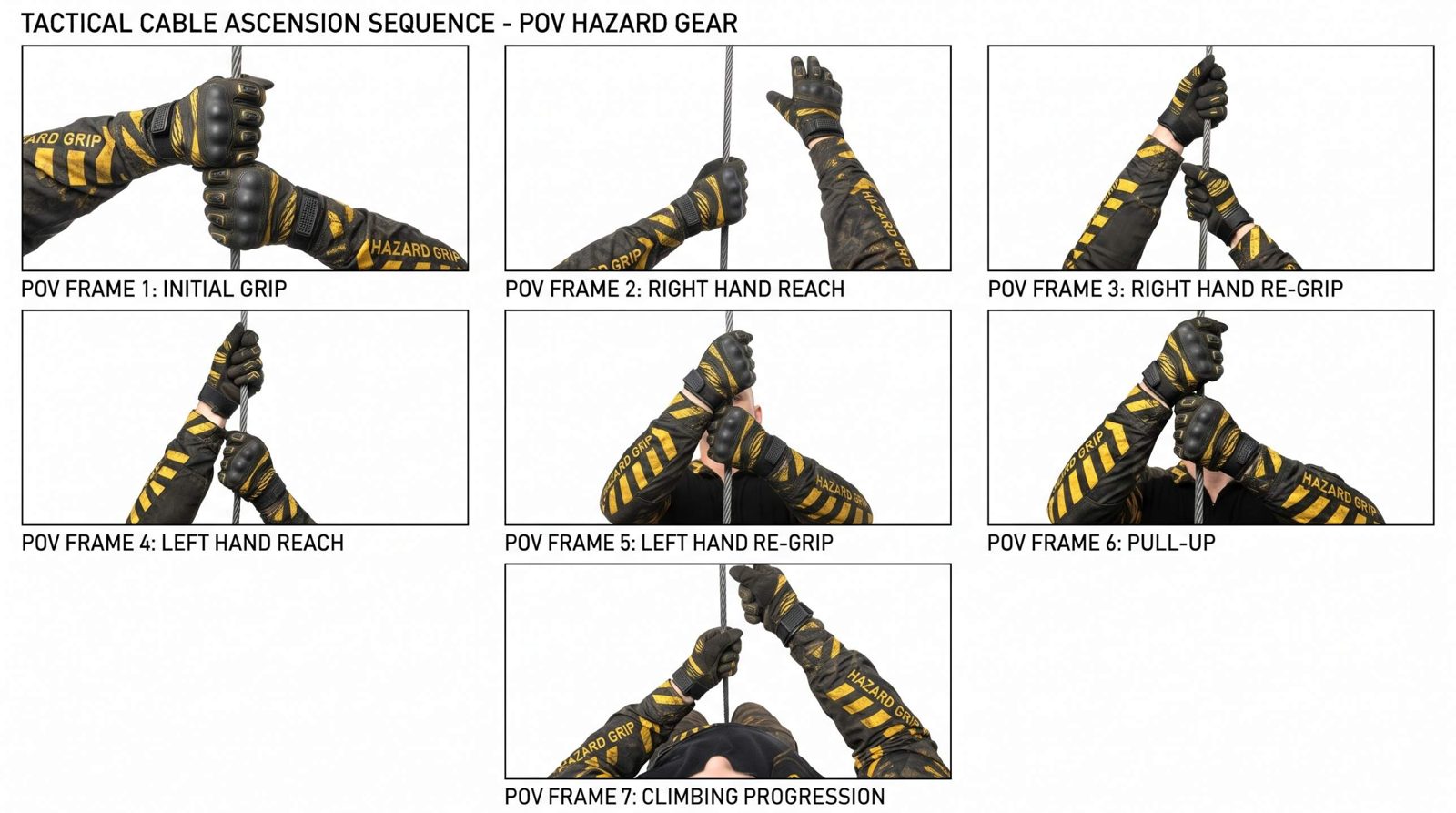
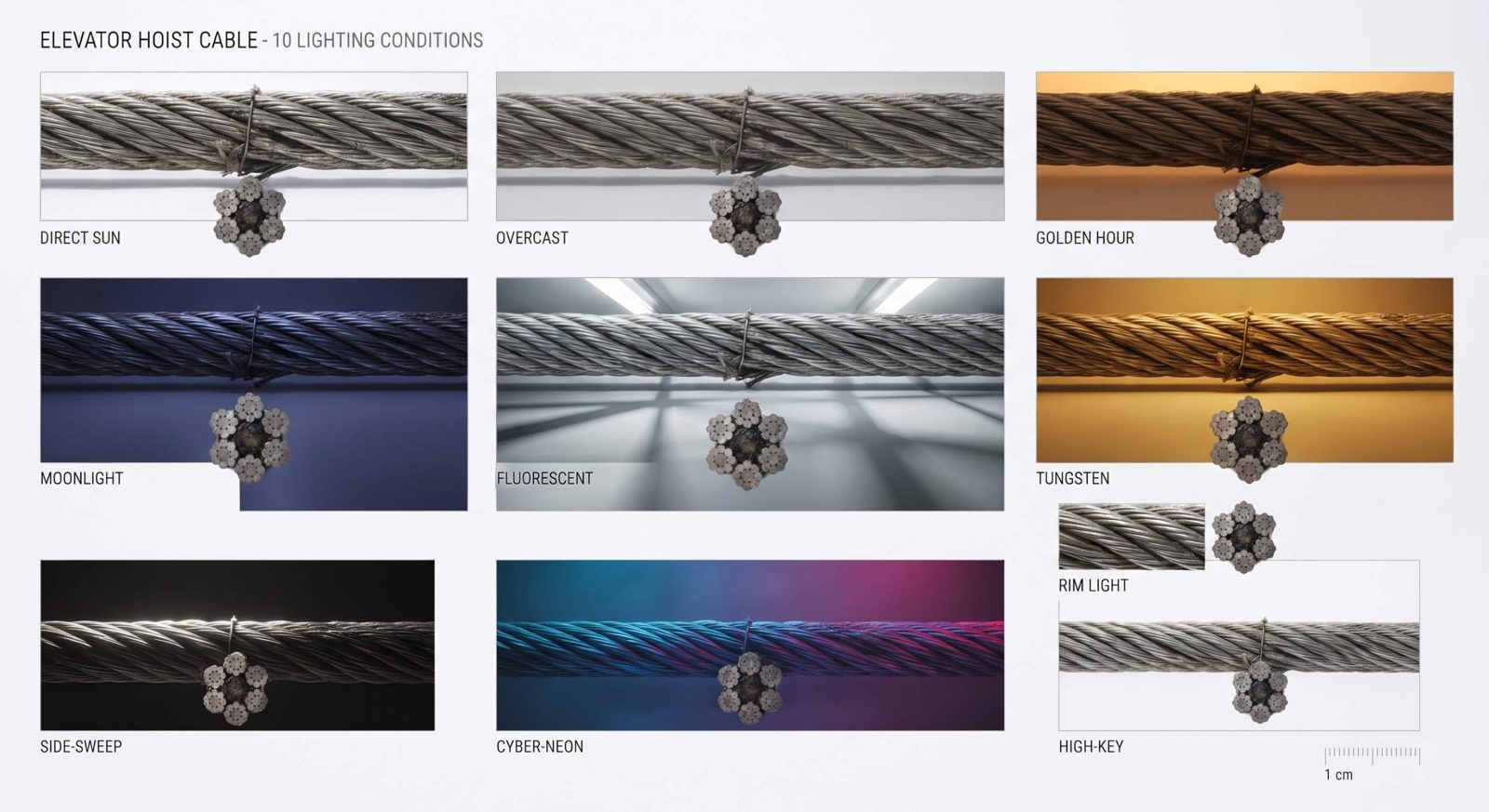
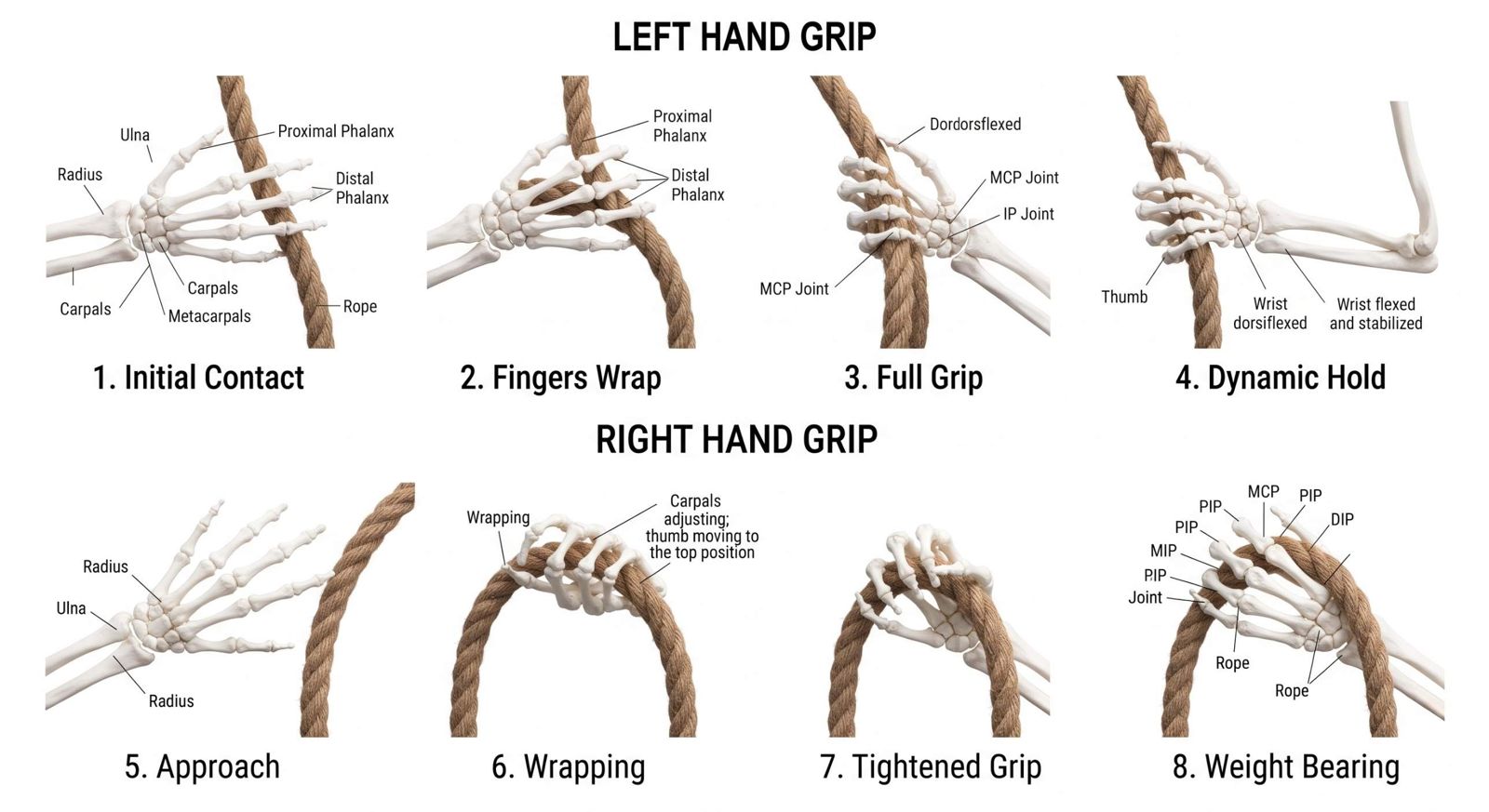
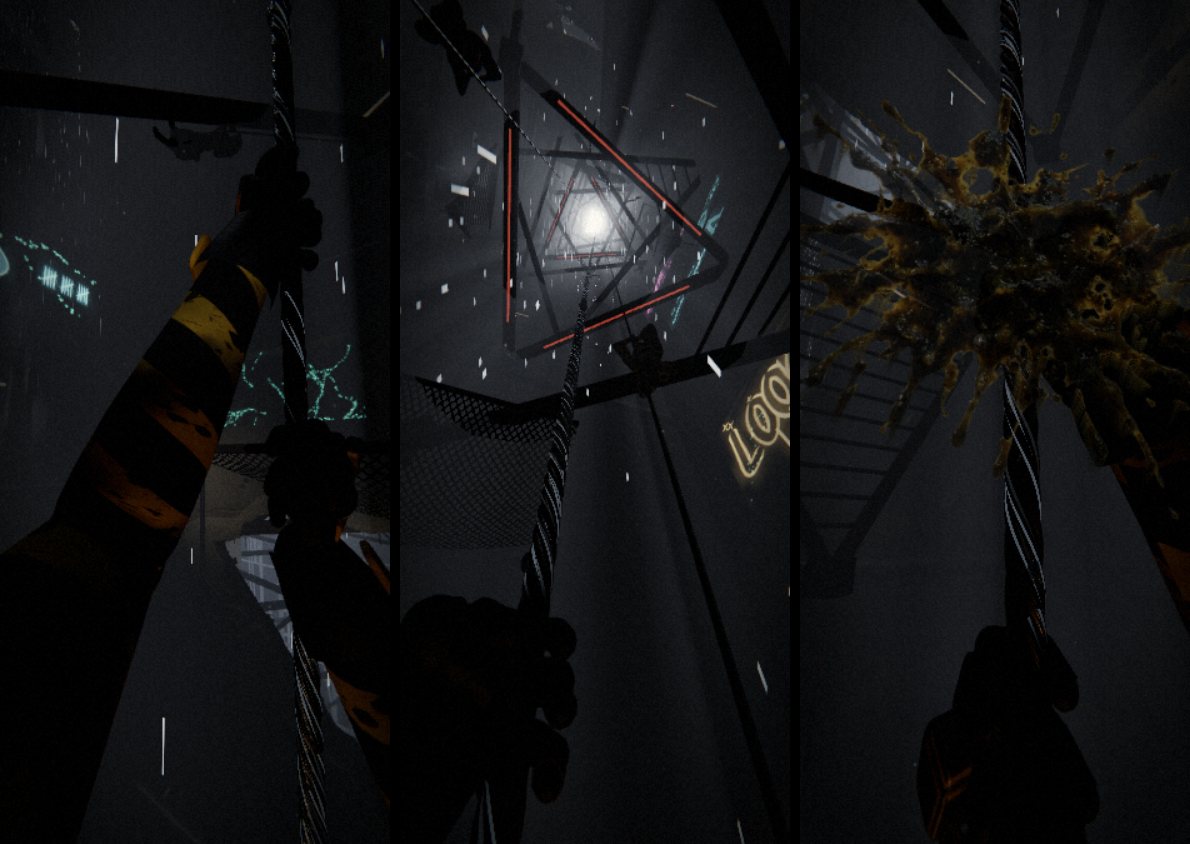
By giving them something to hold. A 22 mm hoist cable hangs a hand's width from the face, built along its own helix so the six strands are real shapes that catch the light, with fine wires in each. Its flaws sit at fixed heights and ride past as you climb: broken wires sprung out of the lay, rust and grease, water running down the grooves. Two gloved hands go up it, hand over hand, two grips to every pull of the camera, so the body and the view share one rhythm. A hand lets go knuckles first, reaches to near full extension, arrives hooked, and closes on the steel; it never passes through it. The elbows swing wide, so the arms come in from the corners of the frame and never cross the eye.
The thing in the hole
How do you make someone feel they are really there?
Use the way they see. Something pale runs across the wall and down a burrow. Motion at the edge of vision wins a reflex: about a fifth of a second later the eyes jump to it, and while they jump the world smears and dims, as it really does. Then the gaze locks on and follows, the field of view narrows the way attention does, and the climb stops dead. The headlamp beam swings with the head and lands on the wall, lighting the critter and the broken lip of the hole. A beat on the empty hole, then the climb resumes. Everywhere else, sight is given cues to work with: things that only show when they move, hanging cables that slide past faster than the walls behind them, detail that thickens as you get closer, haze that thins it as you look away.
Crunch
What makes a broken edge look real?
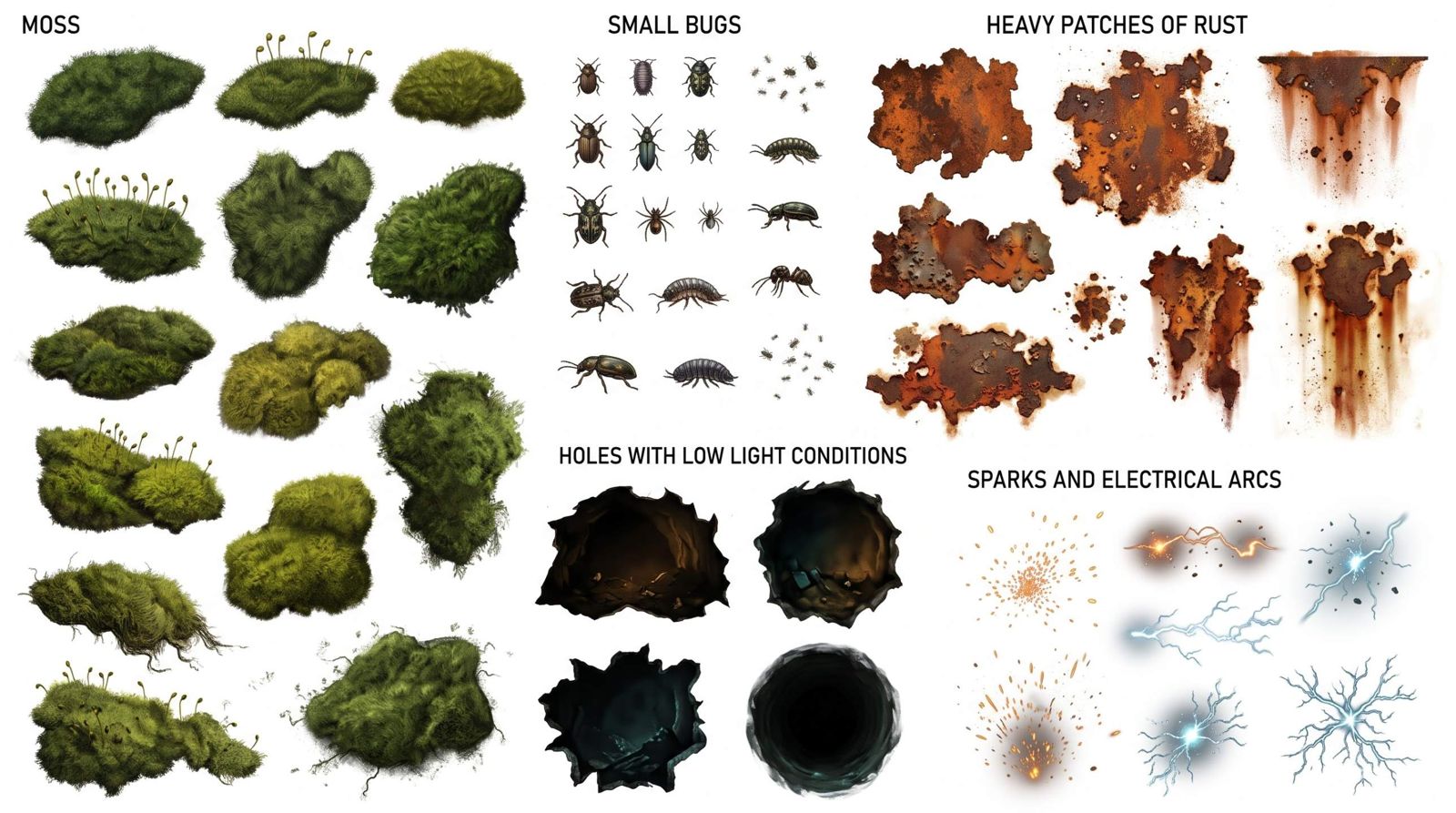
Many small faces, each turned a slightly different way, so each catches the light differently. Every broken lip is crusted with angular fragments, rubble sits on the ledges inside, and a stronger relief runs through the cast face. Light comes from several directions at once: warm wall lamps, a cold LED headlamp, the sky from above, and the blue flicker of arcing cable ends, so the same edge shows a lit side and a shadow side. Rust bleeds from everything bolted on and from the bar in the deep breaks; moss grows where the water sits. Some holes go on into darkness.
Looking down
What makes a fall feel possible?
Seeing what holds you, and what does not. The climber now has a body: chest and belly, bent knees, boots pinching the cable between them, standing up through each surge and re-clamping higher in the slow part of the pull. Every so often, in a hold, the climber hangs back on straight arms and looks down: past the glove on the steel, along the cable, between the knees and boots, into the drop. The shaft below is built now too, two segments of it, going dark. The view stretches a little, a slow dolly-zoom, the oldest trick for vertigo. The body swings on the cable. Sometimes a boot slips on the wet steel: a drop, a grab, the gloves clench, a held breath. And when debris comes down close, the climber looks up at it, flinches into the cable as it passes a body's width away, then turns to follow it down past their own feet, watching it fall into the dark, holding there a beat. It was a close one.
What lives in the walls
How do you make a swarm feel close on a phone?
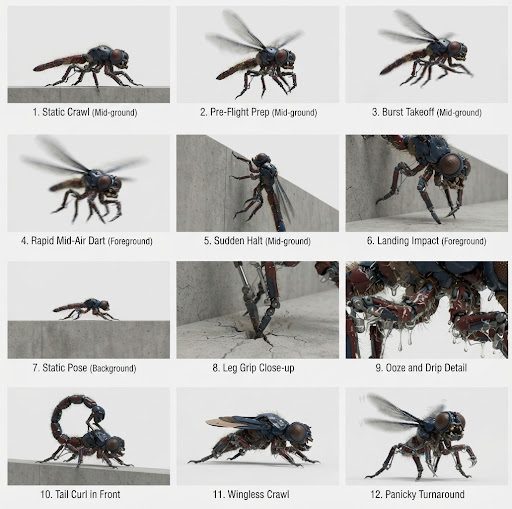
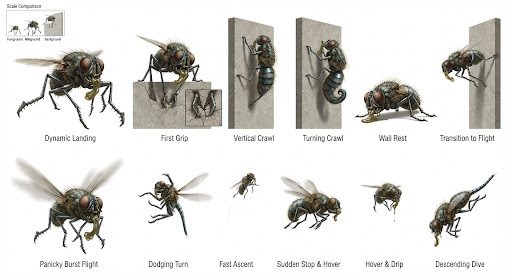
Give it individuals first. A dozen of the creatures live in the shaft at any time, each sitting on a lip or a crack near you: they rest, crawl a little, crouch, burst off, dart close to your face, stop dead and hover, then land somewhere else and grip. Some carry a scorpion's tail curled over their back. Then, every few minutes, the swarm. There is no sound, so it starts as a glint far up the shaft; the head snaps up to it; the mass comes down the column at you. A short tuck into the cable, then the head comes out to watch one whip past the face, then turns to follow them down along the cable, past your own boots, into the dark. Cables they brush against spark. A few peel off and land on the walls near you, and leave later. The climbers below you flinch from them the way they flinch from stone.
Match the creature, not the idea of it
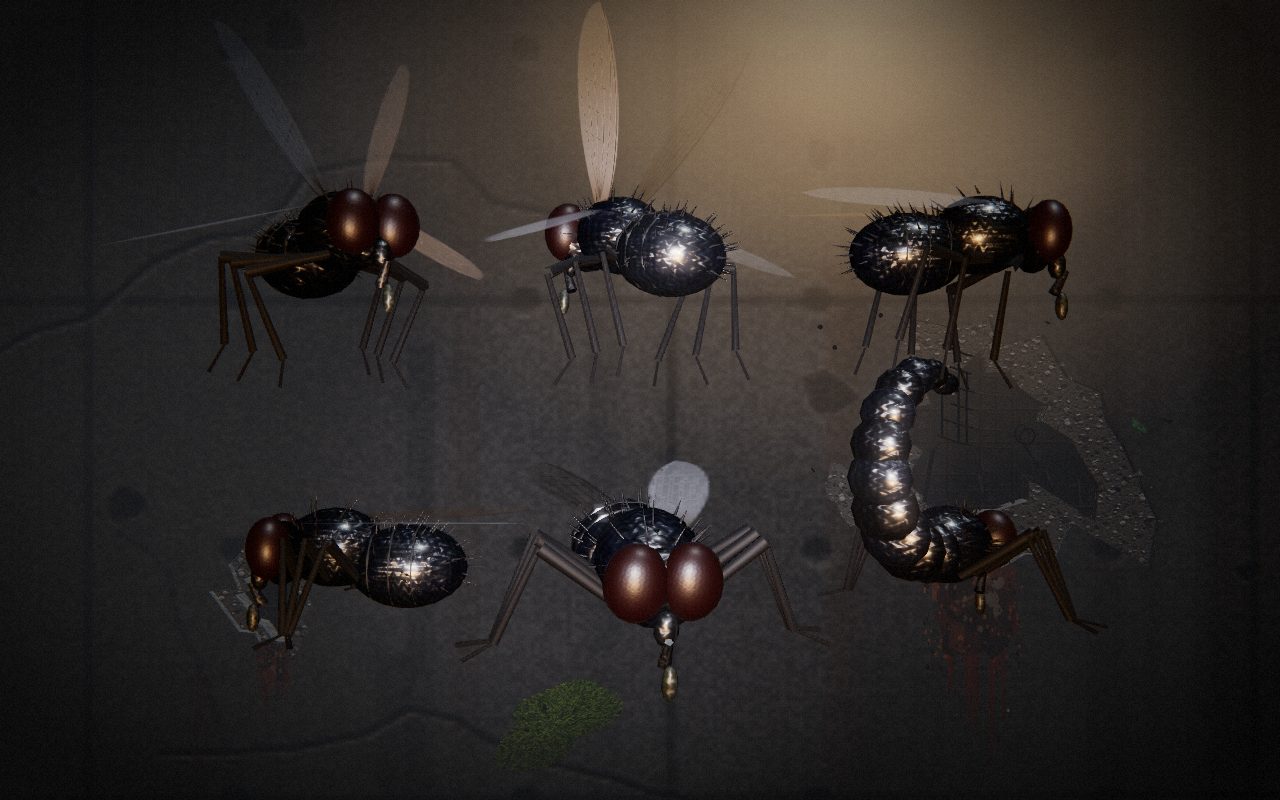
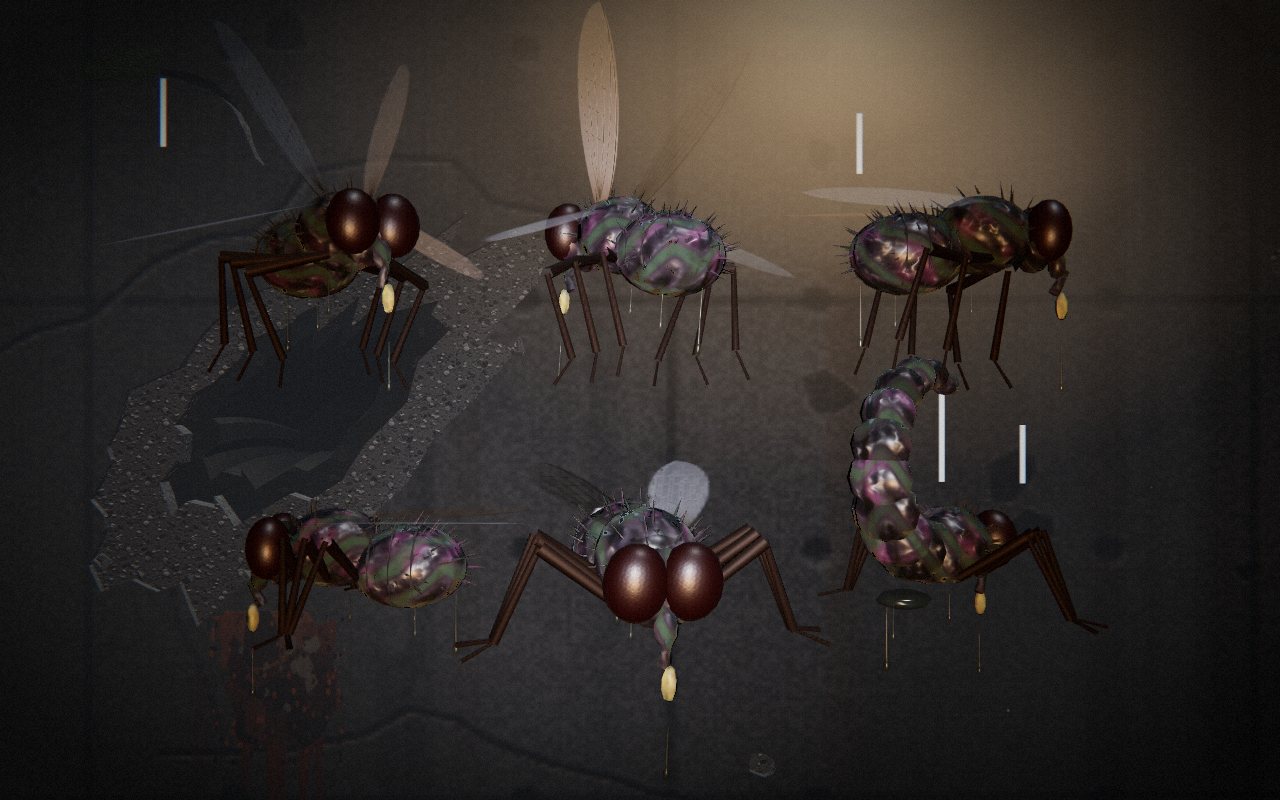
Why did the first creature read as a mosquito?
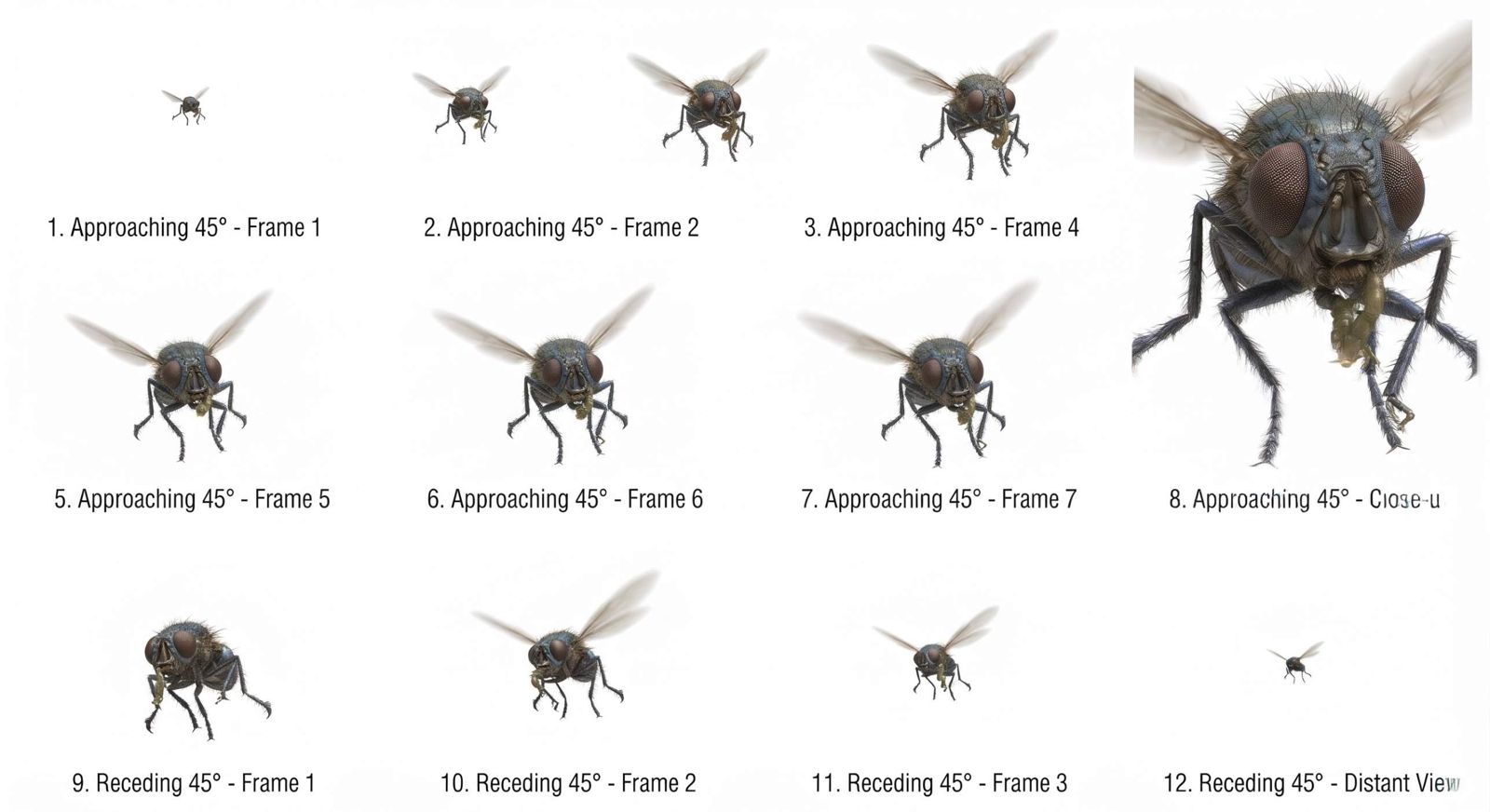
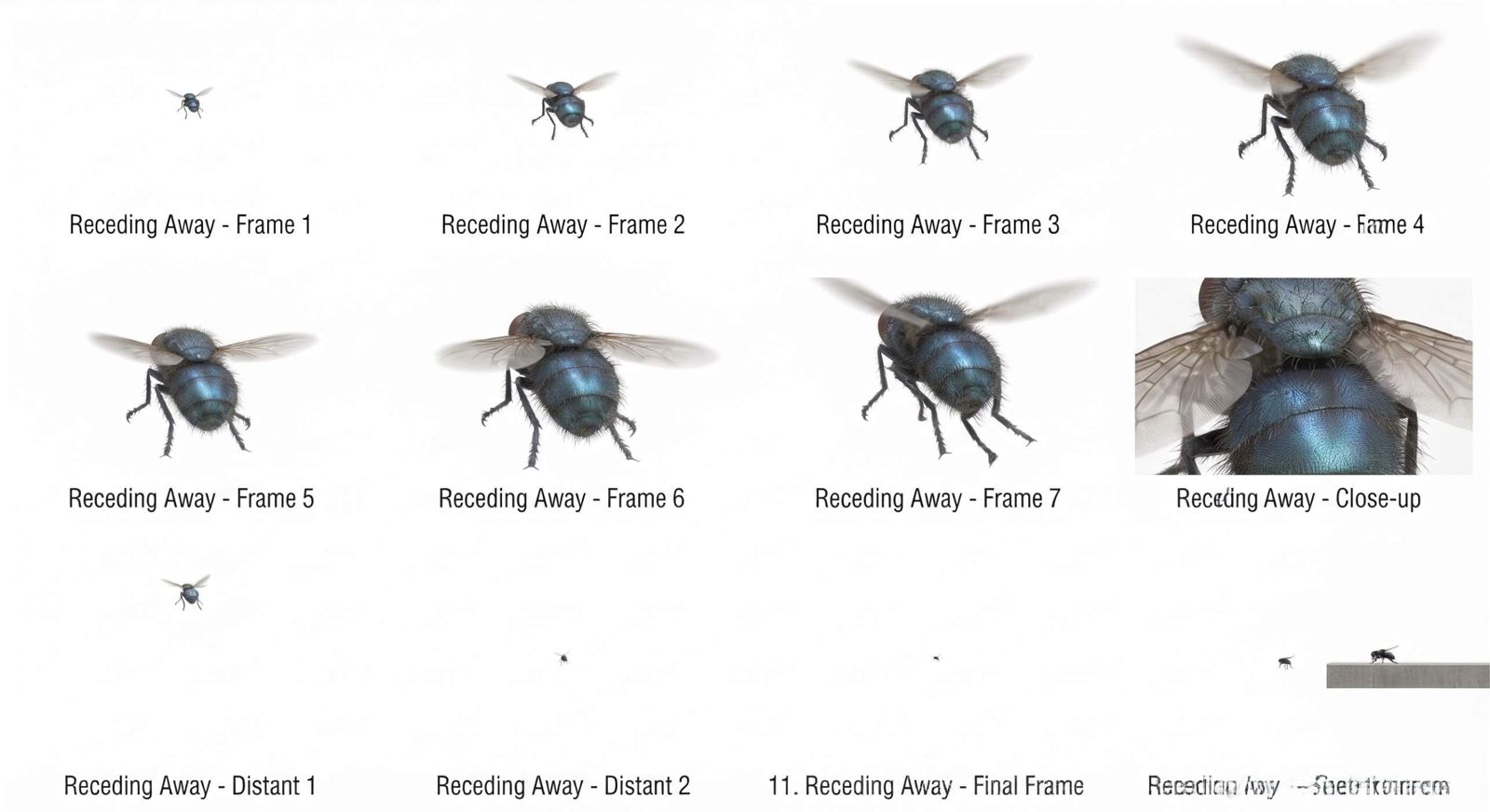
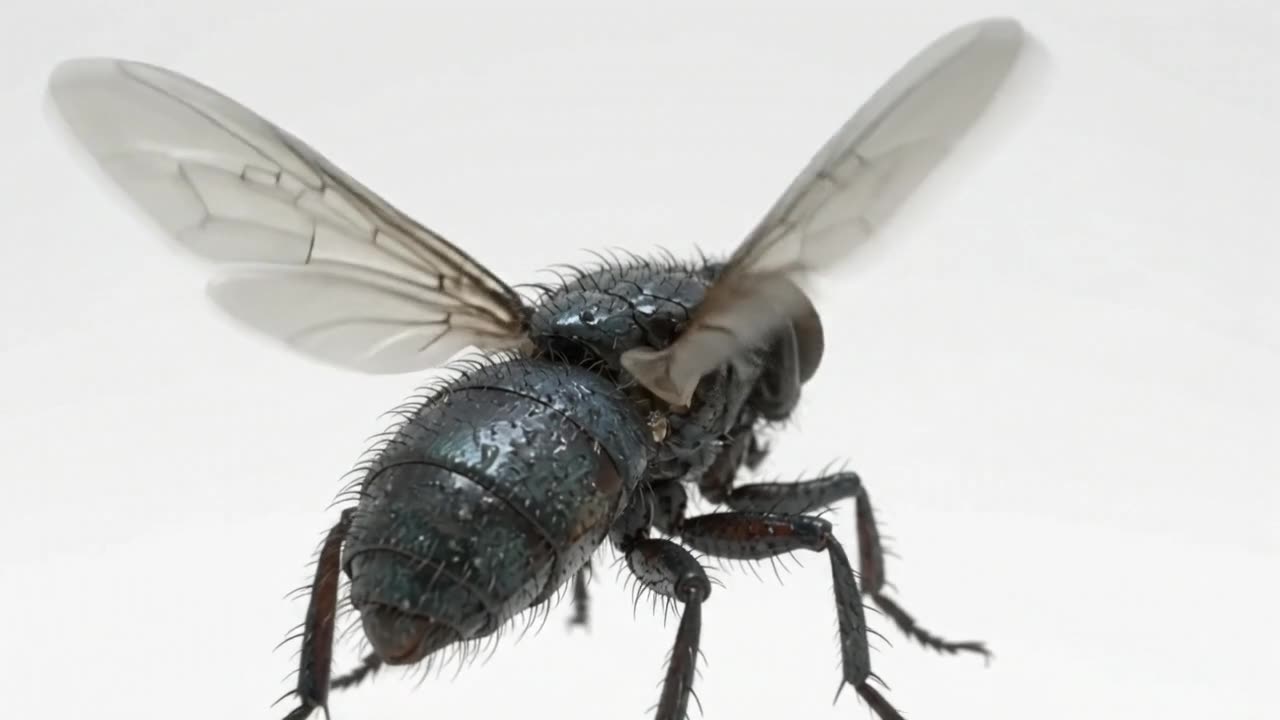
Because it was built from a description of the sheets, not from the sheets. Long segmented abdomen, thin plated body, red and cream bands: an idea of a biomechanical insect. The references show one specific animal, a blow fly, and every one of its signature shapes was missing. So the second build started from silhouette, the thing a phone screen actually shows: a head that is almost all eye, a broad bristly thorax, a short egg of an abdomen, legs that hang. Then surface: blue-black and wet, with a fine beaded texture, bristles standing off the body, dark faceted eyes rather than glowing ones, clear smoky wings with dark veins, folded back in a V at rest. Then the one grim detail all the sheets share: something pale hanging from the mouth.
No dead direction
Where is there nothing to look at?
Before this pass: the walls, square on. Up had the frames and the skylight, down had the drop, but the walls were a surface. Now most walls are broken right through around a triangular steel frame that was cast into them, and beyond is a structure with no end: a braced space frame of rusted steel, red and blue towers crossing as in the sketch, pale columns running straight up and down through everything, catwalks, ladders, bulbs on wires, sparks falling somewhere far off, all thinning into cold haze. It is built for one 40 metre storey and repeated, and it moves by whole storeys as you climb, so you can never reach its top or bottom. Every few minutes the head turns to look out through the nearest hole and drifts deeper into it while the hands hold.
The break itself is the crunch. A front lip in big bites a metre apart; the second layer stepping in; then the full thickness of the wall, about 70 to 90 cm, in faceted fracture that darkens as it goes in; rebar snapped off and bent into the void; clusters of broken pieces still hanging on the lip; rubble on every ledge that faces up. In places the concrete still hangs over the frame; elsewhere it has fallen away past it.
One frame ruins it
What breaks the body first?
Not the big moments; the one or two frames where the body stops being solid. Pass 18 measured every frame of eight look-downs and thirty seconds of climbing for the distance from the eye to each arm and hand. The worst cause was not a collision at all: to keep forearms out of the face, the elbows had been told to swing outward whenever an arm came close, so when the head turned they winged out until the forearm lay flat across the view. Now a pulling arm hangs its elbow under the hand, the elbow drops before it ever opens out, and the head is the thing that gives way: it moves away from any arm that comes within a cheek's width, sideways when looking, at once, and comes back slowly. Looking down, the head goes forward over the chest and out to the side away from the lower forearm, so the legs pinching the cable and the drop are what fill the frame. The thumb is solved last, after the wrist turns: it wraps round the near face of the cable and rises along it, the pad on the steel, and it can no longer bend back or pass through the index finger.
Alive, not machined
What makes a creature gross rather than mechanical?
Pigment, not polish. The hide has no metal in it: matte, wrinkled, near black with purple and bottle green in the skin itself, wet only in patches, beaded. The machine lives in the legs, rusted and oiled. Strings of dark goo hang and stretch as they move. During the swarm one of them comes straight at your face and bursts on the visor; you flinch and the rain runs it off in streaks over the next several seconds.
Shrapnel
What is inside a wall that has been blown open?
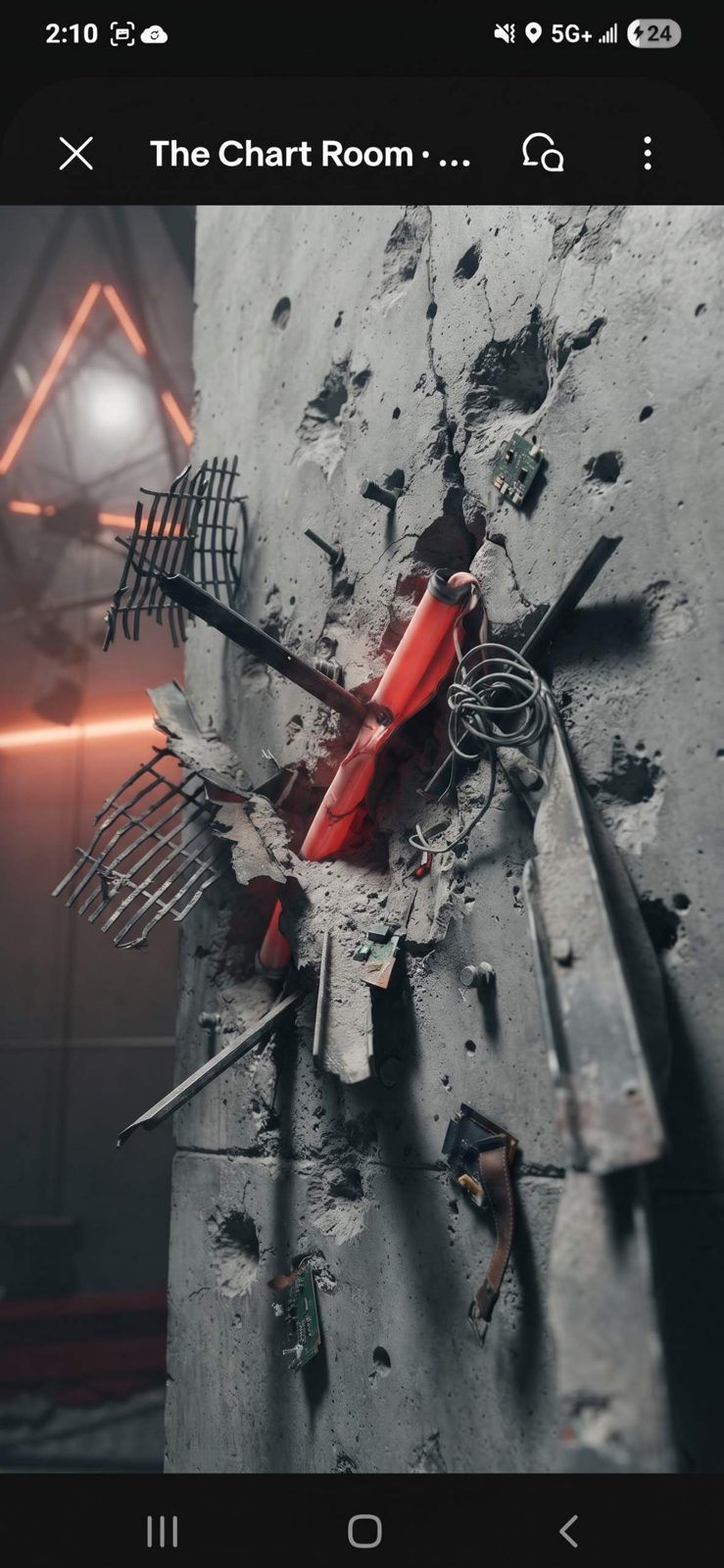
Everything that was built into it. In the larger breaches the mesh is peeled back out of the concrete, a red pipe is torn off and bent into the shaft, a coil of wire spills out, a steel strap is bent away from its bolts, and circuit boards are still embedded in the fracture. The aggregate in the broken faces is angular stone at its real size, so the scale of the break reads.
Flinch
What does a climber do when the shaft sheds?
What anyone would. Every climber senses debris by how close it is and how far above, fears it fast and lets go of the fear slowly. They freeze on their holds, press in to the wall or the rope, slide away from the line it is falling down, shrug, duck the head, tuck the elbows and turn the helmet up into it. The lead climbers lose ground while they wait, then climb on a little faster to win the gap back.
The wall is failing
What makes concrete look unsafe?
Edges. Each wall is now a cast skin over a broken core, not a painted plane. The skin is pierced by spalls, pop-outs and cracks with crisp, lit lips. Inside the shallow breaks a second layer shows pale, fresh fracture; where the damage is deep, that gives way too, down to a dark wet core and a rusted 200 mm bar mesh, some bars snapped and sprung out into the shaft. Here and there a slab hangs off its hinge, bottom edge already in the air. The corners of the shaft are chipped back. None of it goes near anything bolted to the wall.
Rhythm by terrain
Why should a ladder feel different from a cliff?
Because the terrain sets the tempo. Ladders run on an even, metronomic beat with rung-sized moves. Vertical panels are slower and irregular, with deeper hip turns. Overhangs keep the arms straighter, move in shorter, slower steps, and hold the hips further out. Nets are quicker and looser. Beam traverses are slow. On the lead ropes it is a different technique altogether: clamp the rope between the feet, stand, reach hand over hand to full extension, then pike the knees up on straight arms.
Is it coming for us?
How do you make something far away frightening?
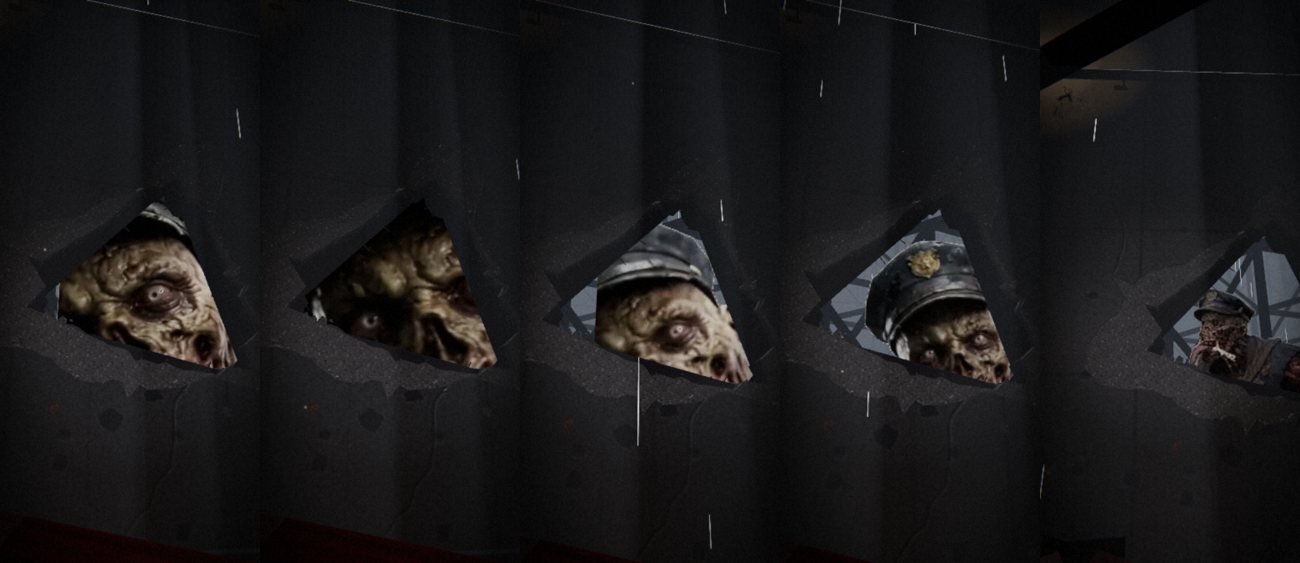
Never let it commit. The giant first shows a hundred and twenty metres out, a dark shape in the haze that the fog takes less than it takes the steel. He clambers through the frame toward the shaft in legs of a few dozen metres, then stops and watches it, drifts sideways, backs off, comes on again. He keeps mostly to where a break at your height would show him, and you keep looking back at him through it, more often the closer he gets. Only at the end does he pick a break and come straight for it.
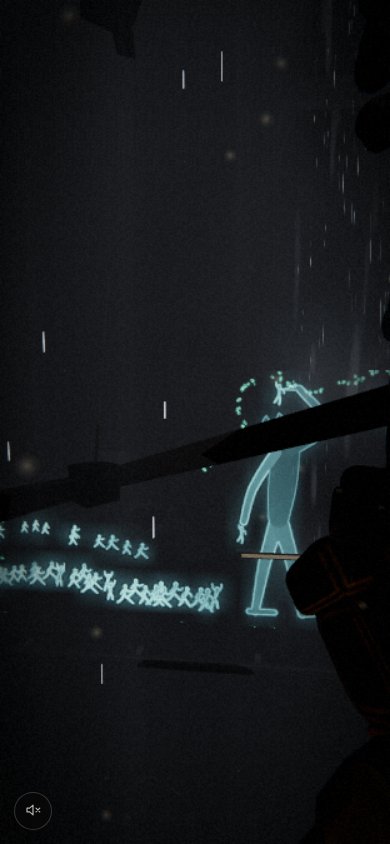
Then he leans his face into the hole. He puts the other hand on the wall beside it, reaches an arm through, and the lip comes away in chunks. The arm draws out longer than an arm should. Then his face fills the hole: your video of him leaning in, cut out and played behind the break, slid frame by frame so his eye stays in it while your view narrows on him. The lip comes away in chunks. He takes the climber on the rope above you, or whoever is on the wall nearest the break, pulls them out kicking, and goes. A few minutes later he comes back. By then someone else is on the rope above you.
Out of my own way
What happens to your arms when you turn to look?
They get between you and what you are looking at. When the head turns hard, a sleeve or glove right against the eye now dissolves through a fine screen and is gone. It only does this while you are looking, and only for the parts closest to your face, so in the climb the arms stay solid. Withdrawn in Pass 20. On your phone the screen read as a wire mesh in your own body. The body is solid again.
When the power goes
What is left to see in the dark?
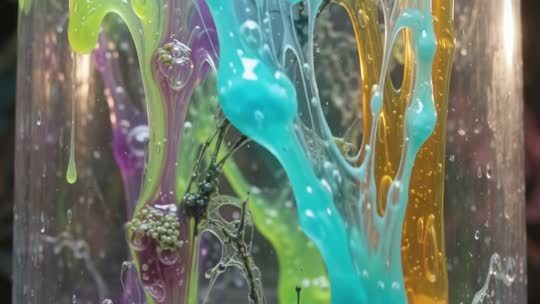
Every two or three minutes the lamps stutter and go. For half a minute or so the shaft is lit only by what does not need the power: the sky far up, faint; lightning flaring through the breaks; the slime in the concrete; and the small lamps on the other climbers' helmets, each lighting a patch of wall around them. Your own lamp is weak. Then the lamps stutter back. The slime and the climbers' lamps light the concrete through the wall and steel shaders themselves, as up to eight soft points, so the dark costs nothing extra to draw.
Wet
Where does the rain go once it is inside?
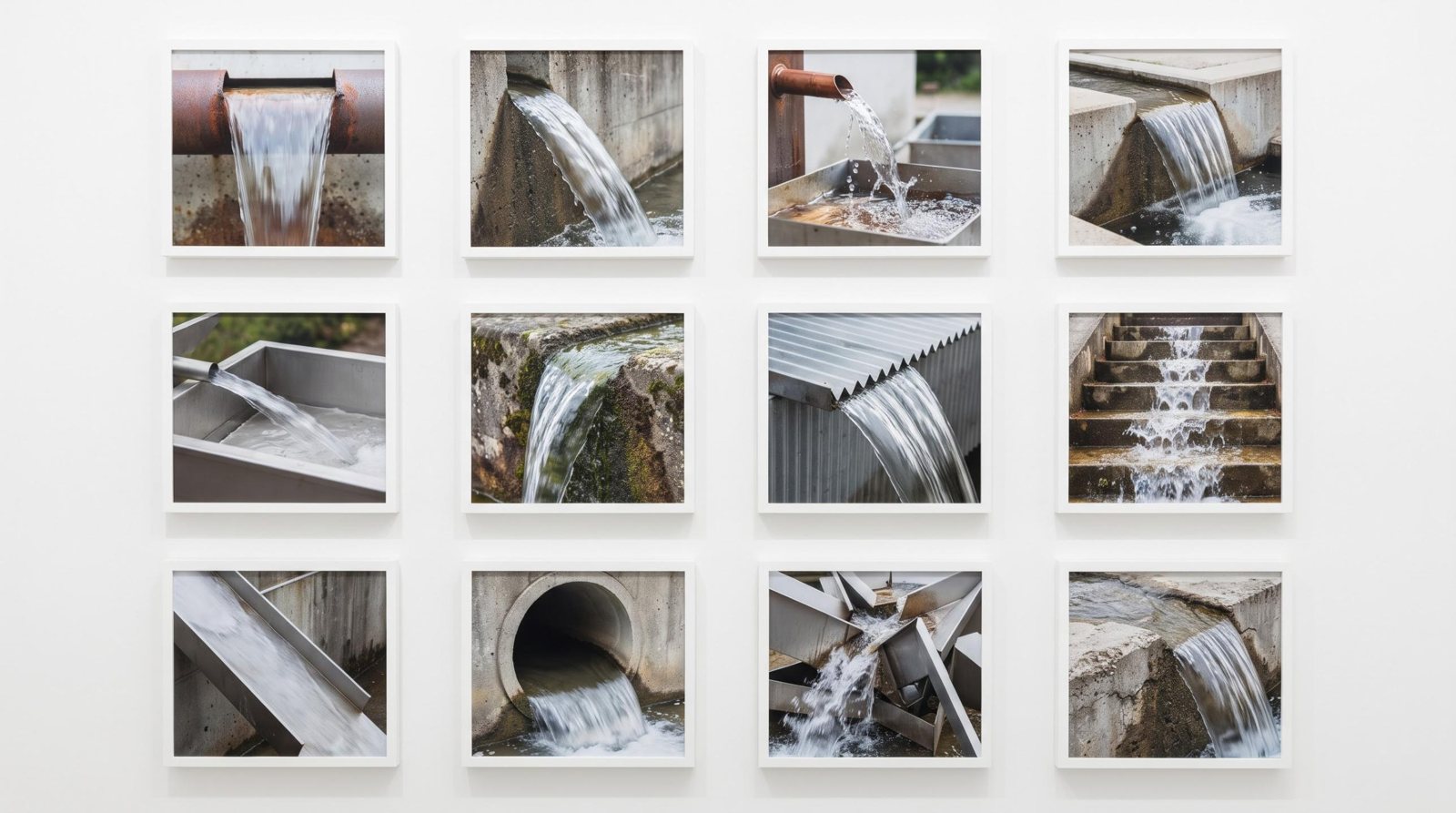
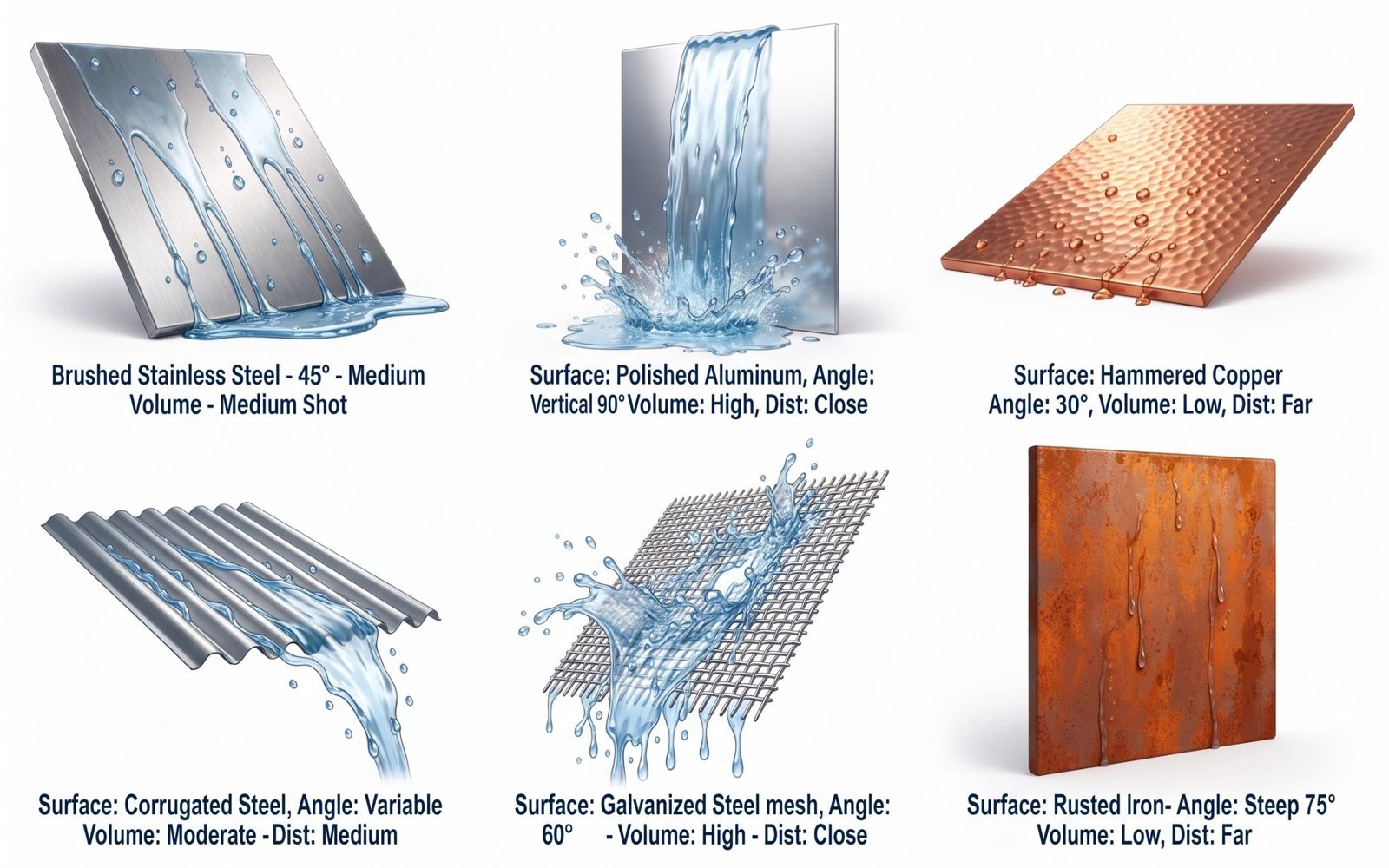
Over the lips of the breaks. Most breaks pour: a smooth clear tongue at the edge, thrown a little out into the shaft, breaking into white streaks as it falls speeding up, streaking and tearing apart as it falls, until by the bottom it is spray and drifting mist. Below them thin clear runs go down the wall. The cable is wet along its length: darker, glossy, water sliding down the grooves between the strands, with more beads on it that catch the light.
Things in the way
What makes falling debris feel heavy?
That it hits things. A piece falls on its true path until it meets a beam of one of the red triangles or a climber; then it is knocked off sideways, spinning harder, and falls on. A climber struck by it flinches. Your own grip fails too, now and then: the hand goes, you slide half a metre or more down the wet cable, the catch stops you with a jerk and a spring, and both fists clamp down hard before you climb the height back.
He eats
How do you keep a slow thing frightening?
Give it a purpose you can see. Every few minutes he walks to a far shaft standing in the haze, out beyond the break you are about to climb past, and waits. When you look, he reaches into it, draws something small out, brings it to his mouth and tips his head back to the sky. He is cut at the neck, shoulder and elbow from your standing frame so that arm and head can move. Between meals he paces instead of standing still.
Size is a distance
What tells you something is huge and far away?
Not detail. If a figure shows more detail than its real size and distance allow, the eye reads it as small and near. So the air does its work on him. His frames are made small and soft before they reach the screen. His colour drains first, then his contrast, and he goes a shade darker than the haze behind him. Only the rain sheeting past catches his edge, broken and faint. He walks at a pace set by his height (about 3.5 m/s for a 24 m body), slow to start and slow to turn, and his stride frames advance with the ground he covers. He keeps 46 to 72 metres out, beyond the lattice, often half behind it. He walks to stand beyond the break you are about to climb past, and when you reach it you look out and he is there. Lightning far behind him lights the haze, and he becomes a dark shape against it.
Use the art
When is building it the wrong move?
When the reference already exists and the build cannot reach it. Your giant is a finished, detailed character; a body of spheres and tubes made in a browser will never look like him. His sheets and your video are on white, so they cut out cleanly, and a cut-out stood in fog and framed by a broken wall is all the eye gets at that distance anyway. He is now your images, not my idea of them.
The bar
What does studio quality mean in a browser?
About 130 About 185 About 237 About 250 About 265 About 265, and about 280 while the giant is in view, draw calls a frame, post-processing included, now with the viewer's cable and hands, the creatures (all fifty-two of them drawn in five instanced calls) and the world outside the walls (about a dozen instanced calls). Triangles rose to about 900,000 a frame, which is the number to watch on older phones. Geometry is merged per segment, the climbers are instanced and reuse their working vectors every frame. Resolution adapts to the display's own refresh rate, and antialiasing uses MSAA where it is affordable and FXAA where it is not. The piece recovers if the browser drops the graphics context, honours reduced motion, and can be paused.
IV.Decision ledger
CBH my call C proposed by my AI collaborator (Claude, Anthropic) and accepted
| Decision | By |
|---|---|
| The subject: a climbing shaft of triangular frames, nets, ladders, panels and climbers | CBH |
| The references: pose sheets, concept images and frame studies | CBH |
| The experience: the viewer climbs through the frames with the climbers | CBH |
| The tension: the climb never stops, yet always feels closer | CBH |
| The bar: studio quality, with a review of the art and the code on every piece | CBH |
| Muscles and joints visible over the frame: flexing changes a limb's diameter, tendons pull, flesh constrains; no hand through a torso | CBH |
| Climbers dressed in the shaft's own palette | CBH |
| Something falling from above to draw the viewer in, with reference footage of a debris collapse and of water falling from a skylight | CBH |
| Climbing mechanics: arms that extend almost fully and then contract, a rhythm that changes with the terrain and shows in the hips, and the natural joints of a human body | CBH |
| The viewer climbs too: a cable close to the face and their own hands going up it, with reference sheets for the hoist cable and the hazard-gear grip sequence | CBH |
| A recording of a wet, broken-wired cable as the reference for its flaws | CBH |
| Climbers react when debris gets close: they move, or clutch in to their line | CBH |
| The climber looks down sometimes; the body positioned for every movement so a drop feels possible; debris that barely misses is watched falling past and down | CBH |
| Wrist turn and clench while pulling must not be rigid; a bone-by-bone grip sequence as the reference | CBH |
| More life and decay at every depth: moss, bugs, heavy rust, dark holes, sparks and arcs, wet cable | CBH |
| Use human sight and optical effects to deepen immersion; the climber stops for a moment when something scuttles into a hole | CBH |
| More crunch: higher contrast, uneven edges catching light many ways, true perspective and light | CBH |
| Crunchier decay in the walls, with defined edges that read as deteriorating, unstable concrete | CBH |
| A swarm recording, two creature motion sheets and a shrapnel reference, to be used in the shaft | CBH |
| The creature must be the blow fly in the sheets and turnaround videos, not a reading of them | CBH |
| Rebuild order: silhouette first (what reads on a phone), then surface, then the one grim detail; the scorpion-tail variant kept from the first sheet, rebuilt on the fly body | C |
| Break the walls open into triangle frames onto a perceptually endless world; keep some concrete; render the broken edge deeply; captivating in every direction | CBH |
| The outside is one 40 m storey, repeated and moved by whole storeys, with a far ring and a painted haze behind it so there is no edge; colour from the sketch (red and blue towers, pale columns) | C |
| A look-out beat: the head turns to the nearest hole ahead of the face and drifts out across the lattice while the hands hold | C |
| No frame where the body passes through itself; the arms right in the look-down; thumbs wrap the cable or press along it; creatures organic and gross, not shiny; steadier rain, also outside | CBH |
| The head gives way to the arms, never the arms to the head; elbows drop before they open out | C |
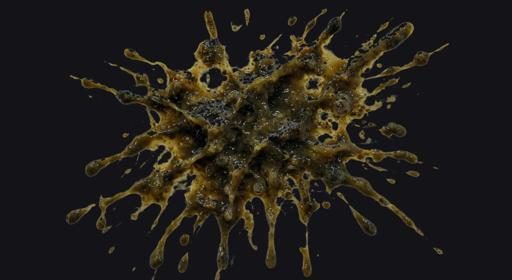
| Your splat used on the lens: a fly hits the visor in the swarm and the rain runs it off | C |
| Real-time 3D rather than a rendered video, so it can genuinely never end | C |
| Recycled segments: six layouts, four headings, ring beams at the joints | C |
| Red gates every 24 metres, fitted around the viewer's path, as the thing you approach | C |
| Lead climbers whose gap breathes but never closes | C |
| A slow ascent that pulls, surges and settles | C |
| Haze that gathers toward the centre of the shaft and brightens with height | C |
| The four-beat move (reach, step, drive, settle) and a rhythm table for each kind of terrain | C |
| J-hook rope technique for the lead climbers | C |
| Muscles spanning origin to insertion, keeping their volume as they shorten | C |
| The palette: rust, red oxide, olive canvas, concrete and soot, with faded safety helmets | C |
| Both references at once: constant skylight drips, and periodic slips aimed through the middle of the view | C |
| Climbers that cycle endlessly: climb, rest, lower off or down-climb | C |
| No text, no interface, nothing between the viewer and the climb | C |
| The cable as six-strand right regular lay, geometry following the helix; its flaws fixed in the world so they ride past | C |
| Two grips per pull cycle, scheduled by height so the hands lock to the camera's rhythm; one hand always on the steel | C |
| The headlamp turned down on anything within arm's reach, so the gloves stay black rather than glowing | C |
| Threat read from distance and height; freeze, hug, slide away, duck, then the leads make up the lost ground | C |
| Walls as a two-layer skin over a core, with cracks, rebar and hinged slabs, kept clear of anything attached | C |
| The hand turns round the cable and the wrist bends through each pull; a short slide as the grip takes the weight; the thumb closes last | C |
| The stop built from real visual reflexes: reaction delay, saccade with suppression, pursuit, narrowing attention; the climb has its own clock so it can halt | C |
| The critter is pale, as cave animals are, so it reads against dark concrete | C |
| A cold LED headlamp beam that turns with the head | C |
| A visible body: boots pinch the cable and stand up through each surge; knees come up and re-clamp in the slow part of the pull | C |
| Two kinds of look down: a deliberate glance in a hold (hang back, dolly-zoom, sometimes a boot slips) and the near miss (a chunk aimed a body's width away, in front and to one side, so the eye can follow it past the feet) | C |
| The head moves apart from the body: it leans out and over to see past your own arms and chest; elbows make room | C |
| Near misses kept rare (about four in ten slips) so they stay close | C |
| Dead power cables hang from the bracing frames beside the climb, for near-field parallax, and arc | C |
| A dozen resident creatures that perch, crawl, fly and land near you; a swarm every few minutes, built from instances so forty cost a handful of draw calls | C |
| The swarm reaction: glance up, a short tuck, track one past the face, then look down along the cable as they fall away; close passers come by inside the view so the head never turns into its own arm | C |
| Shrapnel only in the larger breaches, never in a burrow or a slab, so the wall reads as built and then broken | C |
| No floating steel: nothing may hang loose in a wall break | CBH |
| The climbers rebuilt from the cyborg operative sheets | CBH |
| A giant outside the walls who comes closer over time, never plainly heading for the shaft, then reaches in, does damage, takes a climber, leaves and comes back for another | CBH |
| Five archetypes from the sheets, weighted so the standard suit is the most common; colours held dark so they sit in the shaft's light | C |
| The giant's path is made of approaches, holds and retreats, steered toward breaks at your height so he is seen; the haze takes him at half strength so he reads as a silhouette | C |
| He leans in at a break near eye level, takes the lead climber on the rope above you if his arm will reach, and someone else is on that rope by his next visit | C |
| C | |
| The giant must look like the references; the body must never be see-through | CBH |
| The giant made from your walk-cycle frames and your video, cut out of their white ground, instead of a model | C |
| The two lead climbers wear the Carbide and Tension suits; the hazard stripes are drawn on the suits by the shader | C |
| The giant only ever in the distance; softened, darkened and desaturated by the air; rain catching his outline softly; his speed set by his size; slow, a little sluggish; lightning in the sky | CBH |
| He walks to stand beyond the break you are about to climb past, and the look-out finds him there; 46 to 72 m out; about 3.5 m/s for a 24 m body | C |
| CBH | |
| Lean out of the way to look; water gathering and pouring from edges; glowing slime seeping through the concrete and lighting it; times when the shaft goes almost dark, lit by the sky, the lightning and dim climber lamps; water running down the cable; the giant reaching into a far shaft, pulling someone out and eating, mouth to the sky; references for slime and water | CBH |
| The local light faked in the shaders (eight nearest points) instead of real lights; the slime in four colours from your video; power cuts every two or three minutes for 20 to 45 seconds | C |
| Falls end in mist; the ooze inverted into hollows in the concrete; debris bounces off the triangles and the climbers; a slip on the cable with a jerk recovery and a close clench | CBH |
| Debris stays on its exact path until it hits, then is simulated; your slip slides the whole body and hands down the cable while the climbing rhythm keeps time; about one slip every two minutes | C |
| The meal begins when you look; he waits beyond the break you are about to reach; your view narrows on him; he paces while he waits | C |
| The water looks terrible; professional quality needs a different approach | CBH |
| Falls rebuilt as thousands of single drops thrown by the physics of a real fall (gravity, a little push off the lip, drift that grows as they drop), each drawn as the streak a camera would catch; spilling from the lowest point of the break's edge; most drops dim, a few catching the light; the wall runs turned into dark wet stains instead of white lines | C |
| The whole wall around a stream is wet for a misting distance, so the straight lines go; the falls must leave the edges of the breaks (they started too low); many more carved hollows, plain recesses with the lights on that begin to glow when the lights go out; stuttering arms; the mist carried by the air moving through the shaft | CBH |
| Falls start at the lowest point of the see-through edge of the hole, with a thin dribble off the front lip on some; one wet patch per fall that widens as it goes down, darkest under the stream, with a sliding film; 18 to 26 hollows a section in small clusters; each hollow wakes at its own moment over about five seconds of darkness and fades in under two when the power returns; a steady draught up the shaft that swings and gusts, leaning the lower fall and carrying the mist up and across for five to nine seconds | C |
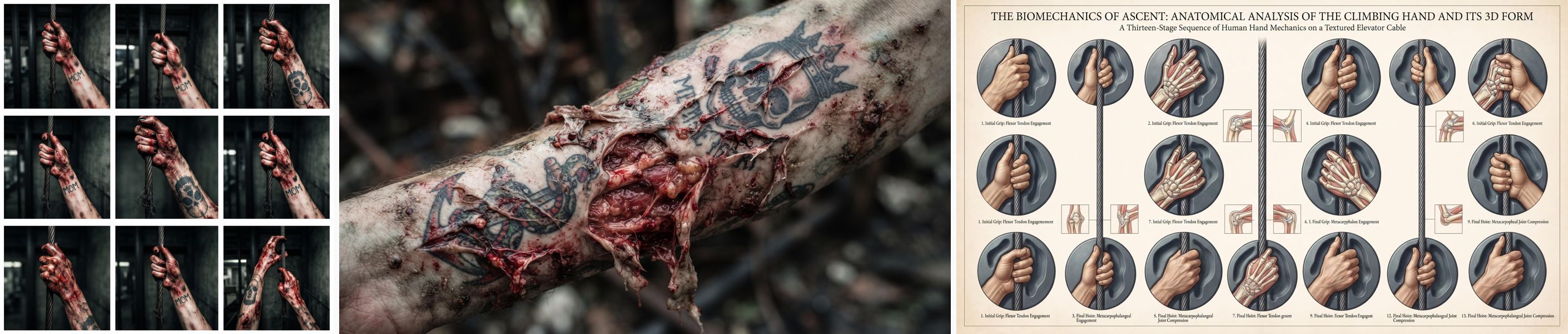
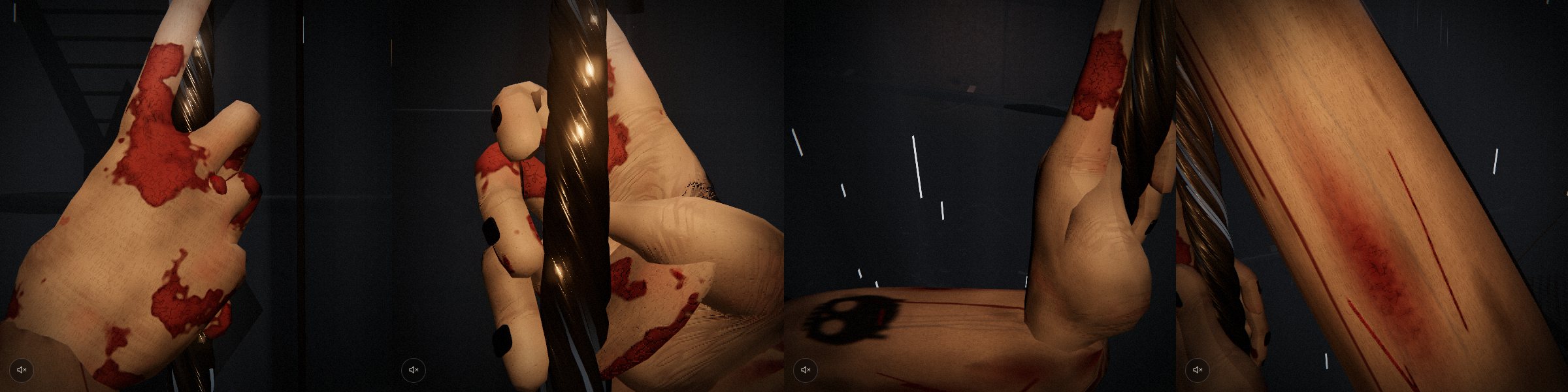
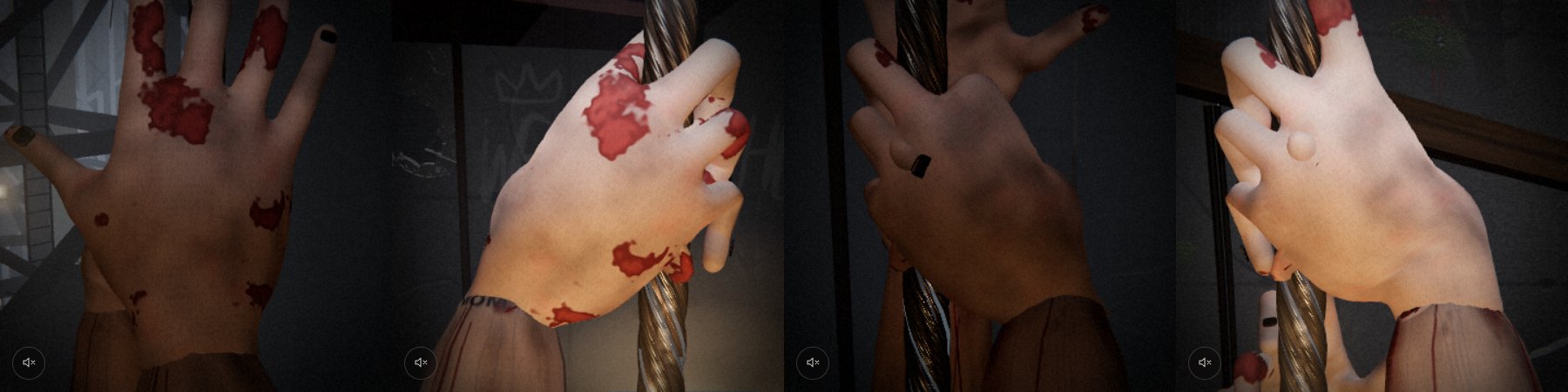
| Since it is purgatory, change the climber's hands; references: bloodied bare hands with black nails on a frayed cable, MOM and skull tattoos, a torn wound, and atlases of the climbing grip | CBH |
| Gloves, knuckle armour, strap and cuff removed. Skin marked from each piece's own surface so the blood and dirt move with the hand: grime, dried and fresh blood, raw red patches, dark knuckle creases, glossy where wet. Black nails. Bare forearms painted in code: MOM on the right inner wrist, a skull on the left forearm with a torn wound beside it, scratches, smears and runs of blood toward the elbow. Fingers slimmed from the glove's thickness. Broken wires fraying out of the cable every few metres. The grip itself unchanged: the atlases confirm the wrap it already used | C |
| It still looks rough and the fingers do not look functional; reference: a sculpted, tattooed hand turning on a stand. Work it out | CBH |
| The hand rebuilt as one sculpted, skinned surface over a 25-joint skeleton (the open WebXR generic hand, MIT), driven by the same grip. Each finger joint bends only around the knuckle line, the knuckle also spreads a little, the thumb aims its base and hinges in one plane; nothing twists. Creases at every joint, blood and grime from the same skin, black nails on the real fingertips. The forearms with MOM and the skull are kept | C |
| Getting better but not there: more crunch in the skin, it reads as a smear; the joins still pop outside the skin; little hairs and tiny pores on the arms and hands; the pointer fingers wrap, but not around the cable | CBH |
| Skin with relief that catches the light: pores, fine lines, knuckle folds, short dark hairs lying along the arm, blood with crusted, cracked edges, a faint fuzz at the edges; on the forearms too, finding the painted blood by its red. The wrist ring tucked into a stub inside the forearm and the old wrist ball removed. Joints given real ranges. A closed hand pulls every finger segment onto the steel. Nails smaller, flush, on the backs of the fingertips | C |
| Closer, but the thumbs are off again. The arms and hands need a serious studio-quality effort. The palms are chunky, not contoured for holding. Insert skin folds over the joints where things look robotic; the folds pile and relax as the skin near them stretches and relaxes | CBH |
| The hand re-sculpted at load: one step of Loop subdivision (four triangles for one, bone weights carried), the palm carved to about 3 cm through a hollow centre with a thumb pad, a little-finger pad and a ridge under the knuckles, the thumb slimmed. The palm cups round the steel as the grip closes. The thumb wraps the other way round the cable from the fingers, and rests as sculpted when the hand is open. Skin folds driven by each joint's own bend: piled on the back of a straight joint, pulled flat and pale as it bends, palm creases deepening as it closes. The wrist skin follows the forearm; the forearm is oval and ends inside the wrist | C |
| When the debris falls the sound turns choppy, like the speakers will pop; it returns to normal after. Keep the debris sound | CBH |
| Debris sounds budgeted (two a frame, ten a second), the rest folded into one growing clatter; quieter whistles; soft onsets; a hard ceiling on the level | C |
| All I hear sounds like static and it cuts out | CBH |
| Voices built only when needed; one noise for the draught and its moan; the echo as delay lines; rain hiss cut to a third; songs higher; automatic lighter sound if the phone falls behind | C |
| The sound cuts out a ton | CBH |
| Each sound lives only as long as it plays, at most 20 at once; light spatial audio; voices steered 30 times a second; a larger audio buffer; a gentler limiter; the songs dip less | C |
| Mostly the swarm is heard, sometimes the water; things that fall are barely heard, or not at all; if debris hits something we should hear it. The three songs as a rotation, for the emotion they add. This is the climb through purgatory: the climb stays endless and no one leaves the shaft. The graffiti must not sit in picture-perfect squares, which reads as modern neon signs. The climber magically slides back up after a slip | CBH |
| Every falling piece gets a voice (eight at a time, heard further off and never thin), and a sound where it strikes a wall or lands below sight; impacts heard three times further. The creatures that are always about made quieter and closer-ranged; the swarm keeps its weight. Songs in a shuffled rotation, 25 to 70 s of the shaft alone between them, matched in level, under the place and ducking when something happens, paused with the mute. Each wall piece fades out through a ragged edge, inside the art and as it is drawn. After a slip you climb on from where you were caught: the slip is a whole number of climbing cycles and the clock is set back by them, so nothing seen moves | C |
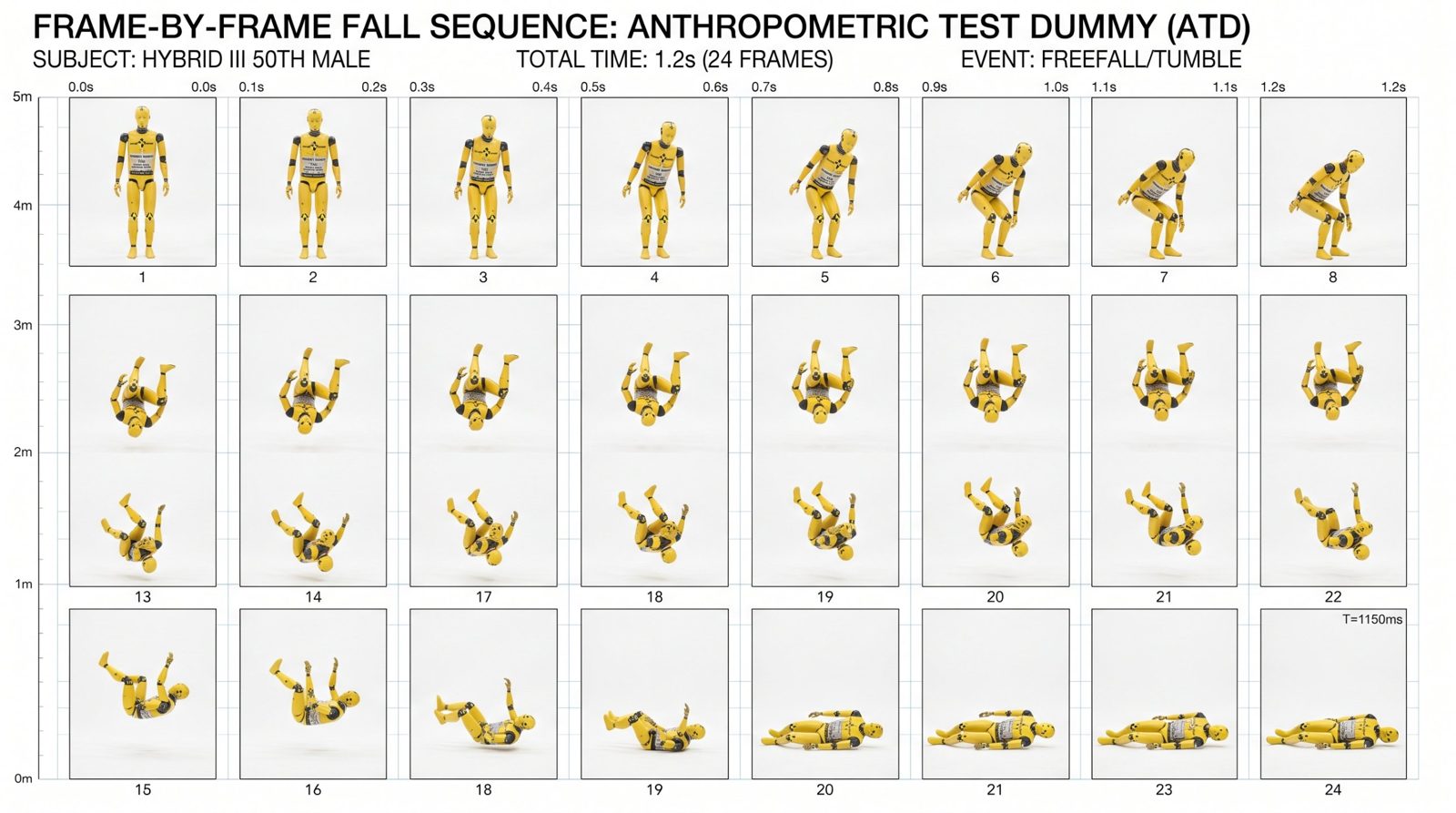
| The slip reads as levitating: only a hand in the air. Sound for everything that falls; hard impacts when climbers are hit; a shaft that echoes like a deep canyon; creatures that make real noise; a horror siren for existential dread; sounds that arrive and depart through the shaft; sound for the climbers' movements at their distances. The graffiti half hidden by a grey panel. A climber losing its grip entirely and dropping when the debris falls, now and then, after the test dummy fall sheet and video | CBH |
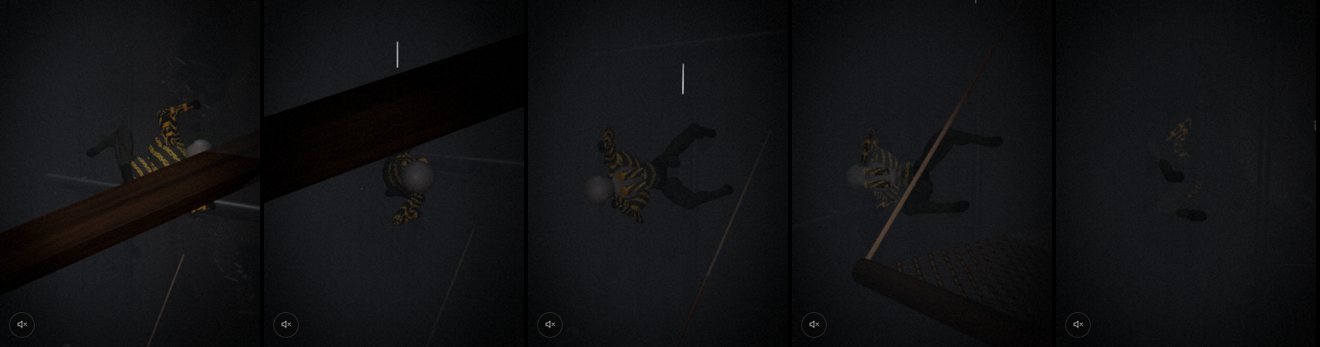
| Your slip: 1.6 to 2.8 m, eyes drop to the glove on the racing cable, water and the odd spark thrown off, the view widening with the speed. Knocked off: the strike takes a wall climber off, the rope parts and hangs, the body tumbles head over heels, glances off walls and frames; your head follows it down, leaning past your arm; about four in ten minutes. Sound placed in the shaft with your head as the listener, an echo built for a 14 m shaft (a flutter between the walls and late returns from below), the six nearest falling pieces whistling with pitch that rises as they come and drops as they pass, the five nearest creatures buzzing with shrieks on close passes, the air tearing past a falling body, a rope snapping and a cry, a deep blow and a crack and a grunt for a struck body, rings for steel, a crunch for concrete, hands and boots and hardware on the other climbers, a siren far overhead that winds up and down three to five times, often when the power goes. The art kept clear of every panel and net | C |
| Quality and performance check; look for opportunities to increase immersion | CBH |
| Sound, made live in the browser from noise and a few tones, nothing to download: rain and drips, the draught, the lamps' hum that dies in a power cut, thunder late by its distance, the nearest fall, breath that quickens, the glove on the cable, debris on steel and people, wings, the giant's footfalls, your slip and catch, a glassy chord for the art. It starts on the first tap; a small button mutes it and is remembered. In the dark you stop to watch a piece of the art finish drawing. Lighter spheres on the other climbers; mist only near you | C |
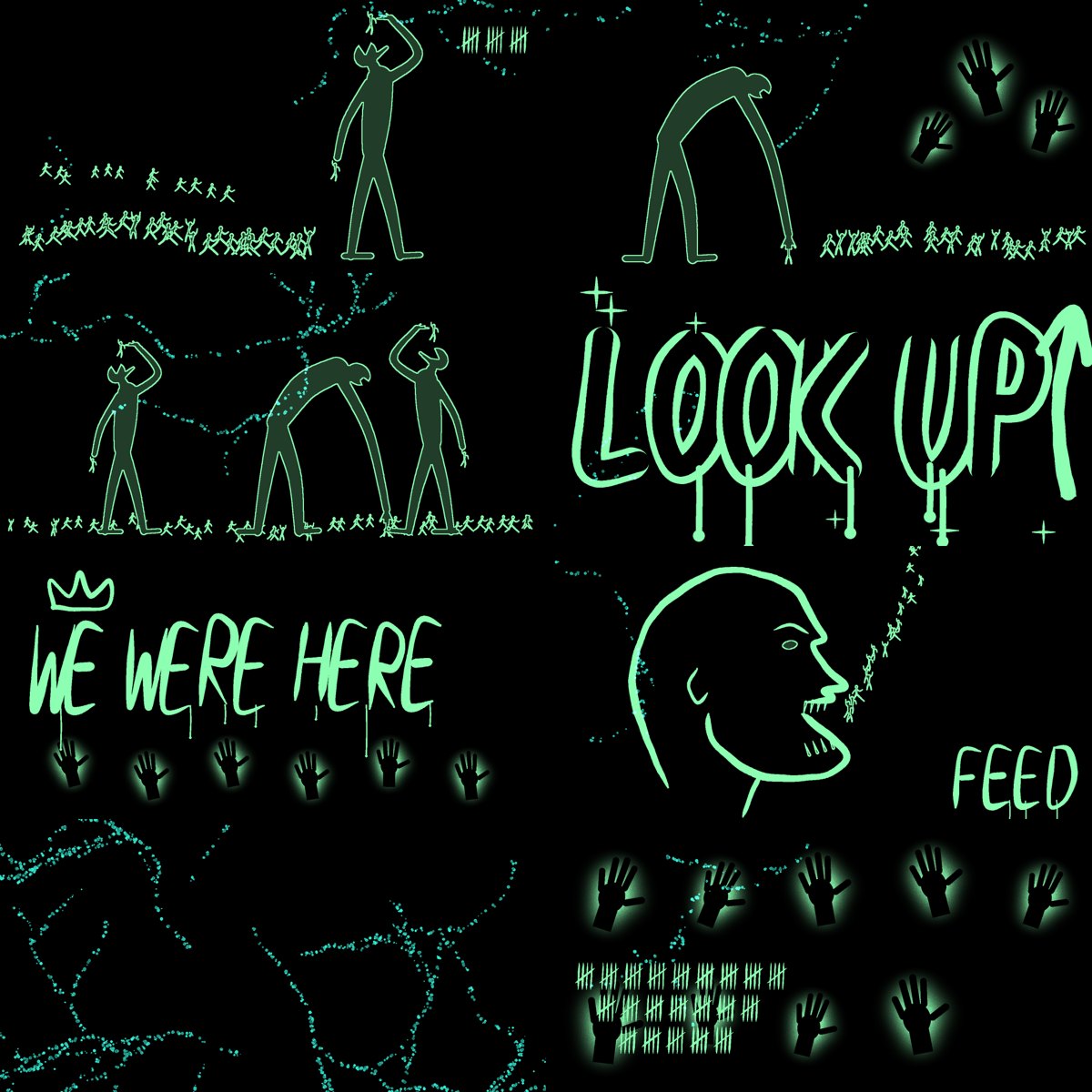
| Instead of the neon spots in the dark: glow-in-the-dark graffiti, urban style, and bioluminescent moss in the cracks of cave drawings of giants eating droves of people; elegant and impossible to look away from. A creature flying round the climber glitches the arm | CBH |
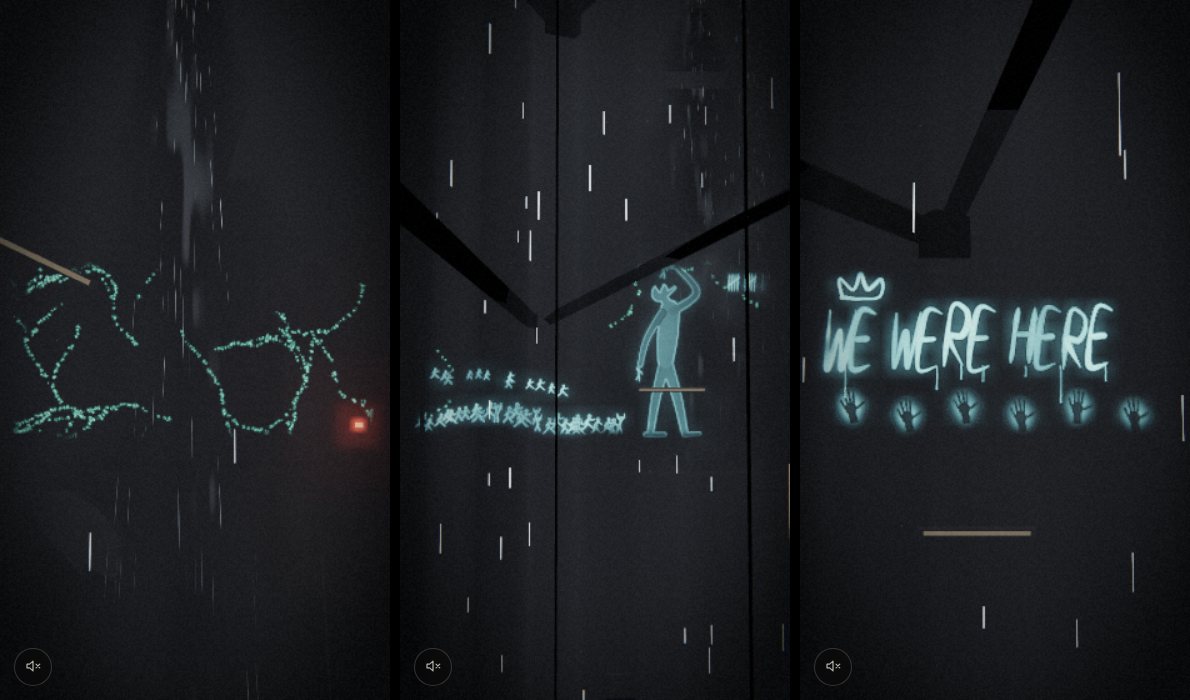
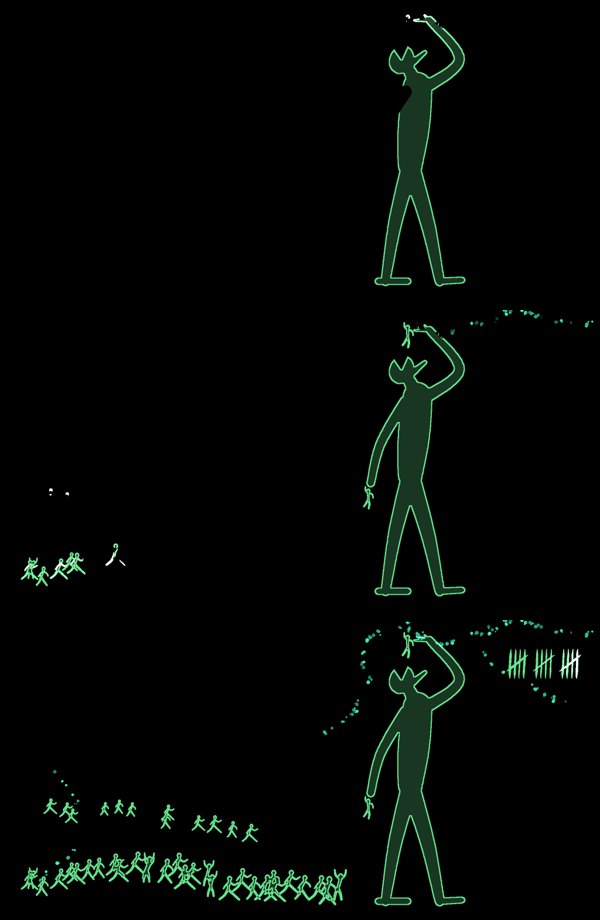
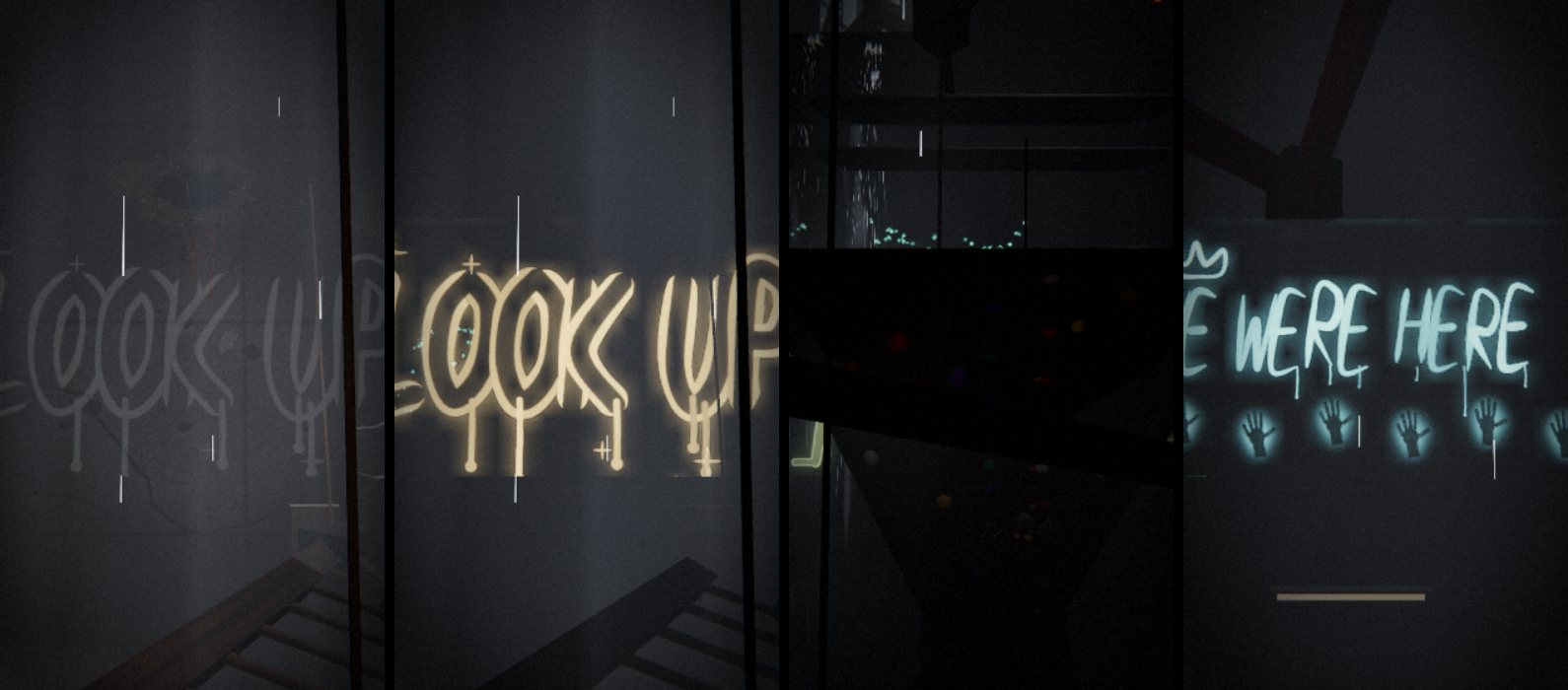
| Eight pieces drawn in code as strokes that remember the order they were painted; the giants as solid rock-art figures with a bright rim and a soft glowing body; the words LOOK UP, WE WERE HERE and FEED; negative hand stencils and tallies tying the cave to the street; each piece draws itself in over about eight seconds with a white-hot tip on the line, then breathes; moss lights speck by speck and twinkles; one to three pieces a section, kept off the breaks; with the lights on, almost nothing shows; the glowing hollows retired | C |
| The arm glitch was the head and the view, not the arm: the head's lean and the gaze now ease and are limited to the speed a head can turn | C |
| Taper the ends of the wrists; they read as cylinders and make the movement look less fluid. Soften the giant a little more | CBH |
| Forearm as a turned shape that swells below the elbow and narrows to about 60 percent at the wrist; the glove cuff narrows again into the hand with a small wrist joint; the giant blurred by a ring of samples that widens with distance, with a softer edge, lower contrast and more haze | C |
V.Process log
Kept as it happened. Superseded choices are struck through, not erased.
- First render. The composition read immediately: one-point perspective up the shaft, frames converging on the light. Lamp light on the walls showed as hard-edged discs. The glow was being read from
the colour channeland is now read from the alpha channel. - Dust read as snow, so the motes were shrunk to about a third of their size. The image was flat grey, so fill light was cut from
0.9to 0.32 to let the lamps and the skylight do the work. - Close-up camera on each kind of climber. On ladders the arms never rose above the shoulders, so the hand holds were raised from
0.12to 0.34 above the body. The plywood was far too orange and was desaturated. - The climbers you overtake are on screen for only seconds, which is not "with the climbers". Added two lead climbers on ropes in the climb column, always just above.
- The lead ropes glowed orange under the viewer's own light and were darkened. The mid-shaft haze was washing out, so its onset was pushed higher.
- The first studio review found that most climbers ahead of the viewer were frozen in place, waiting for a camera that arrived too late. They now cycle without end. It found that nothing actually got closer:
the skylight simply held its distance. The red gates were the answer. It found that the ascent was1.7too fast, now about 0.68 metres a second, and that the lead climbers scurried. Rope climbers got their own gait. - Engineering fixes from the same review: GPU memory cut by using MSAA only where affordable, a frame-pacing loop that could never recover, no recovery from a lost graphics context, overlapping light-shaft layers, and per-frame allocations in the climbers.
- The first red gates whited out the screen as you passed. Their glow was cut to under a fifth and their lamps given their own dimmer, saturated red, so they read as red from forty metres away.
The skylight swelled as each gate approached and reset under a flare as you passed through.Removed after the second review showed the reset could be seen. The gates now carry "closer" on their own. - The second review found the lead climbers' bodies clipping gate beams at 245 of 250 gates, because the fit checked only their ropes. Gates are now fitted around the climbers' full width; a re-probe of 250 gates found no contact and no gate touching a wall. Hands and feet jumped up to a metre in one frame when a climber changed phase. Limb motion is now smoothed and capped at 3.5 metres a second; a re-probe of 25 full climber cycles found no step over 6 cm.
- My review of the climbers: too robotic and jittery. An arm has to extend nearly fully and then contract to move a body up, the rhythm has to change with the terrain and show in the hips, and the bodies need all their natural joints. The climbers were rebuilt.
A diagonal gait that moved one limb at a time while the body slid up at an even ratebecame a four-beat move: reach, step, drive, settle. A lumbar joint, a counter-turning chest, wrists, hands, ankles and feet were added. - Measured before trusting it: legs were overstretched in about a quarter of all frames, and feet slid up the wall to compensate, which was part of the jitter. Reach had been
treated as purely vertical, ignoring that the body hangs out from the wall. Every step, hang and foot placement is now derived from the limb geometry. Re-measured: arms swing from 20 to 45 per cent contracted at lock-off to 95 to 99 per cent extended at the hang, with no measurable over-reach, and legs over-reach in under 2 per cent of frames, on overhangs only. - Found while rebuilding: the two lead climbers stopped being drawn after the first 90 metres, about four minutes in. Fixed. The ascent slowed from
0.68to about 0.4 metres a second so the rope climbers can keep a human tempo, and the gates moved fromevery 48 metresto every 24 to keep the beat. - A third review, of the climbing mechanics alone, found that ladder climbers gripped empty air
40 cm in front of the rungs, that the harness rope ran through each climber's chest, that elbows flipped in a single frame at the end of each descent and during the rope cycle, that planted hands and feet crept onto their holds becauseevery limb was smoothed, and that the bodies hung too far off the wall, so moves were too short. Panel climbers gripped blank plywood. - Planted hands and feet are now exact; only a change of phase moves them, on arcs, one limb after another. Elbows and knees aim from where they were the frame before, so they cannot whip around: peak elbow speed fell from
17 to 24to 3 to 8 metres a second. Ladder hands and feet land on the rungs. The rope ties in at the belay loop and runs up in front of the chest. Hips sit closer to the wall and lock-offs are deeper, so moves are longer. Panels now carry the holds each climber actually uses. Wrists hook over holds above the shoulder, press palm-down below it, and hang loose when free. The ascent slowed from0.4to 0.3 metres a second so the rope climbers keep a human tempo. - My review: hands sometimes pass through the torso; dress the climbers in the shaft's colours; add a layer of muscle and joint over the frame, so flexing changes a limb's diameter and tendons and flesh show; and have something fall from above to draw the viewer in. I supplied reference footage of a collapse and of water falling from a skylight.
- Muscles, tendons and landmarks added; the body now moves out from the wall whenever a hand would sit inside the chest (re-probed: under 0.2 per cent of sampled frames, none on ladders or ropes). The first slips fell
straight down the centre, just above the top of the frame, so they now start ahead of the camera and fall through the middle of the view. Rock fragments rendered as crumpled paper until their mesh wasroughened face by facewelded first. - Found while checking the new palette: distant climbers showed white blotches.
A beam grime texture on clothingwas not the cause. Every limb, muscle, hand and torso shape had been built on a mirrored set of axes since the first version, which turned them inside out and lit them from the wrong side. Fixed; climbers now read as solid silhouettes against the haze. - A fourth review, of the anatomy, palette and falling debris, found: the torso push could jolt the pelvis 25 cm in one frame; sheet muscles (lats, traps, spine) were flattened on the wrong axis and stood edge-on like fins; flexion was real but too subtle to read at viewing distance; full detail switched on at
26 m, far beyond where anyone could see it; debris fellat 6 to 12 m/slike leaves, partly through beams; the water bokeh was invisible. - The push now rides the body's inertia and is capped (re-probed: largest pelvis move 3.7 cm per frame). Sheet muscles lie flat on the body. Flexion is exaggerated just enough to read, and tendons are twice as thick. Detail switches on within 10 m, with hysteresis. Debris breaks away high in the haze with sparks, falls at 15 to 32 m/s inside the clear column, and is kept out of the lens; the dust hangs high. Near drops now bloom into soft rings. The palette was
darkenedbrought back up, with chalky shirts and faded high-vis helmets, since the earlier white-out had been the inside-out geometry, not the colours. - The viewer climbs. A 22 mm six-strand hoist cable now hangs a hand's width from the face, with broken wires, rust, grease and water beads at fixed heights. Two gloved hands in hazard sleeves go up it hand over hand, two grips per pull of the camera. Climbers now sense falling debris: they freeze, press in to the wall or rope, slide away, duck and look up, and the leads then make up the lost ground. The walls became a cast skin over a broken core: spalls, cracks, rebar, chipped corners and slabs hanging off their hinges. A single NaN pixel from bump mapping on the new wall faces could white out a whole frame through the bloom, so it was found and guarded.
- A fifth review, of the hands, cable, debris reactions and walls, found: fingertips read as loose beads under the headlamp; the reaching arm came in from the side at eye height
from the bottom corners, as intended; a reaching hand could swing toward the lens; fingers sank up to 8.6 mm into the cable while closing; the cable cost 75k triangles; spalls read as stickers rather than craters;a few nearby climbersmore than half the shaft flinched at every slip, and the freeze was only a slowdown. - Matte leather and smaller fingertips. Elbows held low and swung wide, so forearms rise from the bottom corners; hands kept 16 cm from the eye; an overreach moves the whole hand, never the wrist alone; tapered sleeves and worn-through bands. The cable mesh roughly halved, with stronger rust and grease, and thicker broken wires kept clear of the gloves. Spall outlines broken harder. Only debris within a few metres frightens anyone now, and real fear stops a climb dead.
- The wrist came alive: the hand turns round the cable and the wrist bends through each pull, the grip slides a finger's width as it takes the weight, the knuckle shell lifts under load, the thumb closes last. The shaft filled in at every depth: faceted rubble on every broken lip, burrows that go on into the dark, rust bleeding from brackets and bar, moss where water sits, small bugs that move only now and then, and cut power cables hanging beside the climb that arc and throw blue light on the walls. A cold LED headlamp turns with the head. And the stop: something pale runs across a wall and down a hole, and the climber's eyes, head and climb respond the way human sight does.
- A sixth review found: the headlamp did not exist, because its code had ended up inside a comment; the critter usually started off screen and was too small to see on a phone; it ran across thin air in front of the hole, and a few bugs sat over voids;
the wrist bend was a wrist bendthe "wrist bend" tilted the whole wrapped hand into the cable; pushing the hand clear of the eye forced fingers into the steel; the clench bent the fingers past the cable's surface, so it could not be seen; arcs were too dim to light anything; rust looked like orange splats. - Headlamp restored. The event now starts only where you could see it, higher up the wall, and the critter is the size of a large cave cricket; it runs to the lip, drops down the broken face and into the tunnel; the head leans out past the cable and your own hands to watch. Bugs keep to their moss. The wrist bend now moves only the wrist and palm about the knuckles. Hands on the cable are never pushed; the clench shows in the knuckle shell. Arcs are short, flash, and light a real blue pool. Rust starts at the bracket and is duller.
- No finger enters the steel, ever.
A few frames of fingers sinking about a centimetre into the cable were accepted.Each finger is now drawn in half-joint sections; any section that reaches the cable is held on its surface, and the glove gives instead: thinner toward the steel and slightly wider across it, so the palm side molds into the contour. The palm carries a pressed pad that spreads under load. Contact has its own light: the pressed core goes dark and warm, occluded and compressed; the edge where the glove lifts off catches a cool sliver bounced off the steel; inside and just around the fist the cable itself goes dark and warm. Re-probed over a minute of climbing: deepest overlap 1.0 mm, inside the glove's allowed give. - Looking down. A body under the camera: chest, belly, legs, and boots that pinch the cable, stand through the surge and re-clamp. The shaft is now kept built two segments below you, with the cable running on down into the dark. A glance down in a hold, with hang-back, a slow vertigo stretch and the odd slipping boot; and the near miss, followed from above, past the body and down. First renders failed in useful ways: the boots were scheduled above the head (a sign error), a stray 1 m sideways offset crept in and pulled the arms off the cable, and the chest filled the whole downward view
until the torso was made smalleruntil the head was moved apart from the body, leaning out and over the chest the way a real head does, with the elbows swinging wide to make room. - Creatures, the swarm and shrapnel. A dozen resident biomechanical flies and scorpion-tailed crawlers, each with
a plated body, two-joint legs on a tripod gait and folded wings that blur when they buzz(rebuilt in Pass 16) legs on a tripod gait and wings that blur when they buzz; they perch on burrow lips, cracks and breaches near you, crawl, burst off, dart past the face, stop dead and hover, then land and grip. Every few minutes the swarm comes down the shaft. Larger breaches now hold shrapnel: peeled mesh, a torn red pipe, wire, a bent strap, sheared bolts, boards. The breach aggregate was redrawn as angular stone at a finer scale. First renders: the creatures were too small and too dark to read on a phone, and in the swarm the viewer pressed so hard into the cable that its own arm filled the framefor three seconds; the tuck was shortened and the close passers moved in front of the face. - A seventh review found: swarm creatures that landed never appeared, because their heading was never set (NaN); the close pass was aimed at where the eye was five seconds earlier, so it went by at chest height; bodies rolled erratically on the near-vertical dive; about a thousand small objects were allocated a frame for the wings; shiny metal with no environment to reflect rendered the bodies black, so only the glowing eyes read, unlike the dark eyes of the reference; the swarm was thinner than the video; swarm and resident creatures were at different scales; leaving creatures popped out of view at the time cap; the swarm blocked other events for up to 24 seconds; crawlers spun in place at the edge of their patch; and the shrapnel was too small and too recessed to read against the reference.
- The creature, rebuilt. Your screenshot of the Pass 15 still showed a mosquito: long banded red abdomen, small separate red eyes, opaque wings, straight stick legs. None of that is in the references. Rebuilt against the new turnaround sheets and videos: a head that is mostly two large dark red-brown faceted eyes; a broad humped thorax with a dark stripe; a short smooth egg of an abdomen with dark band ridges; about two hundred short bristles on each body; a wet blue-black clearcoat with a fine beaded bump worked out in the body's own space, so every instance carries it at no extra cost; thicker black legs in three segments that hang and splay in flight; wider clear wings with dark veins and a smoky root, folded back in a V at rest and up in a V in flight; a pale larva hanging from the mouthparts. Still five draw calls for all fifty-two.
- The walls broken open. Most walls now carry one or two triangular breaks, 4 to 9 metres a side, around an I-section steel frame cast mid-wall, with gussets and rivets at the corners. Each break goes through the full wall in layers: a jagged front lip, a stepped second layer, then a faceted tunnel through the wall's thickness that darkens with depth, rebar snapped and bent into the void, rubble on the ledges, big pieces hanging on the lip. Pipes and ring beams are allowed to keep running across the void. Outside: a new module builds the structure (space frame, towers, catwalks, ladders, columns, bulbs, sparks, haze) and the fog turns cold and blue-grey outside the shaft. Flies perch on the lower lips. A look-out gaze beat added.
- An eighth review found: the outside had no light of its own, so the red and blue towers and pale columns read as brown silhouettes; the lattice ended at 48 m and floated 4 m clear of the shaft; about 40% of the outside was drawn where no hole could ever show it; coplanar faces at every lattice joint (flicker); catwalks buried in the tower beams; bulb wires ending in air; halos sized for one screen and fading slower than the bulbs; sparks ignoring the fog; the broken edge reading as an even traced band rather than a smash; the look-out beat choosing holes behind the body; and a 6 mm overlap at the start of each tunnel.
- The body made solid, the creatures made flesh, the rain made real. Measured eye-to-arm and eye-to-hand distance over eight look-downs and thirty seconds of climbing; found the elbows winging out flat across the view when the head turned; fixed as described in "One frame ruins it". The thumb re-solved after the wrist turns. The hide rebuilt with no metal: matte purple-black and green, wet in patches, wrinkled and beaded; slime strings; rusted legs. A swarm fly now hits the lens. And a find: the rain had been invisible for many passes, its streaks culled whenever they turned over on screen, which is whenever you look up. Rebuilt as on-screen streaks of a fixed pixel width, drawn from both sides, denser and spread through the whole shaft, and a second rain falls outside, seen through every break in the wall.
- A ninth review found the inside rain still culled (the double-sided flag had landed on the wrong material), streak width stretched by the screen's aspect, no fallback if the splat image failed to load, the thumb able to pass through the index finger or stretch a bone, the look-down forearm still central, the hide still reading as soap bubbles and the slime as amber beads. All fixed in the same pass.
- Floating steel: the struts that bore on the shaft from outside showed through the breaks as steel hanging in the air. They are gone, and the corners of each triangle frame are now set into concrete. Climbers rebuilt as cyborg operatives: helmets with a blinking status lamp, back plates and canisters, hazard bands, a four-armed variant. The first pass was too bright under the headlamp, so the suits were darkened by about a third. The giant was built and checked from a studio camera at 13, 40, 70 and 90 metres. On the first try he was a stick figure in a T-pose with a plaid skin: he was given a climbing pose, a mottled noise skin and a larger skull. From in front, his cap hid his face because the head tilted toward the camera. The fog swallowed him past 30 metres, so it now takes him at half strength. On a phone the first attack framed only your own sleeve; the break he chooses was moved down to eye level and near sleeves now dissolve. The creatures' eyes and legs were dulled. Your close-up showed glossy bronze eyes and orange legs.
- A tenth review, independent, found:
his walk to the break could pass through the shaft(now it goes round);he could start his lean-in in the middle of a look-down or swarm and take the camera from it(now gated);a taken lead could be recycled as a wall climber that still counted as a lead;a taken wall climber stayed listed in its old section and could later vanish a climber in view;a reach limit about a metre longer than the arm. Also fixed: the climb no longer creeps on during a near miss in the middle of a grab, a degenerate limb basis, a leftover debug object. Still open: the giant's pose code allocates about a hundred small objects a frame. - You saw it on your phone: the giant looked nothing like your art, the climbers did not look different, and you could see through the viewer's body as a wire mesh. All three were right. The mesh was the screen fade I added in Pass 19; it is gone. The giant was rebuilt from your images: eighteen frames of the walk cycle and twenty-one frames of your video, cut out of their white ground. Your video plays in the hole, slid each frame so his face stays in it. The climbers: the two leads, the ones you see most, were still being repainted in the old shirt colours, which hid the new suits. They now wear the Carbide and Tension suits, and the sheet's broad yellow hazard stripes are drawn on the suits. Found on the way: the line that narrows your view when you lock on to something had been swallowed by a comment since it was written; it works now.
- You said the giant still looked amateur, and set the terms: always in the distance, softened, darkened, desaturated, the rain only softly picking out his outline, a speed true to his size, a little sluggish, lightning in the sky. He is now a card from your walk cycle, made small and soft, with his own atmosphere shader. The first studio render showed a hard glowing outline like a sticker; the rim was cut to the rain streaks alone. From the cable he was at first never seen: he lined up with a break you were facing about 3% of the time. Now he walks to stand beyond the break you are about to reach, and the look-out turns to him (about one look a minute and a half). Even lined up he vanished at 89 m: he was the same brightness as the haze. Now he is a shade darker than it, and kept nearer, 46 to 72 m. Lightning: a jagged far bolt, the haze and the outside air flaring for a few tenths of a second in two or three pulses, every 16 to 50 seconds. The close-up and the grab are gone. Known: your own arm can still cover the break during one of these looks.
- Lean-out: when you look out at him the head goes right out past the arm and pulls in close to the cable; checked on three looks, the arm no longer covers the break. Cable water: rivulets in the grooves, the rope darker and glossy, more beads. Slime: the first version was thin glowing lines; your video showed thick clear goo, so it was rebuilt as fat runs that bulge and drip, with bubbles, in four colours. Close up it showed as speckle: the per-seep seed varied very slightly across each pixel and the hash amplified it, so the seeds are now whole numbers. Pours and water runs from the breaks, after your stills. The dark: the first blackout barely changed anything (the red bars, the sky and the sun stayed lit); it now takes them down too, and the first dark frame was blown out green by the slime's own light until that was cut back. The meal: a puppet cut from your standing frame, far shafts in the haze for him to feed from. Twice the code hid itself: one of my comments swallowed the line that added the towers to the scene. Seeing the meal from the cable was the hard part: lined up by the shaft's centre instead of your eye, then his head on the lip of the break, then the meal starting before you looked. Now he waits beyond the break you are about to reach and begins when you look, and your view narrows on him.
- The falls were lanes of streaks moving in step: chaser lights. They are now one sheet with long soft streaks from noise, glassy over the lip, tearing open as they speed up, and ending in spray and puffs of mist. One render glittered: the time value had grown large enough to break the hash, so it is wrapped. The ooze was inverted into hollows: the first try read as grey tubes with cyan tips; the second as a black cut-out; the third, with a soft rim, a dark overhang, a lit lower lip and a stain, reads as eaten concrete. Debris: in a first count it never touched a triangle, because it all fell within 1.2 m of the middle and the triangles' beams are at least 2.3 m out; the fall was widened, and about sixteen pieces now strike something in each slip. Your slip moves the whole body with the hands and feet down the cable, so the arms do not stretch.
- You were right about the water:
one sheet with long soft streaks, glassy over the lipread as flat white and grey columns, and the wall runs as squiggly white lines. Painting water onto flat cards was the wrong approach, so the cards are gone. Each fall is now 150 separate drops computed on the graphics card: every drop leaves the lip with a small push, falls under real gravity, and drifts sideways more the further it falls, so the stream is a tight rope at the top and a loose spray of beads at the bottom before the mist takes it. Each drop is drawn as the short smear a camera would record in a 22nd of a second. The first build showed nothing at all; the cause was that the little smear shapes were facing away from the camera and the graphics card skipped them. The test also showed the falls began inside the hole, in mid-air;they now start at the lowest point of the break's edge, where the water would really spill. The wall runs are dark wet stains.(Both superseded in Pass 25: the edge used was the front lip, below the hole; the stains became soaked patches.) - You were right that the falls began too low.
They start at the lowest point of the break's edge: they started at the edge of the front lip, which sits well below the see-through hole, because the break steps down through the thickness of the wall. They now start at the bottom of the hole itself, where the water comes in from outside. The thin dark runs are gone; in their place each fall soaks a patch of wall that widens with the spray. The hollows no longer show any colour in the light; when the power goes they wake one by one and light the wall round them, and there are about three times as many. The mist at first never showed: a fade-in mistake blanked every puff after the first third of its life. It now rides a draught that moves up the shaft and swings from side to side. The arm stutter was measured frame by frame: twice in every climbing cycle a whole hand jumped up to 14 cm for one frame and back. The step that keeps the fingers out of the steel pushed the hand along whichever joint was deepest, and when that joint changed the push changed direction.It now pushes straight out from the cable through the knuckles, eased over a few frames;(Pass 25b: that lifted a closed hand off the cable, see below); the elbow also eases instead of being solved fresh each frame. The worst jolt in the climbing rhythm fell from 140 mm to under 20 mm of frame-to-frame change, and arms came near the face half as often. - You caught that the hands no longer grabbed the cable. My Pass 25 fix caused it: pushing the hand along one fixed line out from the cable meant the fingertips curled round the far side could only clear by moving the whole hand past the cable, so a closed grip floated off. The push is back to the original kind, toward the deepest joint, which keeps the fingers wrapped; what stops the pop is easing the total push over a few frames instead of applying it all at once. Measured over 60 s: gripped fingers sit 20 mm from the cable's centre, the same as before Pass 25, and the worst frame-to-frame jolt in the climb is about a quarter of what it was before Pass 25.
- The forearm was a straight tube ending in a straight glove cuff, so the wrist bent like a pipe joint. Both are now turned shapes: the forearm is fullest just below the elbow and narrows to about 60 percent at the wrist, and the cuff narrows again into the hand, with a small rounded joint where the hand meets it. The giant is blurred by a small ring of samples, wider the further off he is, with a softer edge, flatter tones and more haze. Grip and smoothness were re-measured afterwards and are unchanged.
- The arm glitch, measured during a forced swarm: the arm was steady in the world; what moved was you. When a creature crossed your eye line, the side your head leans out to flipped in a single frame (3 cm), and the gaze, which followed its target exactly, swung up to 37 degrees in one frame as the creature skimmed past. Both now ease, and the head turns no faster than about 260 degrees a second. Worst arm movement on screen in a swarm fell from 241 mm to 32 mm a frame.
Glowing hollows that wake in the darkretired for the wall art: eight pieces drawn by a script as strokes that remember their painting order, so in a power cut each one draws itself in with a bright tip on the line. The first draft had stick-outline giants whose eating pose did not read, hand stencils that were blobs, and a stencil piece that read as a spider; the giants were redrawn as solid rock-art figures with a rim, the hands rebuilt as real hand shapes with the spray blown round them, the spider replaced by a giant's head swallowing a falling stream of people (whose first version read as a duck and was redrawn with a brow, nose and dropped jaw). In the wall, the glow first appeared before the lines were drawn, LOOK UP blew out to white and lit the wall like a floodlight, and the trace was too visible with the lights on; all three tuned down. - Measured on the test machine at phone size: about 290 draw calls and 0.9 to 1.05 million triangles a frame, about 1 ms of simulation, 42 textures. The biggest single cost was 800 to 1,600 spheres making the other climbers' joints; they are now lighter, and the mist only rises near you, which cuts the large soft shapes a phone has to blend. Triangles fell about 7 percent. The piece had no sound at all, and sound is the largest immersion gain left, so it now has a full soundscape made live from noise and oscillators, measured running and level in headless Chrome. The giant's footfall is below what a phone speaker can play, so it also carries a shudder the speaker can. A first build crashed on load because the piece runs a few frames before the new parts existed; they were moved earlier. In the dark the climber now turns to watch a piece of the art finish drawing (four times in ten minutes).
- The slip: measured, you dropped under a metre with your eyes on the sky, one hand in the air and the other travelling with you, so nothing said fall. Now you slide 1.6 to 2.8 m and look down at it. The first spray drew as large white squares (points that close to the eye need a small round sprite). Knocked off: built on the climbers' own pose system, so a falling body is drawn by the same code as a climbing one, with a tumbling frame, flailing hands and kicking feet. Your own arm first blocked the view as you followed the fall; the head now leans out on the other side. Strikes on wall climbers turned out rare (one fall in ten minutes), so a debris shower now catches a climber in reach some of the time, at the moment it would arrive: four falls in ten minutes. The sound was rebuilt around positions:
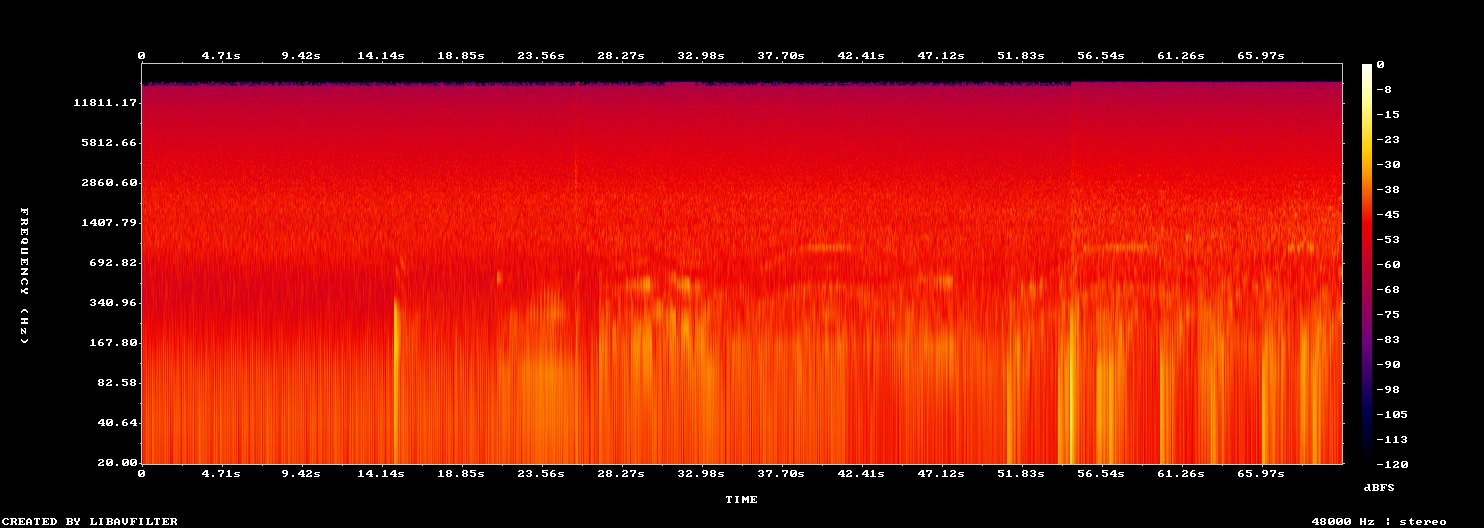
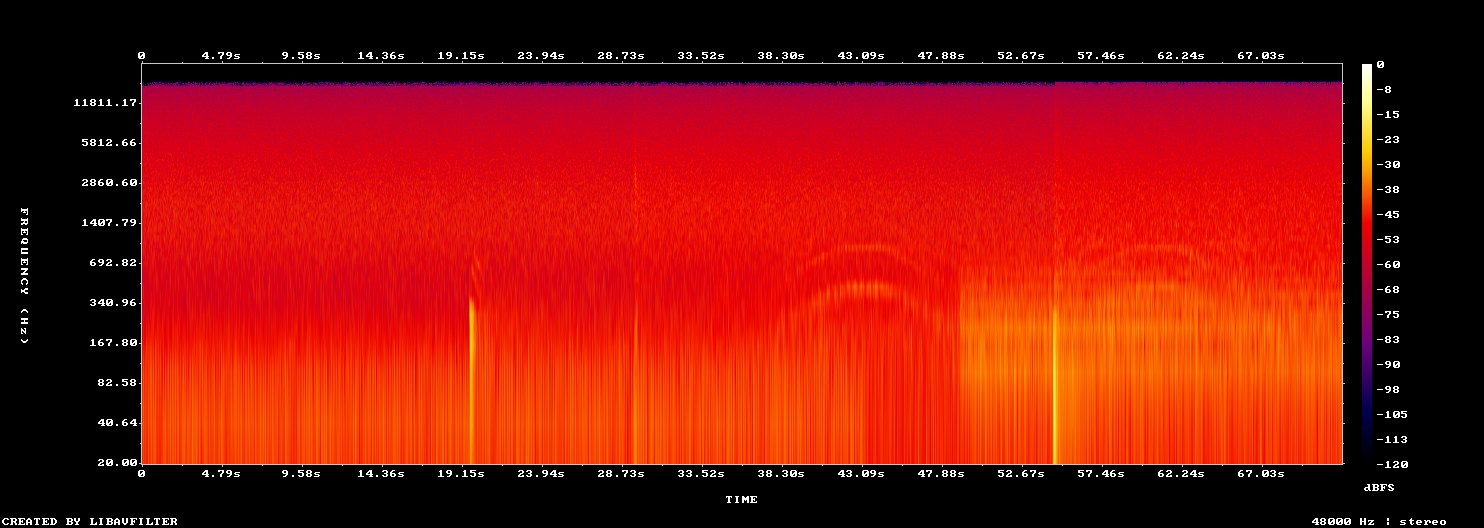
sound panned left and right only. Recorded in the test browser and read as a spectrogram, the first mix was buried under the draught's low roar (the swarm did not show at all); the roar, the hum and the splash were cut, sub-bass below 32 Hz removed, the creatures given more body and made to fall away beyond 10 m, so they now arrive and leave. The art had been placed without knowing where the climbing panels and nets were; it now knows, and over 51 placements none overlap. - The slip's glide back up was the old recovery: the lost height drained back into the body over a few seconds while the hands stayed on the cable.
After a slip you climb the lost height back: now you do not get it back at all. The slip is four or six climbing cycles of height (an even number, because the body sways over two), and once you are caught the climb's clock is set back by those cycles: the same hand positions, at the height you actually are. The first try still jumped: the sway, the head's lean and the gaze smoothing all read the climb's clock, and the easing snapped when it stepped back; they now read a clock that never jumps. Measured at the moment: the camera moves 5 mm and the elbows 0.1 mm in that frame. The leads climbed on while you slipped, so they now ease until the gap is back. The music would not start in the first test: the trick that lets a phone play it later paused the song that had just begun; fixed and heard in the recording. The squares were two things: moss and crowds cut off at the edge of their panel, and the glow stopping at the edge of the drawing, leaving a faint box; both now fray out. - You heard the sound cut out a lot. The cause was mine: every drip, step and strike built its own small set of sound nodes and kept them alive for 12 seconds, so at a busy moment a phone's audio was running well over a hundred at once and dropping out. Each sound now lives only as long as it plays, at most 20 run together (the quiet ones give way), the heavier spatial mode was swapped for a light one, the moving voices are steered 30 times a second instead of every frame, the echo is shorter, and the audio asks the phone for a larger, steadier buffer. In a busy test with the swarm and a fall: at most 12 alive, 3.5 on average. The limiter was also squeezing the whole mix after big hits, and the songs dipped deep under events, both of which can sound like dropping out; both eased. A 72-second recording has no gaps.
- Still static and dropouts on your phone.
Each sound now lives only as long as it playswas not enough: about twenty noise generators ran all the time (rain, draught, moan, water, breath, and every voice slot held open at zero volume), and the echo was a 4.5-second convolution, all while the phone drew the shaft. When a phone's audio falls behind it crackles and gaps, which is static and cutting out. Now the voices are built only when something comes near and taken down when it has gone, the moan rides on the draught instead of a second noise, the echo is three delay lines instead of a convolution, the rain's hiss is a third of what it was (on a phone speaker the hiss was most of what reached you), and the songs sit higher. If the phone's audio clock still falls behind real time, the sound sheds load by itself: echo off, fewer sounds at once, no drips. High-frequency hiss fell from 24 to 14 percent of the sound's energy. - You traced the choppy, about-to-pop sound to the debris: normal until it passes. A shower throws 16 to 58 sound events a second (strikes on frames and walls, landings below, the climbers' moves) and each became a sound of its own, built in the same few frames; the phone fell behind and the stacked strikes made sharp spikes. Now two strikes a frame and ten a second play as themselves and the rest join one clatter that grows with how much is hitting, so a shower is a roar of debris, not a pile-up: 0 to 7 sounds started a second during a shower. The falling pieces' whistles are quieter, every strike starts four milliseconds soft so nothing clicks, and a hard ceiling after the mix makes clipping impossible.
- The hands, after your references. The gloves hid how the hand is built (a palm block, finger pieces, balls at the joints); bare, the first look was a wooden mannequin, so the finger pieces now darken at their ends into creases, the skin is greyer and mottled, and the fingers are slimmer than a glove's. The blood first came out as specks; it is now broad smears. The skull tattoo first rendered as a black blob: cutting its eyes out of the arm's own picture cut holes through the skin; it is now drawn on its own and laid on. The canvas runs twice as far round the arm as along it, so the ink is drawn squashed to read true. Bare, the forearm's open end showed as a cut tube; it is closed and rounded. Ten nails, six broken wires near you at a time, and the draw count unchanged in kind (160 calls, 0.63 million triangles in the test frame).
- The hands, again. You said they still looked rough and the fingers did not look like they could work; the fix was the one left open last pass. The pieces (a palm block, finger capsules, balls at the joints) are gone from the hand: it is now one sculpted, skinned surface over a real 25-joint skeleton, the open WebXR generic hand (MIT licence, Amazon 2019), posed every frame by the same grip that drove the old pieces, so the climbing is unchanged. First attempts: the hand was invisible (its skin shader would not compile); then the fingers twisted along their length; then they bent backwards, because this model's bones all hang straight off the wrist instead of off each other, so the finger chain is now walked by hand, joint after joint. Each finger joint is a hinge around the knuckle line and the thumb bends in one plane, so the fingers close round the cable the way fingers do: the tips land within one to two centimetres of where the grip puts them (they missed by eight to ten at first).
The blood came out as solid red over the whole hand; it is broad smears now, with creases darkened wherever two bones share the skin, i.e. at every joint.The joint creases first came out as regular stripes across the back of the hand; they are broken up now. The grip itself can flick a finger five centimetres in one frame when it re-grips; the hand eases those over a few frames, measured calmer than the grip that drives it. No NaNs over 900 frames; posing both hands costs about a millisecond and a half. - From your phone: the skin read as a smear, the joins popped outside the skin, there were no hairs or pores, and the pointer fingers wrapped round nothing. The pointer finger first: the old grip never put it on the cable (its points sit four to four and a half centimetres from the cable's centre, where a finger resting on the steel sits two), and I had only pulled fingers onto the cable when their grip points were already near it. Now a closed hand pulls every finger segment onto the steel: each joint turns until its end rests on the surface. That search first made the fingers flick between two equal fits; each joint now prefers last frame's bend and turns at most about 13 degrees a frame, measured calmer than the grip (86 fast frames against 188). The joins: a 2 cm ball left from the old hand still sat at the wrist, and the sculpt ends in an open ring wider than the forearm; the ball is gone and the ring is drawn into a stub inside the arm, once, at load. Fingers could also bend past what a finger can and fold the skin out; each joint now has a real range. The skin: pores, fine lines, knuckle folds, short dark hairs along the arm and a faint fuzz at the edges, all as relief that catches the light and fades once smaller than a pixel. The blood has hard, crusted edges and cracks; on the forearms the painted blood is found by its red and given the same crust.
The first skin lines read as cracked reptile hide; they are faint now.The first hairs read as a dirty smudge; they are single strands now.The nails came out as flat squares, then as two black dots cutting through the fingertip; they sit on the backs of the fingertips, away from the steel. - A studio pass on the hands. The thumbs: the grip's thumb points cannot be trusted (its segments stretch from 4 to 6 cm between frames), so the thumb was lying across the palm or pushing into the cable. Holding, the thumb now wraps the cable the other way round from the fingers, joint by joint, until it rests on the steel; open, it rests as it was sculpted.
My first rule for which way the thumb wraps came from the grip's thumb points, and on one hand it went round the wrong side and came out through the fingers; the direction now comes from the fingers' own wrap. The palm: it measured 5 to 6 cm through, about twice a real palm, with a thumb pad like a mitten. At load the mesh is now subdivided once (four triangles for every one, 9,256 a hand, each new point taking the bone weights of the points it came from), then the palm side is carved toward a real palm: about 3 cm through a hollow centre, a firm pad at the base of the thumb, a smaller one along the little-finger edge, a ridge under the knuckles. Only the palm side moves, and only skin carried by the palm's own bones. The thumb is slimmed toward its own bone line. Holding, the ring and little-finger knuckles roll toward the palm, so the palm cups round the steel. The folds, after your idea: every point of skin knows which joint it straddles and reads that joint's bend every frame. On the back of a straight joint the skin piles into soft wavy folds and bulges a little; as the joint bends they pull flat and the skin over the knuckle goes taut and pale; on the palm side the creases deepen as the joint closes. The wrist:the forearm's round end showed as a cuff round the narrower wrist;then the wider hand's open edge showed outside the forearm. The skin behind the wrist now follows the forearm, the forearm is oval (flatter back to palm, as real forearms are) and ends just inside the wrist, and the hand's last centimetre of skin dives in under it. Also a warm edge where light comes back through skin. Steady over 900 frames: no NaNs, fewer fast finger moves than the grip itself (107 against 188), 1.6 ms a frame to pose both hands.
VI.Studio review
Six Seven Eight Nine Ten Eleven Twelve Thirteen Fourteen Fifteen Sixteen Seventeen Eighteen Nineteen review passes, plus my own notes, covering art direction, engineering, climbing mechanics, anatomy, the falling debris and the viewer's own climb, were run by a separate AI reviewer working only from the code and the rendered frames, not from the reasoning behind them. Findings are listed most severe first, with what was done about each.
Pass 33: from some angles a faint line still shows where the hand's skin meets the forearm. When the thumb wraps, its tip can sometimes push up between the first two fingers as a small knob.
Open. The wrist line is where two separate surfaces meet; the real cure is one skin from elbow to fingertip, a bigger job. Your call whether it is worth it.
Pass 32: the skin's fine detail is extra work for every pixel of the hands, and the hands fill much of the screen. In the test renderer the frame time did not measurably change; a phone's graphics chip is not the test renderer.
Open: worth a look on your phone. If it stutters, the hairs and pores can be dropped on smaller screens.
Pass 31: the new hand's fingertips can still flick a few centimetres in a single frame when the grip re-grips; the hand's skin colour is a little warmer than the forearms'.
Eased: finger targets are smoothed in the hand's own frame, so the hand is measured calmer than the grip it follows (half as many fast frames). The colour difference is left; in the shaft's light it reads as blood in the hand.
Very close, the hand still shows it is made of pieces (the thumb most of all).
Open. A single sculpted, skinned hand would be the real fix; a larger job, worth it if you want the hands to carry close-ups. Fixed in Pass 31: one sculpted, skinned hand with hinged fingers.
Debris showers made the sound choppy, as if the speakers would pop. Caught by you, source found by you.
Fixed, to be confirmed on your phone. A budget for debris sounds with the rest folded into one clatter (from up to 58 a second to at most 7), soft onsets, quieter whistles, a ceiling on the level.
Static, and still cutting out, on your phone. Caught by you.
Fixed in Pass 29c, to be confirmed by you: far less running at once, a cheap echo, less hiss, songs higher, and the sound lightens itself if the phone falls behind. Recording (MP3).
The sound cut out a lot. Caught by you.
Fixed. Not enough on its own (Pass 29c). Too many sounds kept alive at once for a phone; now short-lived and capped, lighter spatial audio, a steadier buffer, a gentler limiter. Measured: from over a hundred at once to at most 12.
After a slip the climber slid magically back up the cable. Caught by you.
Fixed. You climb on from where you were caught; measured, nothing seen moves when the climb's clock is set back.
Mostly the swarm heard; falling pieces faint or silent; strikes not always heard. Caught by you.
Fixed. Creatures that are always about made quieter; every falling piece has a voice and a sound where it strikes or lands. Recorded and checked; your phone is still the judge.
Wall art read as neon signs: square edges. Caught by you.
Fixed. Ragged edges in the art and as drawn.
Your slip read as floating: eyes up, one hand in the air, under a metre of drop. Caught by you.
Fixed. A real slide, eyes on the cable through the glove, spray, a wider view with the speed.
Sound did not follow things through the shaft, falling things were silent, hits on climbers were soft, no echo, the creatures nearly silent, the other climbers silent. Caught by you.
Fixed. Positioned sound with your head as listener, a shaft echo, voices for falling pieces, creatures and bodies, hard hits, climbers' hands and boots, a distant siren. Checked by recording and spectrogram; still needs your ears on a phone.
WE WERE HERE half hidden behind a grey panel. Caught by you.
Fixed. The art knows where panels and nets are; none of 51 placements overlap.
The cries and grunts are synthesized from tones and noise; they are short and kept low so they do not tip into the comic.
Open. Recorded voices would be better, if you have or want any.
No sound at all, in a piece built on rain, thunder, falling water, a power cut and a giant.
Fixed. A generated soundscape tied to every event; starts on the first tap, muteable. Worth hearing on your phone with headphones: the levels are set by measurement, not yet by ear.
About 140 separate shader programs are compiled, because each lit material gets its own copy; on a phone this lengthens the first seconds.
Open. Sharing them safely needs each material's changes checked; logged rather than risked.
Triangle count is high for older phones (about 0.85 to 1 million); most of it is the broken walls, which are the look.
Accepted. Climber joints lightened; walls left as they are.
A creature flying round you glitched your arm. Caught by you.
Fixed. It was the head jumping and the view snapping, not the arm. Both eased; measured over 40 s of swarm: arms on screen at most 32 mm a frame (was 241), the camera at most 17 mm (was a 3 cm jump), the view at most 0.7 degrees of sudden change (was 35).
The art is drawn by a script, not by hand: the lettering is a simple hand style and the hand stencils' thumbs are stiff.
Open. Worth your eye on the phone; any piece can be redrawn or replaced in the script.
Nothing yet makes you turn to the art in the dark; the look-outs choose other things.
Open. A look toward a piece as it finishes drawing would make it hard to look away from. Done in Pass 27.
Wrists read as cylinders, which made the arm movement look stiff; the giant still a touch too crisp. Caught by you.
Fixed. Tapered forearm and cuff; the giant softened. Checked the grip depth and frame-to-frame smoothness again: unchanged.
The hands stopped gripping the cable after the Pass 25 stutter fix. Caught by you.
Fixed in Pass 25b. Grip depth back to what it was before Pass 25 (fingers 20 mm from the cable's centre); stutter still gone. My check had measured smoothness but not whether the hand still held the cable; grip depth is now part of the arm check.
Arms stuttered: a hand jumped up to 14 cm for a single frame twice each climbing cycle. Caught by you.
Fixed. The finger push out of the cable now follows one smooth direction and is eased; the elbow eases too. That fix lifted the hands off the cable (Pass 25b). Fixed again: the original push, eased over a few frames; the elbow eases too.
Falls began on the front lip, below the hole; straight dark runs instead of a soaked wall; mist sat in place. Caught by you.
Fixed. Falls leave the edge of the hole; a wet patch widens under each; the mist rides the shaft's draught. A fade bug that hid most of the mist was found and fixed on the way.
The remaining large arm movement measured is a fast but smooth reach while the head is turned, and the jolt in your own slip, which is meant.
Accepted.
The water looked terrible: flat white columns and squiggly white lines. Caught by you.
Fixed. Falls are now real falling drops from the low edge of each break; wall runs are dark wet stains. Checked lit, in a power cut and from the climb.
The first particle build drew nothing: the drop shapes faced away from the camera and were culled.
Fixed. Drawn from both sides; a guard added for a drop falling straight at the eye.
The falls looked like chaser lights; the ooze did not belong. Caught by you.
Fixed. Falls are torn sheets that end in mist; (falls superseded in Pass 24) the ooze is now hollows in the concrete with slime in them.
A bounce off a beam is hard to see in a still; it was confirmed by counting hits (about sixteen a slip) more than by eye.
Open. Worth watching on your phone.
Seeing the meal from the cable depends on the break: through some he is clear, through others a ladder or the steel outside covers most of him.
Open. The meal now starts when you look and your view narrows on him; the next step is to choose breaks with nothing across them.
The test runs are not repeatable (the swarm and some effects use unseeded randomness), so the same moment cannot be rendered twice.
Open. Logged.
The wet glints on the cable are lit even in the dark.
Accepted for now: they read as sky light caught on water.
The giant looked amateur: a crisp, studio-lit cut-out pasted into a dark scene. Caught by you.
Fixed. Far off only, with atmosphere: small soft frames, colour and contrast drained, darker than the haze, rain on his edge, a giant's pace, lightning behind.
From the cable he was almost never seen, and when lined up he matched the haze and vanished.
Fixed. He goes to the break you are about to reach and the look-out finds him; he is kept a shade darker than the air. Seen in phone renders, partly behind the lattice.
During some looks your own arm can cover the break.
Open.
The giant looked nothing like the references. Caught by you, not by the studio review, which checked that he worked, not that he was him.
Fixed. Rebuilt from your walk-cycle frames and your video, cut out of their white ground. Checked on a phone through two full visits.
The viewer's own body showed through as a wire mesh. Caught by you.
Fixed. The screen fade is removed; the body is solid.
The two lead climbers kept the old shirt colours, so the climbers you see most never changed. Caught by you.
Fixed. They wear the Carbide and Tension suits, with the hazard stripes from the sheet.
The field-of-view update had been inside a line comment since it was written, so attention never narrowed the view.
Fixed. It now narrows when you lock on to something, most of all on the giant.
The grab is not seen: the climber vanishes while you are looking at his face, and his hand never comes through the hole.
Open. Your video's hand reaches toward its own camera, off to the side of his face, so it falls behind the wall. Moot: the grab is out in Pass 21.
Steel floated in the wall breaks: strut ends from the world outside, seen through the hole.
Fixed. Struts removed and frame corners set into concrete. Checked in renders of every break.
The giant's first attack, seen on a phone, framed only the viewer's own sleeve.
Fixed. He chooses a break near eye level and the flinch was softened. Sleeves and gloves within about 20 cm of the eye screen away while you look. Re-rendered: face in the break, arm through, the lead taken.
Past 30 metres the giant vanished into the fog, so his approach could not be seen.
Fixed. The haze takes him at half strength; at 90 metres he reads as a dark figure.
Review 10: his walk to the break could cut through the shaft; he could take the camera from another event; taken climbers could corrupt the climber pool.
Fixed. Path goes round, start gated, climbers removed cleanly, leads re-armed between visits. Soaked over two full visits with no NaN and no pass inside the walls.
The screen-door on near sleeves shows as a fine pattern on a phone.
Accepted for now. Superseded: it was a blocker, see below.
The giant's pose code allocates about a hundred small vectors a frame.
Deferred. Logged for scratch vectors.
Climbers ahead of the viewer stood frozen at the start of their routes.
Fixed. Endless climb, pause, descend cycles. Verified by probe.
Nothing actually got closer; the skylight and haze were locked to the camera.
Fixed. Red gates, approached and passed through.
Lead climbers' bodies passed through gate beams at 245 of 250 gates.
Fixed. Gates fitted around the climbers' full width. Re-probed: 0 of 250.
Hands and feet snapped up to a metre in a single frame at every change of phase.
Fixed. Smoothed and speed-limited. Re-probed: worst step 5.8 cm.
The ascent was too fast for climbing, and the climbers' pace did not match it.
Fixed. Slower ascent; separate gaits for wall and rope.
The skylight's swell-and-reset could be seen, and the flare at each gate went milky.
Removed. The gates carry the approach.
MSAA buffers could take hundreds of megabytes on high-density screens, and those screens then got no antialiasing at all.
Fixed. MSAA within a pixel budget, FXAA beyond it.
Resolution scaling could lock at low quality or oscillate on 30 fps devices.
Fixed. Judged against a rolling refresh estimate, with hysteresis.
No recovery if the browser dropped the graphics context.
Fixed. Falls back to a still gradient and reloads on restore.
Climbers read as bright mannequins, and their feet pointed the wrong way on some walls.
Fixed. Darker clothing, ropes to top anchors, body-relative proportions.
Several layers of light shaft wrapped the camera, costing fill rate for almost no visible effect.
Fixed. Two inward-facing layers.
Reduced-motion users still got the full sway, and the piece could not be paused.
Fixed. Slower, no sway, listens for changes. Space or double-tap pauses.
Climbing read as robotic and jittery: no full extension and contraction, one rhythm everywhere, rigid hips, missing joints. (My note.)
Fixed. Rebuilt around the four-beat move, a rhythm per terrain, and a full skeleton.
Ladder climbers gripped empty air in front of the rungs; the harness rope ran through the chest; elbows flipped in one frame.
Fixed. Contacts on the rungs, rope in front of the chest, elbows continuous. Re-probed: peak elbow speed 3 to 8 m/s.
Planted hands and feet crept onto their holds; panel climbers gripped blank plywood.
Fixed. Planted contacts exact; holds placed where the hands and feet go.
Limb, muscle, hand and torso shapes were built inside out, lit from the wrong side.
Fixed. Found while checking the new palette.
The torso push could jolt the pelvis 25 cm in a single frame.
Fixed. Rides the body's inertia, capped. Re-probed: 3.7 cm per frame at most.
Sheet muscles stood edge-on; flexion and tendons were too subtle to read.
Fixed. Flattened on the right axis; flexion and tendons made legible.
Debris fell like leaves and partly through structure; the water bokeh could not be seen.
Fixed. Concrete-speed falls in the clear column, sparks at the break, visible bokeh.
One NaN pixel from bump mapping on the new wall faces whited out whole frames through the bloom.
Fixed. Bump normal guarded. Re-tested on the frame that failed.
Gloved fingertips read as loose shiny beads beside the cable.
Fixed. Matte leather, smaller tips.
On phones the reaching arm came in from the side at eye height, like a striped pipe; a reaching hand could swing toward the lens.
Fixed. Elbows held low and wide, hands kept 16 cm from the eye. Re-probed: arms never nearer the eye than 15.8 cm.
Most of the shaft flinched at every slip, and the freeze was only a slowdown.
Fixed. Only debris within a few metres frightens; real fear stops the climb.
Wall spalls read as stickers rather than craters.
Fixed. Harder broken outlines over the stepped, two-layer skin.
The cable cost 75k triangles; it read as new chrome; its broken wires were too fine to see.
Fixed. Lighter mesh, stronger rust and grease, thicker broken wires.
The headlamp beam was never in the scene: its code sat inside a comment.
Fixed. Confirmed in the scene's lights and in frames.
The critter started off screen, was too small to see on a phone, and ran across air in front of the hole.
Fixed. Starts in view, larger, runs to the lip and dives down the tunnel; the head leans past the cable to watch.
The wrist bend tilted the whole wrapped hand into the cable, and the eye-clearance push forced fingers into the steel.
Fixed. The bend moves only the wrist and palm; a hand on the cable is never pushed.
The clench could not be seen; arcs lit nothing; rust read as orange splats.
Fixed. Knuckle shell lifts under load; bright short arcs with a blue light pool; duller rust anchored at its source.
Twenty more draw calls and about a fifth more triangles; some new per-frame allocations in the arcs.
Accepted for now. Logged for an atlas merge and preallocation.
Fingers could sink up to about 9 mm 10 to 12 mm into the cable for a few frames while a hand opens or closes in the air. (My note: they must never sink; they mold around it with a little give.)
Fixed. Per-section contact with a 10 percent give; the glove flattens and spreads against the steel, with contact shading on glove and cable. Re-probed: deepest overlap 1.0 mm.
The rain was invisible whenever you looked up, which is most of the time: its quads were culled when they turned over on screen.
Fixed. Pixel-width screen streaks, drawn from both sides; inside and outside.
When the head turned, elbows winged out and a forearm lay flat across the view.
Fixed. Elbows drop first; the head moves away from the arms. Measured: nearest arm surface 9.3 cm from the eye, nearest glove 10.7 cm, over eight look-downs and thirty seconds of climbing.
Thumbs bent back: the thumb's root turned with the wrist but its joints did not.
Fixed. The thumb is solved after the wrist, wraps the near face of the cable and rises along it, and keeps clear of the index finger. Glove-into-cable test still passes (no section over 10% give).
Creatures too shiny, then too candy: the colour was in the reflections, not the skin.
Fixed. Matte pigment, wet only in patches, almost no thin-film; goo dark and clear.
The outside read as brown silhouettes: the sketch's red and blue towers and pale columns were lost.
Fixed. Less metal so the light lands, a little of the haze's light on every member, brighter red oxide and blue steel, near-white columns.
The world had an edge at 48 m and floated clear of the shaft; 40% of it could never be seen.
Fixed. A coarse far ring out to 125 m, struts bearing on the shaft walls, three storeys drawn instead of five, the haze drawn last.
The broken edge read as an even traced band, not a smash.
Fixed. Bites a metre apart on the lip, clusters of large hanging pieces, a tunnel that darkens with depth. Hanging slabs on the top edge are logged.
Flicker at lattice joints; catwalks inside tower beams; wires hanging from air; halos the wrong size on dense screens; sparks through fog; a 6 mm tunnel overlap.
Fixed, each. Also fixed a crash found by the soak test: the critter event failed if the clock ever jumped backwards.
The look-out beat could pick a hole behind the body or blocked by the arm.
Partly fixed: holes behind the face are rejected and nearer ones preferred. A sight-line check to the frame corners is logged.
The creature did not match the reference at all. Caught by you, not by the studio review, which checked lighting and scale against the sheets but not the animal itself.
Fixed. Rebuilt as the blow fly from the sheets and videos, then checked side by side with them from six angles in the shaft's own light. Process change: every creature check now starts with a side by side turnaround against the reference.
Swarm creatures that landed computed their heading from an undefined value, so they never rendered.
Fixed. Heading and stride set on landing. Re-probed over a full swarm: 1,322 lander frames, no non-finite values in any instanced matrix.
The close pass was aimed at the eye's old position, so it went by at chest height.
Fixed. Aimed at the predicted eye height at arrival, inside the view, so the head never turns into its own arm.
Bodies read black with glowing orange eyes; the reference has dark eyes and visible carapace.
Fixed. Less metal, rougher plates, dim oxblood eyes. Wings, plates and legs now read in the swarm frames. Superseded: the whole creature was wrong, not just its lighting (Pass 16).
Erratic roll on the dive; about a thousand allocations a frame in the wing code; a creature spinning at the edge of its patch.
Fixed. A fixed side vector per creature on steep dives; preallocated wing maths; crawlers turn back toward the centre.
The swarm held off every other event for up to 24 seconds; leavers popped out of view at the cap; state leaked from one swarm into the next.
Fixed. Busy only for the camera beat; at the cap only creatures out of view are removed; state reset at each swarm and when it ends.
Shrapnel too small and too recessed to read; the pipe looked like clean plastic.
Fixed. Mesh peels well out past the face, thicker wire, larger boards, a torn and flared pipe end with a rougher finish. Breaches are now perches too.
The swarm is still thinner than the video, and few creatures are seen falling away in the look down.
Partly fixed: tighter arrival, falls kept nearer the cable. A distance version without legs or wings, to double the count, is logged.
Nothing in the shaft casts a shadow, so the shrapnel has no contact shadow.
Deferred. Logged for a baked dark decal under each breach.
Wall damage adds about a quarter of a second to start-up on a desktop, likely about a second on a mid-range phone.
Accepted for now. Logged.
Hands still touch the rib cage in about 1 in 1,000 sampled frames on walls; forearms can graze the waist on ladders.
Accepted for now. Logged.
Wall lamps do not cast real light onto nearby frames.
Deferred. Needs a light pool that does not flicker as lamps swap in and out.
World coordinates lose precision after a full day of continuous running, causing about a centimetre of jitter.
Accepted for now. Logged for a world-origin rebase.
VII.Credits
Direction, concept, references and quality bar: Christopher Blake Head. Built in collaboration with Claude (Anthropic), working from the brief and the references above. Rendering by three.js. The climber's hand is the WebXR generic hand from @webxr-input-profiles/assets (MIT licence, copyright Amazon.com 2019), re-skinned and posed in code (served as glTF JSON). Fonts: IM Fell English and EB Garamond.