← Back to Christopher Head · Portfolio · Nucleation Pilot · Research Documentation
Early frames leave persistent, source-decoupled, content-specific traces — and instruction structure resolves into monitorable lanes
Across five independently-built open-weight families, an explicit early frame — a short instruction placed early in a benign dialogue and aged across several turns — leaves an activation-level trace that is (i) readable at the aged read, (ii) causally source-decoupled (survives read-masking the source turn), and (iii) content-specific: different early distinctions occupy different, largely-orthogonal directions. Pushing on what is encoded shows that "an instruction was given" is not one axis but a small family of restriction lanes — and the safety-relevant ones form their own coherent lane, so monitoring needs more than one linear probe.
Contents
2 · H-SC2 — a probe that could not disentangle
3 · H-SC2b — content-specific and multi-axis (5/5)
4 · H-SC3 — instructedness is sub-family lanes
5 · H-SC4 — safety directives have their own lane
6 · What the line establishes
7 · Honest bounds
8 · Integrity & safety posture
1 · H-SC1 — an early frame is persistent and source-decoupled (5/5)
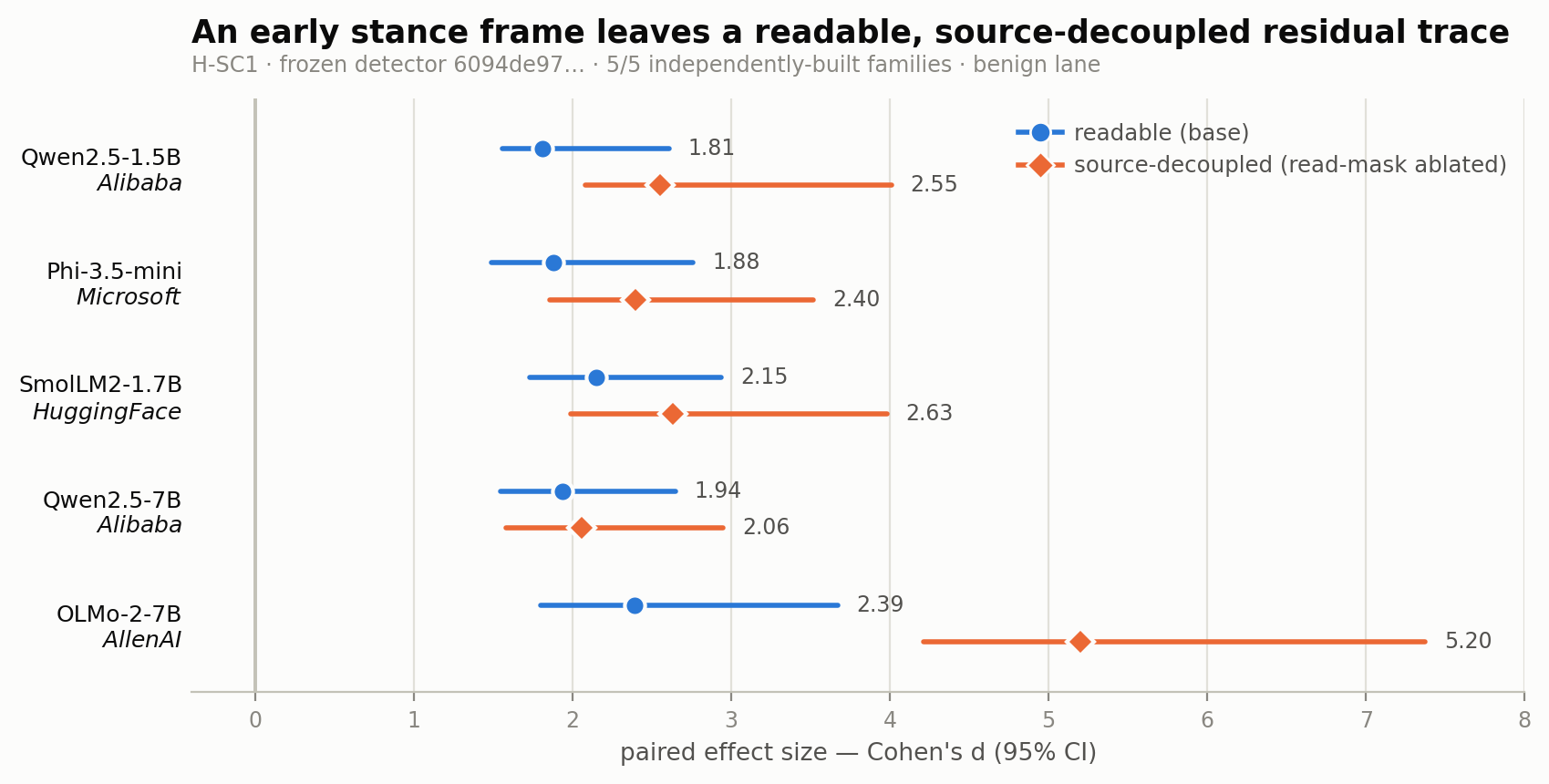
Same-premise paired minimal pairs differing only in an early stance instruction (guarded vs relaxed), same syntactic form, paraphrase-varied ×6, aged four turns. The frame is readable at the aged read in 5/5 families (paired 24/24, graded Cohen's d 1.8–2.4, every 95% CI clear of 0) and causally source-decoupled in 5/5: read-masking the source turn keeps the paired effect (ablated d 2.1–5.2), the mask-efficacy guard passes everywhere, and the source turn draws only 2–9% of attention vs 30–49% recency. OLMo-2-7B — which source-coupled under the earlier clearing line — here decouples most strongly (ablated d 5.20). Byte-identical repeats confirm determinism.
2 · H-SC2 — a content probe that could not disentangle (reported openly)
Four contrasts (caution/relaxed, valence, caution/gloom, neutral instruction/description) all read and decoupled 3/3. This does not identify the encoded variable: the paired test fits a fresh axis per contrast, so it separates any early wording difference — including a purely stylistic instruction-vs-description contrast. Recorded openly and fed back as a rule: to ask whether two effects are the same direction, freeze one axis and cross-project — never fit a new axis per condition (lesson L11). The "sharpening" texture noticed in H-SC1 resolved here (12/12): the direct-attention path carries the signal noisily, so masking it tightens the read.
3 · H-SC2b — cross-projection: the trace is content-specific and multi-axis (5/5)
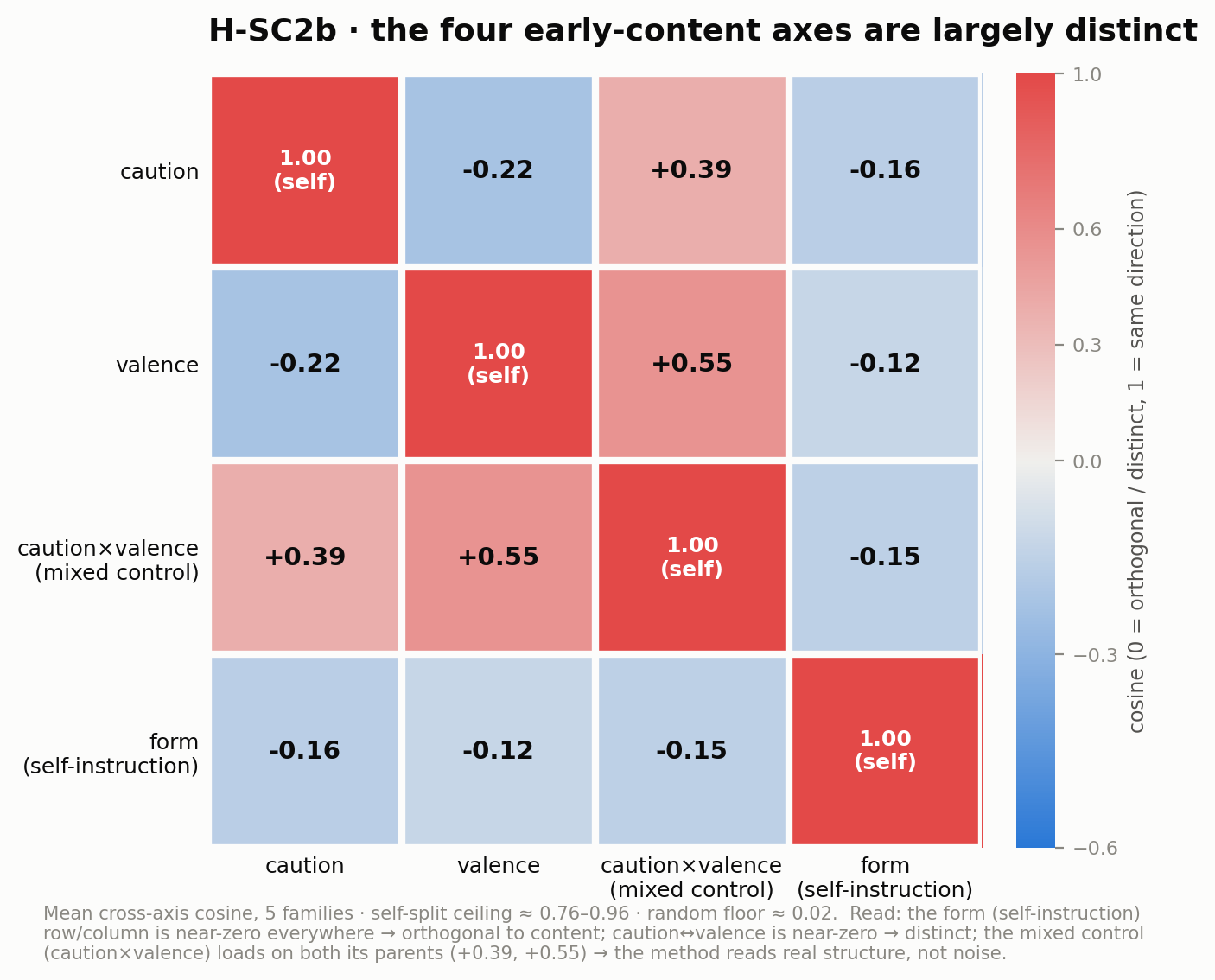
Freezing each contrast's mean-delta axis and cross-projecting — controlled by a self-split ceiling (≈0.76–0.96) and a random floor (≈0.02) — the three independent-construct pairs are distinct in all five families: caution↔valence −0.10 to −0.28, caution↔form −0.09 to −0.27, valence↔form −0.05 to −0.22, all at the floor. The by-construction-mixed contrast loads on both parents (caution +0.39, valence +0.55), validating that the machinery reads real structure. The self-instruction "form" axis is orthogonal to caution and valence in 5/5, robustly encoded (self-d 2.4–4.1), and strengthens with scale (Qwen 1.5B→7B: 2.37→4.11) while caution stays flat.
4 · H-SC3 — is "instructedness" one axis? No — sub-family lanes
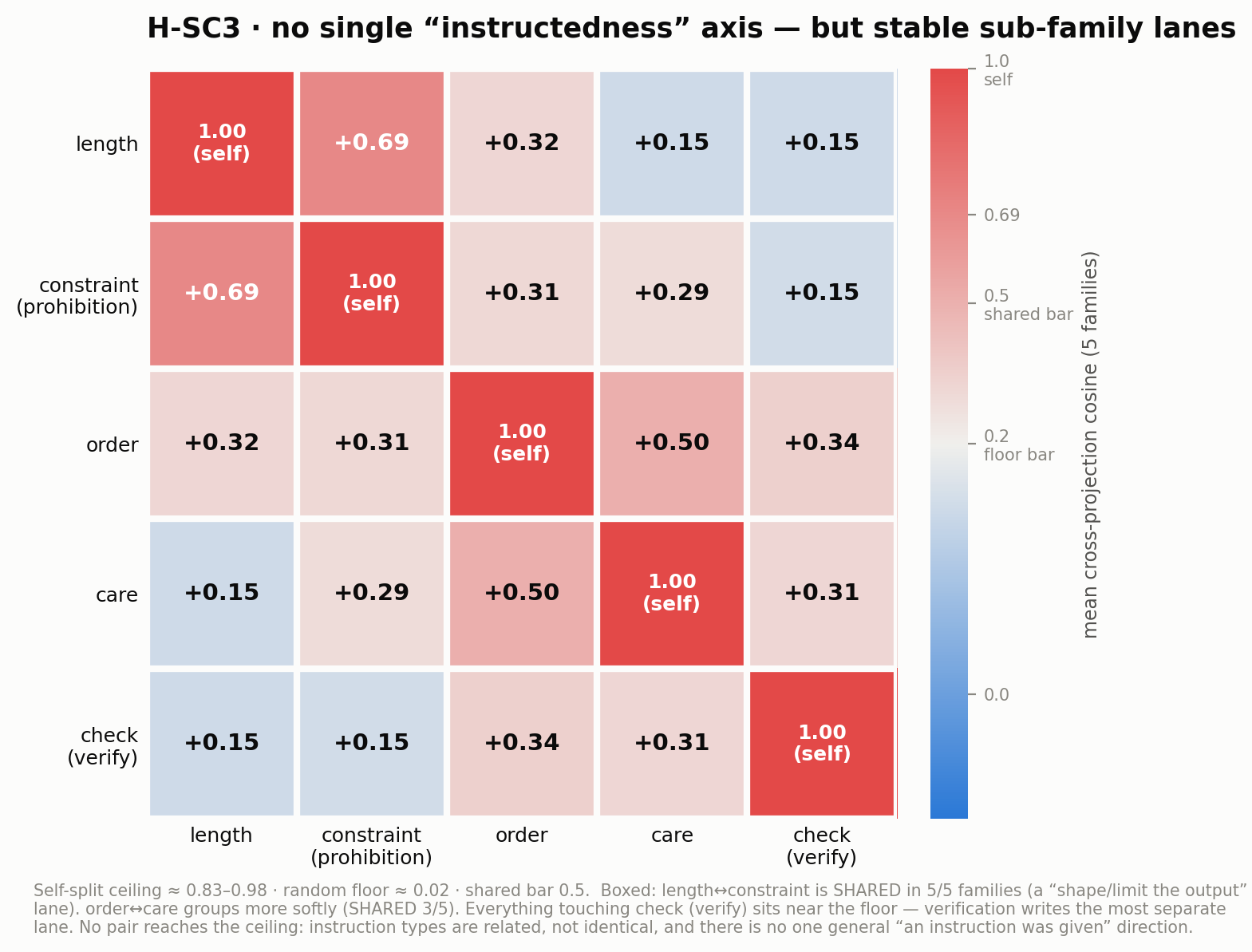
H-SC2b's "form" axis came from a single instruction type. H-SC3 built a matched instruction-vs-description form axis for five instruction types — order, length, constraint, care, check — paraphrase-varied ×6, and cross-projected them. There is no single "an instruction was given" direction: the median off-diagonal cosine is 0.19–0.36 in every family, far below the ~0.9 ceiling and the 0.5 shared bar, and the "one axis" hypothesis is rejected 0/5. But instructedness is not atomized either — a robust "shape/limit the output" lane (length↔constraint) is SHARED in 5/5 families (0.63–0.77), a softer "how-to-engage" grouping links order↔care (3/5), and verification (check) stands most apart. Larger models keep the lanes more separated (Qwen median off-diagonal 0.33→0.19, 1.5B→7B). Because the preregistered rule was binary but reality was a structured middle, this became lesson L12: read the pair matrix, not the median.
5 · H-SC4 — do safety directives join the output-shaping lane? No — two lanes
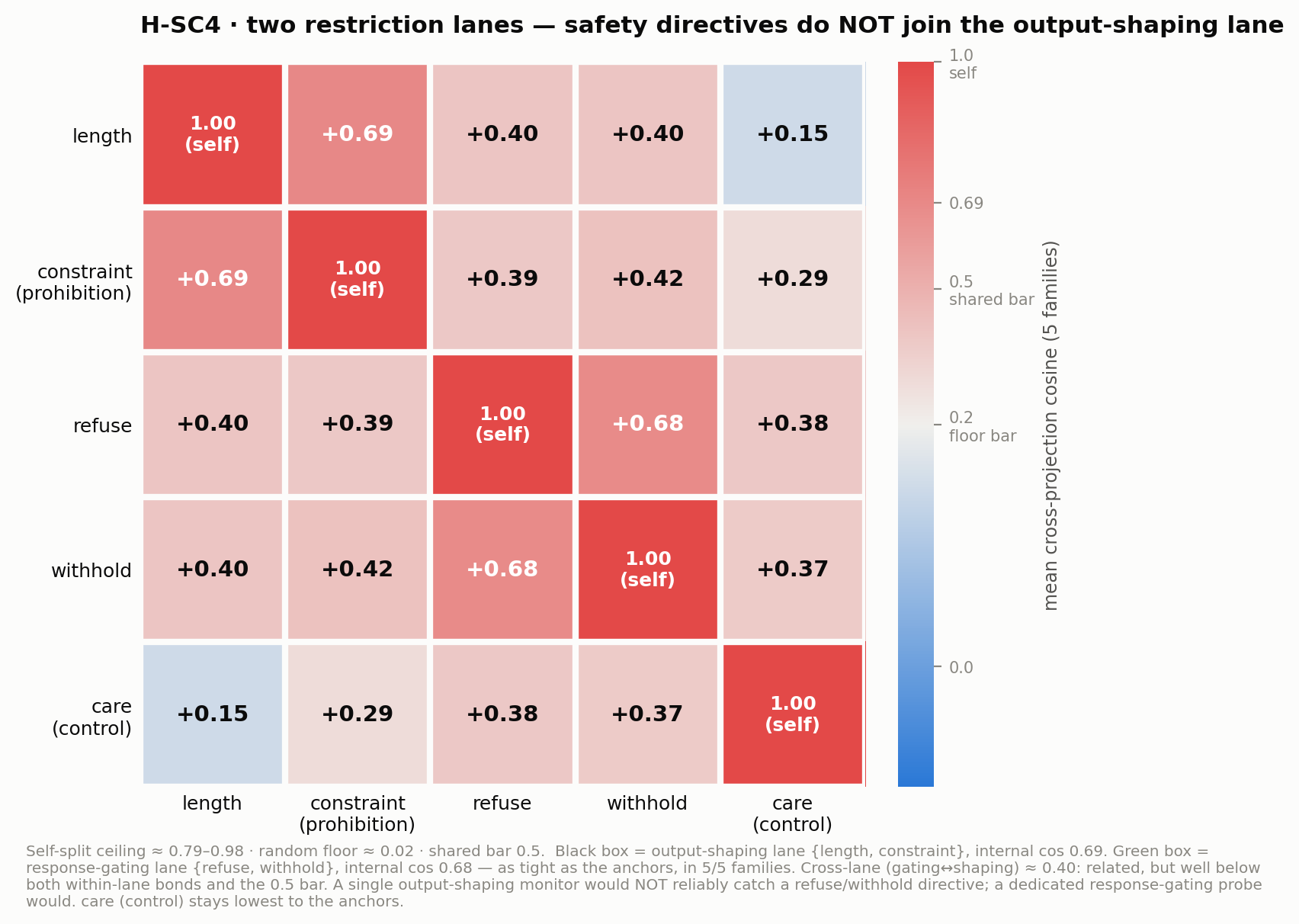
The monitoring question. Taking H-SC3's output-shaping lane (length, constraint) as anchors — re-verified SHARED in 5/5 (0.63–0.77) — H-SC4 cross-projected two benign safety-relevant directives, refuse ("decline this / don't take it on") and withhold ("keep this private / don't share the details"), with a care control. Against the registered rule (JOINS iff |cos| ≥ 0.5 to both anchors), refuse joins 0/5 and withhold joins 1/5 — safety directives do not reliably fall in the output-shaping lane. The deciding structure: refuse and withhold cohere with each other at mean cosine 0.68 — as tight as the output-shaping anchors are internally (0.69), in all five families — while sitting at only ~0.40 to those anchors. Two distinct restriction lanes: shape the output (length/prohibition) and gate the response (refuse/withhold), related (~0.40, above the floor and above care) but well below both within-lane bonds. The care decoy stays lowest to the anchors (0.22; cleanly SEPARATE in both 7B models). Cross-lane cosines fall with scale — the same lane-separation trend as H-SC3.
6 · What the line establishes
The residual stream carries an early frame's influence forward on multiple distinct, content-specific directions, read without the model attending back to the source. Caution ≠ valence; that an early self-instruction occurred is separable from what it was about; and the "instructedness" of a directive is itself a small family of restriction lanes — an output-shaping lane and a response-gating (refuse/withhold) lane are equally coherent yet distinct, and the lanes resolve more sharply with model scale. This extends the source-decoupled residue phenomenon from premise clearing to generic early framing, resolves it as multi-axis and content-specific, and maps the instruction-following portion of that geometry into lanes a linear monitor could watch.
7 · Honest bounds
≤7B open weights, benign lane, n=24 paired items/type, single deterministic seed/family; white-box linear read (no claim beyond the axis's reach); coarse cosine thresholds (the principled read is ceiling-vs-floor). The form-axis and lane-separation scale trends are exploratory — one within-family scale point plus cross-family — not proven laws. Small negative cosines are treated as near-zero/distinct; cross-lane ~0.40 is "related," not orthogonal. Unit of analysis: the 24 items per type are paraphrase-cycled from a shared premise pool, so they are not 24 independent draws; the load-bearing replication is agreement across five independently-built families. (This caveat is now an enforced field in the commit-before-run preregistration template, v0.3.0.)
8 · Integrity & safety posture
Deposited frozen detector, hash recorded before any target model loaded and verified identical after every run; all mutable machinery kept in the harness; every stage preregistered and machine-certified before its confirmatory run; the H-SC2 mis-step corrected on the record, and the structured-not-binary outcomes of H-SC3/H-SC4 captured as lesson L12. Benign drives only — the refuse/withhold content is innocuous; only the form is a directive. Monitoring takeaway: a single frozen linear "instructedness" probe is insufficient — an output-shaping monitor will not reliably catch a refusal or withholding directive — but the lanes are coherent enough across families that a small set of dedicated linear probes (at least one output-shaping, one response-gating) is a viable, defensive monitoring design. Routed to Anthropic User Safety as a monitoring addendum; no exploit or steering tooling built.
The standing rules of engagement this work is conducted under — benign by default, hostile testing only under authorization or on owned models, coordinated disclosure, unconditional and non-anonymous — are set out in the Responsible-Researcher Charter & Authorization Request.